All posts by Gary

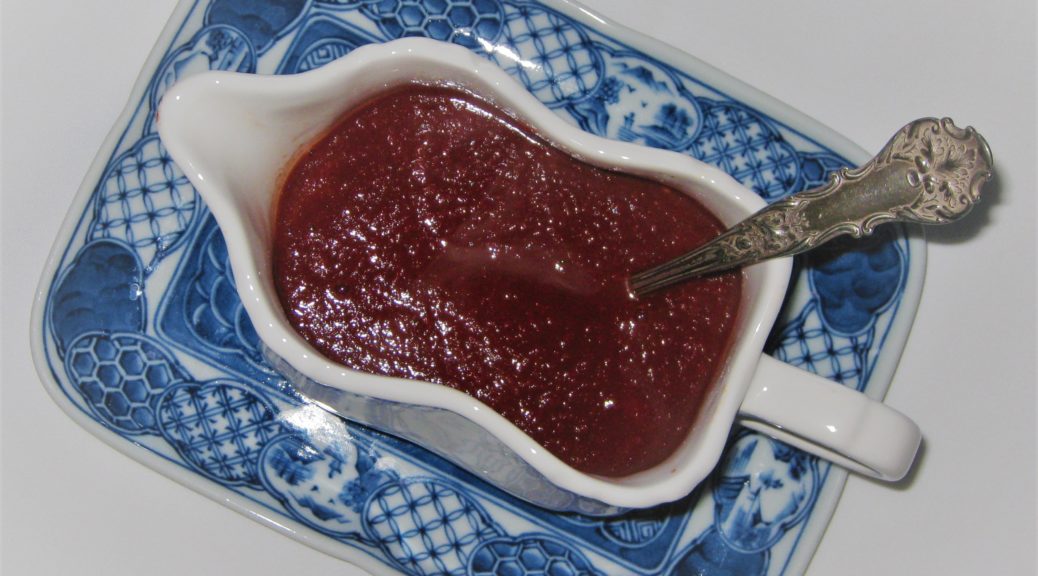
New Mexican Red Chile Sauce

June 21, 2017

I come by a love of spicy food honestly.   I grew up in a family with a strong Southern Italian heritage and a love of spicy foods.  There was usually one, if not two, types of hot salami in the fridge.  My Uncle Joe Medile made the hot Italian sausage that we ate frequently and when my father said it wasn’t spicy enough, as he always did, the next batch was spicier still.  My cousin Angie put up hot peppers (her recipe is coming in the autumn).  Another Uncle ate sandwiches of fried hot peppers from his garden.  I still have hot salami in my fridge, and I make sausage and jarred hot peppers and eat fried pepper sandwiches!

I could go on but you get the picture.

In college, I fell in with a crowd of friends from all around the world, quite a number of whom were into fiery foods; foods so hot that they made anything with a European sensibility (like Italian food) seem like child’s play.

It wasn’t surprising that when I first ate New Mexican food in 1991, I was hooked by Red Chile and Green Chile.

New Mexican chile (and it is spelled chile, with an “e” on the end) at the most basic is a sauce.  Go into any New Mexican restaurant and order a burrito and the wait person, without missing a beat, will say “Red or Green?” unless you are in the know enough to have made your choice of chile part of the order in the first place.  The sauce will be poured over the burrito before serving.  If you are indecisive, you can have “Christmas” which will get you half red chile and half green chile.

New Mexican Chile has nothing in common with chili, whether it’s Tex-Mex, Cincinnati, or any other version.  There is Green Chile Stew which contains pork (usually) and is served in a bowl like, well, a stew.  But you won’t get Green Chile Stew if you ask for Green Chile.  You’ll get a sauce.

I’ve collected lots of Red Chile recipes from friends; eaten Red Chile scores, if not hundreds of times in restaurants; and researched Red Chile in old cookbooks.  I take a very traditional approach to what goes into my Red Chile, and it’s not much.

I think a traditional Red Chile should be made with ingredients that would have been available in the small, isolated farming communities in Northern New Mexico where the dish was perfected.  When I see recipes that purport to taste traditional, if not be traditional, that contain things like raisins, chipotle in adobo, and Asian fish sauce, I sigh.

Mind you, those ingredients, and other equally incongruous ingredients (like frozen orange juice concentrate!), might make a tasty sauce but it would not be New Mexican Red Chile!

Red Chile should taste of chile with other ingredients used in small quantities to complement the chile.   In my case those ingredients are garlic and salt.  Period!

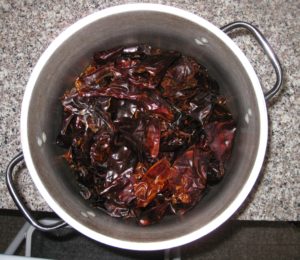
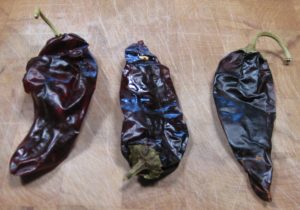
New Mexican Red Chile Pods

Before the advent of refrigeration, Red Chile, which is made from dried fully ripened, i.e. red, chile pods, was eaten most of the year.  Green Chile, made from roasted, freshly harvested green chile pods, was eaten at harvest time.

Next month I’m going to post my favorite New Mexican recipe, Carne Adovada, slow-cooked pork cubes in an abundant amount of red chile sauce.  The Red Chile in this post is an integral part of the process.  If you want to give the Carne Adovada a try you might want to practice making Red Chile.  If you’re at a loss for what to do with it, consider using it as a sauce on steak, chops or scrambled eggs.  Pour it over mashed potatoes.  Make burritos and smother them in red chile.

Before moving to New Mexico full time, we spent almost every holiday in Santa Fe.  We always invited a large crowd of friends over for Thanksgiving dinner.  Since we would leave Santa Fe to return to Chicago on the Saturday or Sunday after Thanksgiving, leftovers became a problem.  We quickly developed the tradition of having all of our Thanksgiving guests back for dinner on Friday which consisted of leftovers.  The only new addition to the meal, though, was red chile which some of us, at least, used in place of gravy!

The uses for red chile are limited only by your imagination.


Click HERE to join our mailing list and you’ll never miss a recipe again!
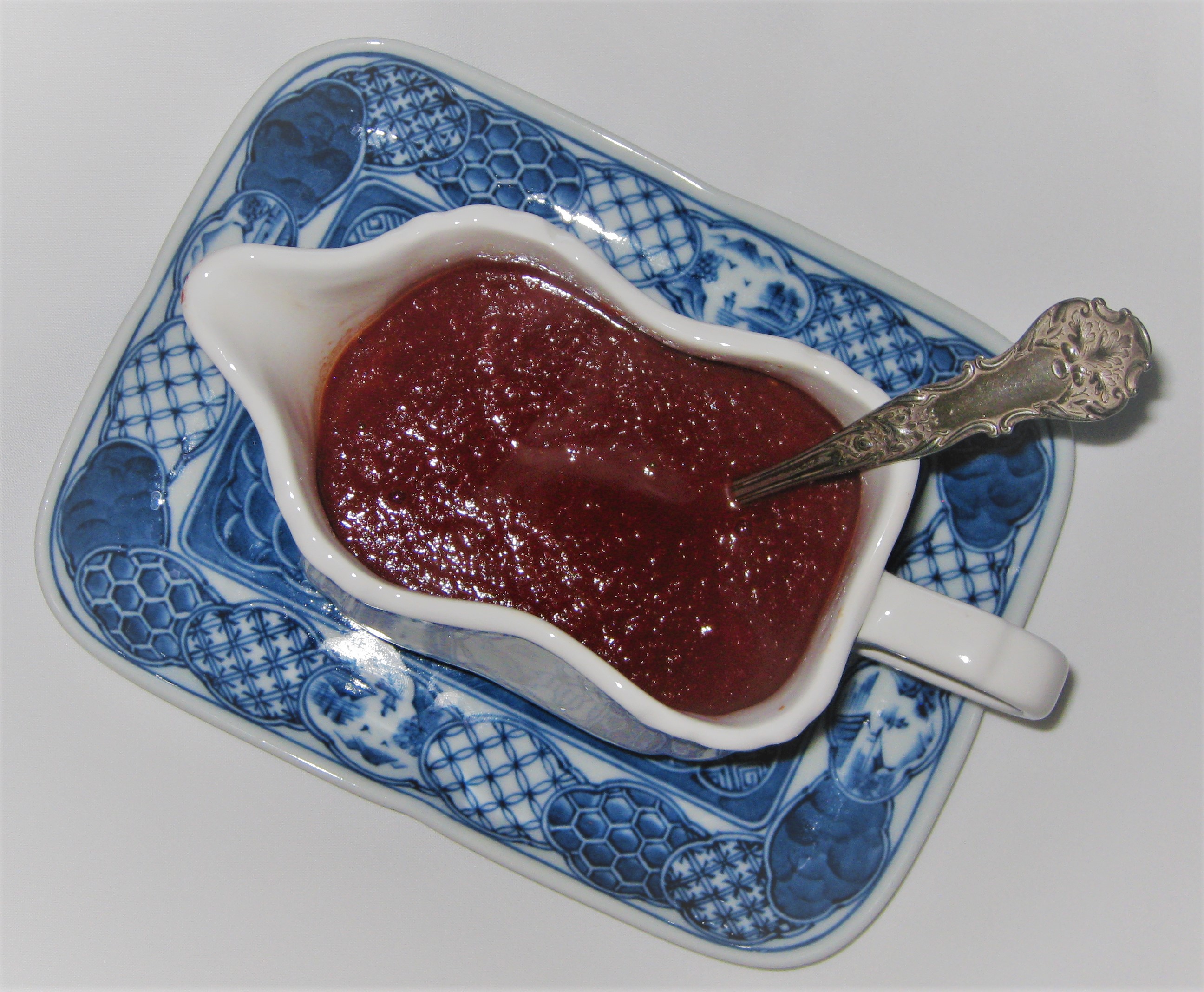
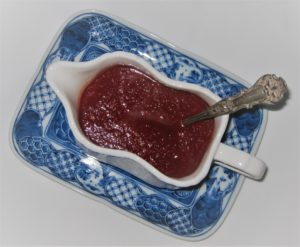
New Mexican Red Chile Sauce

Commercially available red chile pods are categorized by heat level: mild, medium, hot, and extra hot. As with any agricultural product, there is some variability. Look for certified New Mexico grown chile. The town of Hatch in Southern New Mexico is probably the most well know chile-growing region but Chimayo in Northern New Mexico grows some pretty awesome chile, too. If you can’t find New Mexican chile in the markets near you, you can order it on line. I think that using whole pods rather than ground chile (chile molido…NOT to be confused with chili powder!!!) makes for a better texture. See the note at the bottom for a method using ground red chile. Remember, ground New Mexico Red Chile only contains chile pods, nothing else!!! Recipes for Red Chile usually start by specifying a particular number of chile pods. However, many of the pods in any batch of chile are broken. My solution was to weigh the pods, after removing seeds and stems, so that I no longer had to guess about how much broken up chile pod equals one whole pod.
Prep Time 15 minutes
Cook Time 40 minutes
Total Time 1 hour 15 minutes
Servings: 2 cups

Ingredients
  

  • 1 1/2 ounces dried New Mexico red chile pods weighed after stems and seeds are removed
  • 2 cloves largegarlic
  • 1/2 teaspoon salt
  • 1 1/2 cups water

Method
 

  1. The starting point: whole dried chile pods.
  2. Break off the stem of each chile pod and empty out the seeds and pith. You might have to break the pod in one or two places to get out the seeds. Try not to break it into small pieces, however.
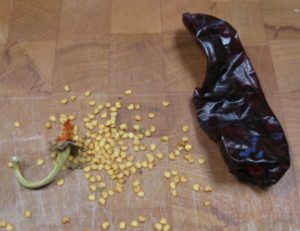
  3. The stems, seeds, and pith ready for the compost heap!
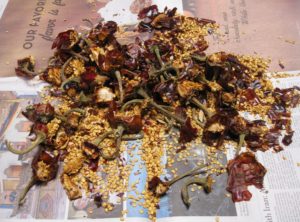
  4. Weigh out 1 ½ ounces of chile pods after stem, seeds, and pith have been removed.
  5. Put the chile in a bowl.
  6. Cover the chiles with very hot tap water.
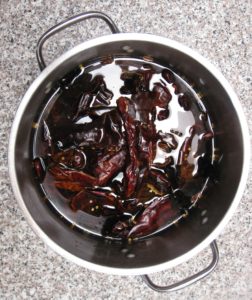
  7. Steep the chiles in the hot water until softened, 15- 20 minutes.
  8. Lift the chiles out of the water and into a colander, attempting to leave as many of the seeds behind as possible. Despite your best efforts, there will still be some!
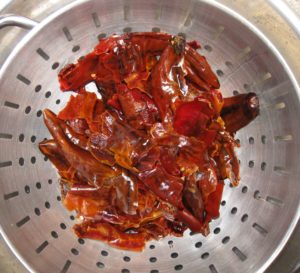
  9. Discard the water used to soften the chiles.
  10. Put the softened chiles, garlic, and 1 ¼ cups of fresh water in a blender.
  11. Puree until smooth, one to two minutes.
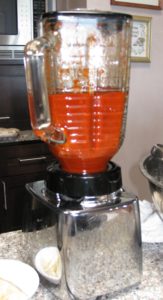
  12. Pour the chile puree into a saucepan.
  13. Use the remaining ¼ cup of water to rinse out the blender jar. Add this to the saucepan.
  14. Add the salt to the chile puree.
  15. Bring to a boil, reduce heat, and simmer uncovered till thickened, about 20-30 minutes.
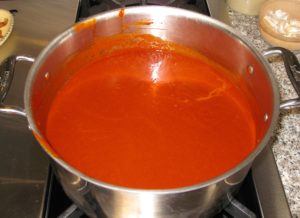
  16. Adjust salt near the end of cooking.

Notes
Some cooks like to toast the chile pods in the oven. I have done this but I don’t believe it adds enough flavor to justify the extra work.
The water used to soak the chile can be bitter so I always discard it and use fresh water for making the sauce. The seeds and pith can also add a bitter note.  You’ll never get rid of all the seeds but eliminate as many as possible.
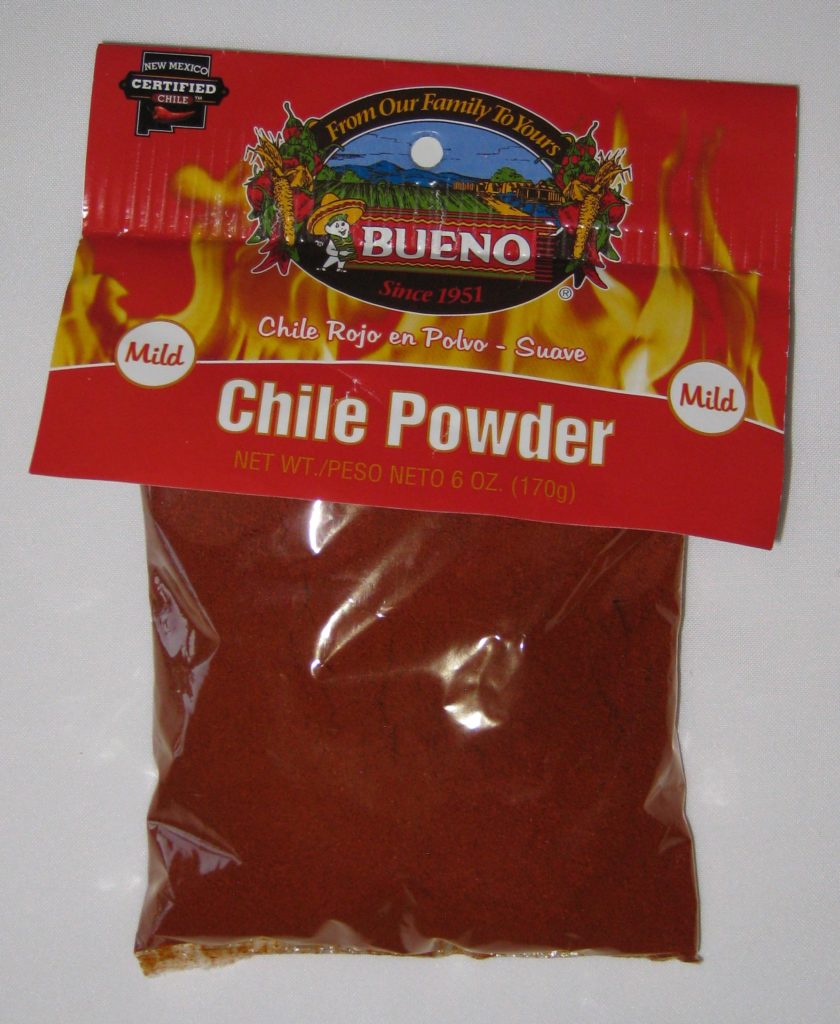
Chile Molido (Ground Chile or Chile Powder, not to be confused with Chili Powder!)
If you want to use ground New Mexico red chile pods (chile molido) rather than whole pods, first puree the garlic with some of the water. Add the garlic puree to the ground chile. Add the remaining water a little at a time, stirring well, to avoid lumps. Add the salt and proceed with simmering as described above.
Copyright © 2017 by VillaSentieri.com. All rights reserved.

Tried this recipe?

Let us know how it was!

Mom’s Slow-Braised Pork Chops

June 16, 2017

Just last week my mother-in-law breaded and quickly pan-fried pork chops for dinner.  They were tender, juicy and truly wonderful.

Now that grilling weather has finally reached Santa Fe, we’ll have pork chops quickly cooked on the grill throughout the summer.  I’ll even grill the occasional pork tenderloin seasoned with olive oil, garlic, lemon juice and rosemary.

I really enjoy juicy, quickly-cooked pork.  However, I also really, really enjoy the style of pork chops that I at while growing up:  thin-cut pork chops cooked slowly in a sauté pan until they are deep brown.

No doubt, this is an entirely different dish from cooking the chops just enough to reach that “magic” temperature of 140°F that the USDA says is “safe.”  It won’t be to everyone’s taste (what is?) but in the interest of presenting an array of very traditional dishes I’m including it.

Just a few nights ago while in Palm Springs, I was served thick-cut braised pork chops cooked by a good friend, John O’Malley, following a recipe from Marcella Hazan.  I use the same recipe from Marcella when I want to cook thick-cut chops for company (ever since John turned me onto it a while back).

Marcella was from Northern Italy, my mother’s family from far Southern Italy, but the two dishes share a style that highlights a common feature of traditional Italian cuisine.  That is, a cut of meat that could be cooked quickly is, instead, cooked slowly coaxing out more flavor and changing the texture in the process.

The realization of the similarity of these two dishes is like the experience I wrote about in April 2017 describing roast chicken I ate in Tuscany that tasted, for all the world, like the falling-apart roast chicken seasoned with garlic and rosemary that my mother made.

Quick cooking is just one style but reading contemporary recipes one would think it’s the only way to cook many cuts of meat.  We all agree that there are cuts that must be cooked long and slow for optimum texture: think Southern Pulled-Pork Barbecue, Hawaiian Roast Pig, Beef Brisket, or Pot Roast, for example.  I challenge you to find a contemporary recipe for roast chicken or sautéed pork chops that doesn’t call for the minimum cooking time and final temperature.  It’s as if we’ve forgotten that these meats can also be cooked low and slow for a qualitatively different dish.

Recording this kind of diversity traditional foodways is one of my main goals for this blog.

As I describe on the About page of this website, I’ve had the very good fortune to cook alongside incredible cooks from many different parts of the world but even that only begins to scratch the surface of traditional foods.  And while I’ve got recipes planned well into next year, I think it’s time to bring in other voices, other stories.

From time to time I am going to feature a blog post, and accompanying recipe, based on interviews with folks who have chosen to share a treasured family recipe and a story to go along with it.  There are several individuals who have volunteered to be in the vanguard of this effort.

If you have a family recipe that you’d like to share, send me an email or add a comment and I’ll follow up.

Click HERE to join our mailing list and you’ll never miss a recipe again!

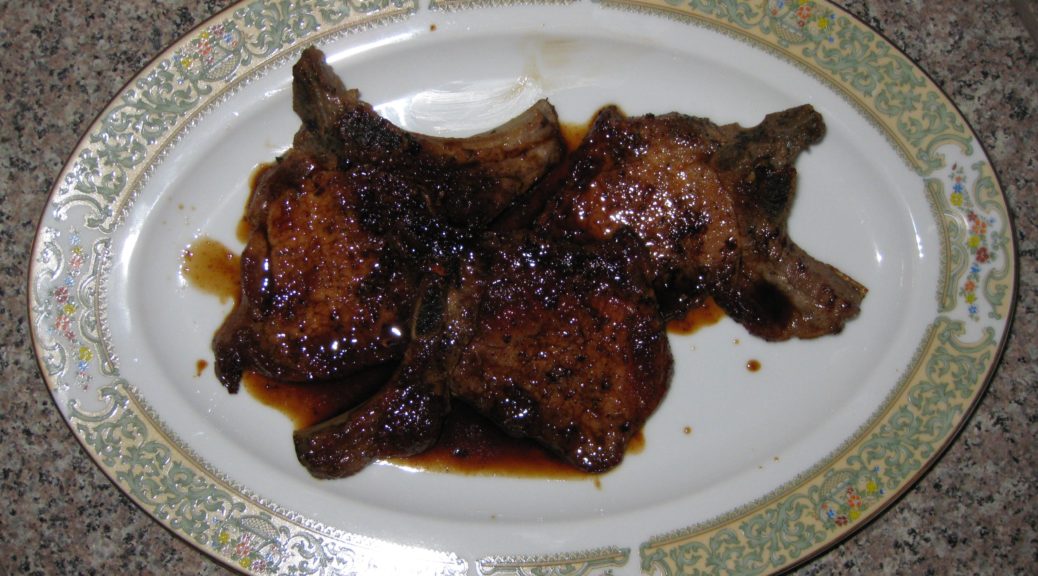
Mom's Slow-Braised Pork Chops

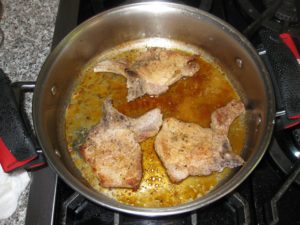
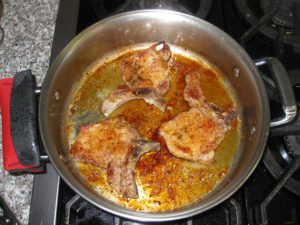
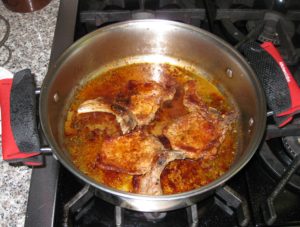
If these chops are being served as part of an Italian-style meal, preceded by pasta, rice or soup, and accompanied by several side dishes, one per person should be enough. Without a pasta course, an average eater could easily consume two of these and someone with a hearty appetite could eat three or four! A sauté pan with a very heavy bottom is needed to avoid hot spots. The chops will be cooked on low heat for most of the time and it is important that the pan conduct the heat well to avoid hot and cool spots for optimum browning. I prefer center-cut pork loin chops, these have a bit of loin and a bit of tenderloin, essentially the same cut as a T-bone steak. Loin chops (without the tenderloin), as shown in the pictures, work well too.
Prep Time 5 minutes
Cook Time 2 hours
Total Time 2 hours 5 minutes
Servings: 2 people

Ingredients
  

  • 4 thin pork chops center cut or loin cut
  • garlic powder
  • salt
  • black pepper freshly ground
  • 1/4 cup oil corn, canola or olive
  • 1/3 cup dry white wine
  • water

Method
 

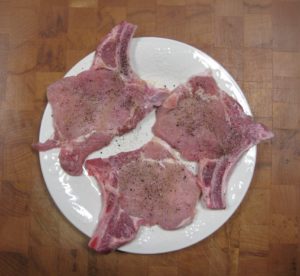
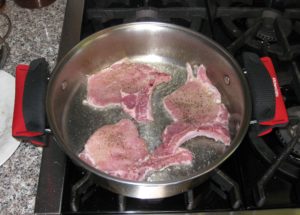
  1. Season the chops generously with salt, pepper and garlic powder.
  2. Using a sauté pan that has a very heavy bottom and that is large enough to hold the chops without crowding, heat the oil until it just begins to smoke over high heat.
  3. Add the chops and reduce heat to medium high.
  4. Cook the chops, undisturbed, until nicely browned, approximately 2 minutes.
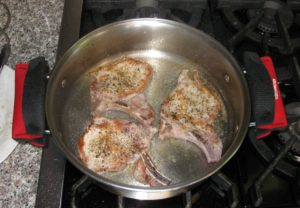
  5. Turn the chops over. If the oil was very hot when the chops were added and if you didn't disturb them while they browned, they should easily release from the pan without sticking.
  6. Brown other side. Approximately 2 minutes.
  7. Turn the chops over. Have the cover ready. Add the wine, immediately cover the pan, and turn the heat to low.
  8. Cook, covered, until the wine evaporates, 15 minutes more or less.
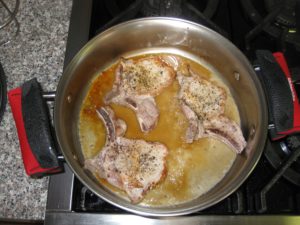
  9. After the wine evaporates the pan juices will start to brown. When they do, add 2-3 tablespoons of water and turn the chops over. Cook, covered, until the water evaporates and pan juices get a little bit darker.
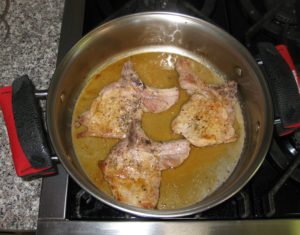
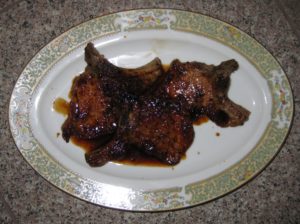
  10. Repeat this process until the chops are falling apart tender and the pan juices are a deep brown. This will take 1 ½ to 2 hours.
  11. At the end there should only be a couple of tablespoons of water plus the oil in the pan. Pour this sauce over the chops when serving. It should have a rich umami porky flavor.

Notes
I rarely use garlic powder. The dishes for which I consistently use garlic powder instead of fresh garlic are Italian slow-roasted poultry, the pork chops featured in this recipe, and steaks. I find that I just can’t get the flavor that I want from fresh garlic in these instances.
Copyright © 2017 by VillaSentieri.com. All rights reserved.

Tried this recipe?

Let us know how it was!

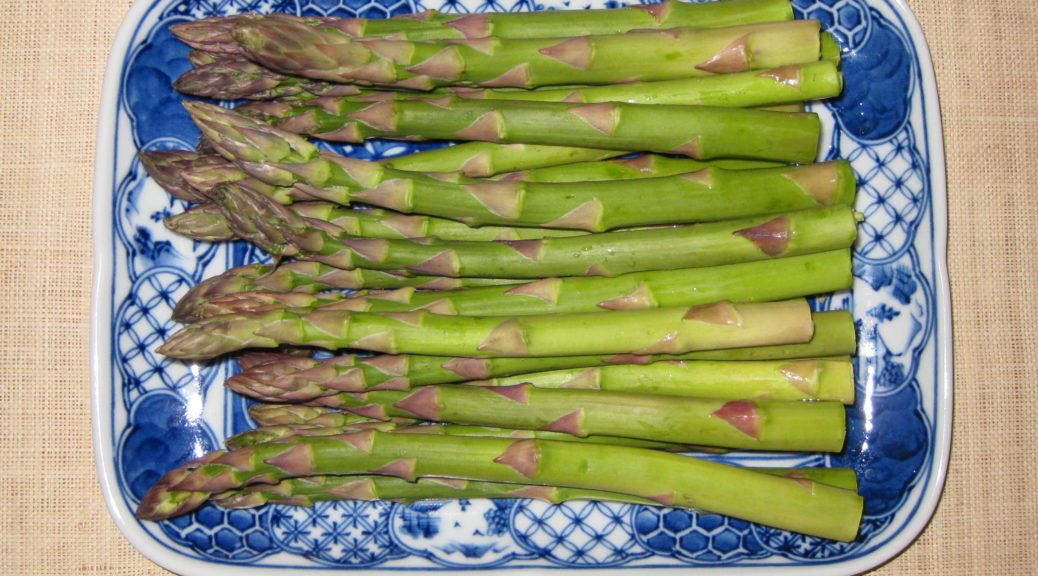
Asparagus with Parmesan Cheese

June 12, 2017

I am writing this sitting on a beach in Akumal, Mexico about an hour south of Cancun by car.

On the beach in Akumal
Iguanas enjoying the beach in Akumal

Just a few days ago, I was at home in Santa Fe where the weather was just beginning to turn spring-like.  The week before that I was in Hawaii.

The view from our lanai in Kauai

By the time you’ll be reading this, I’ll be in Palm Springs, where, even today, the temperature is hitting 100°F!

On the patio in Palm Springs before the heat of the day

Needless to say, my sense of seasonality is out of whack at this point.

No matter the temperature or the weather, asparagus says spring!

Just a few days ago, I was eating grilled asparagus in Santa Fe.  Days before that I made an asparagus frittata, before that I cooked the asparagus that is featured in this post.

Asparagus isn’t something I remember much of before college and usually it was the mushy white stuff out of a can.  White asparagus can certainly be a delicacy but when it comes out of a can that’s an impossibility as far as I’m concerned.

College was a time of incredible culinary growth for me.  Growing up I ate wonderful food as my mother was a great cook.  Mostly, though, it was Italian, Slovak, and the American dishes that every kid in the United States grows up eating.

I didn’t learn to cook until freshman year in college.  I was lucky enough to live in a college house at the University of Pennsylvania that was housed on two floors of an otherwise upper class dormitory made up of apartments with kitchens.  The typical freshman dorms either had no kitchens whatsoever or had the most rudimentary cooking facilities shared by large numbers of students.  Since I had a kitchen, I only took out the minimum required meal contract: 10 meals per week.  Usually this meant I ate lunch and dinner in one of the dining halls Monday through Friday.  On weekends I cooked…and baked!

I called home every Sunday from the day I went away to college.  Occasionally there was a lapse, like the time when I was 31 and hadn’t called home in a couple weeks.  The first words out of my mother’s mouth when she heard me on the other end of the line were, “I was just about to put your picture on a milk carton.”  Point made!  [You may or may not know that “back then” the pictures of missing children were put on milk cartons in the hope that someone would recognize them and call the authorities.]

Besides just catching up on our lives, I got advice.  My father gave me advice on how to handle alcohol, what to do if I had too much (don’t lie down and don’t close your eyes, for example), sex, and other topics.

My mother walked me through the steps of how to cook whatever it was I planned on making for dinner that evening.  By the end of freshman year, I was a credible cook.

My gastronomic circle was not very big, however.  Early my freshman year the resident advisors, Dennis and Martha Law from Hong Kong, took a group of us to dinner in Chinatown.  It was exciting, having grown up in a town without a Chinese restaurant.  The tastes, however, were so…well…foreign that I didn’t like much of what was served.  I tasted everything but rarely had more than one bite till something landed on my plate that struck me the right way.  The serving platter made it down the table past two or three other people till Dennis saw me eating.  He commandeered the plate and put it in front of me to be sure I had enough to eat.

By the end of the year I was not only eating, and loving, Chinese food, I had developed a rudimentary understanding of the regional differences and learned the basics of Chinese cooking from Martha.

After my taste buds got over the shock of Chinese food, I started exploring other cuisines.  A favorite became Indian food at Maharaja just a few blocks from my dorm.  It turns out the restaurant was owned by the aunt of someone I now work with!  I believe it was the first Indian restaurant in Philadelphia.

Sophomore year I was not in the college house but had one roommate in a similar upper class dorm with a kitchen.  Meal contracts were only required of freshmen and I saw no point in eating in the dining hall.  The arrangement I struck with my roommate was that I would cook and he would clean up.  It turns out he would eat, and like, most anything so I was free to explore and experiment.

That set the stage for my junior year when I was admitted to another college house, the International Residence Project.  Half of the students were from the USA and half from anywhere else in the world.

My roommate, and best friend for many years, Ray Hugh, hailed from Guyana.  Valrie Tracey from Jamaica became the third member of a triumvirate that was pretty much inseparable for the rest of college.

Two married couples were our resident advisors, Ambrose and Najma Davis, and Reginald and Nanacy Rajapakese.  Ambrose was from Jamaica, Najma from Bangladesh, and Reggie and Nanacy from Sri Lanka.

Nanacy taught me how to make Sri Lankan food and I’m almost as comfortable making that as I am Italian.  I remained close friends with Nanacy and Reggie, even making several trips to Sri Lanka with Nanacy in the last few years, after Reggie’s death.

Ray and I have reconnected on Facebook which is rekindling many memories of the trips I made to Guyana and my experiences in learning to make Guyanese and Chinese food from Ray and his mother.  Ray’s grandparents on both sides emigrated from China to Guyana in the 1800’s.

Ray and I packed an incredible amount of cooking power into a tiny dormitory kitchen.  Without enough cabinet space to store ingredients, we had stacks and stacks of plastic milk delivery crates packed with an unimaginable assortment of ingredients from international food markets.

Our apartment became known as the place for midnight snacks and folks always came knocking on the door around then to see what we’d whipped up to nibble on.

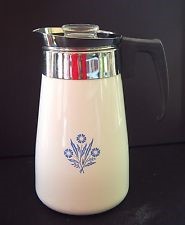
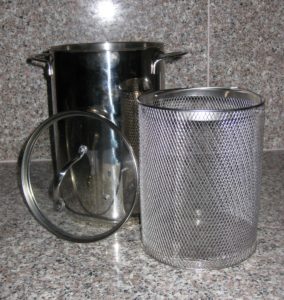
That was the year I discovered that my stovetop Corning percolator made a serviceable stand-in for an asparagus steamer.


Asparagus steamer in a pinch!

Click HERE to join our mailing list and you’ll never miss a recipe again!

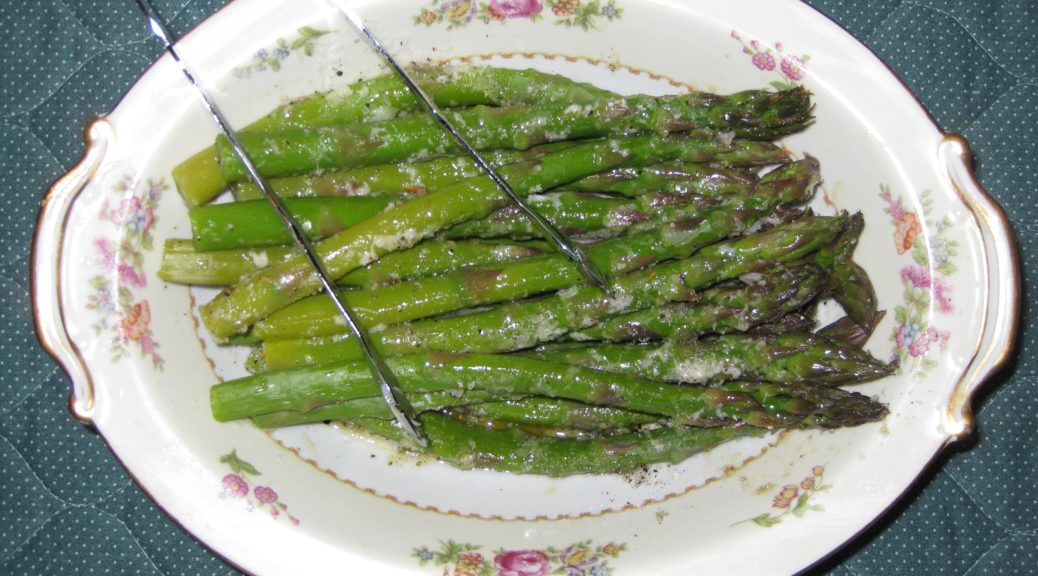
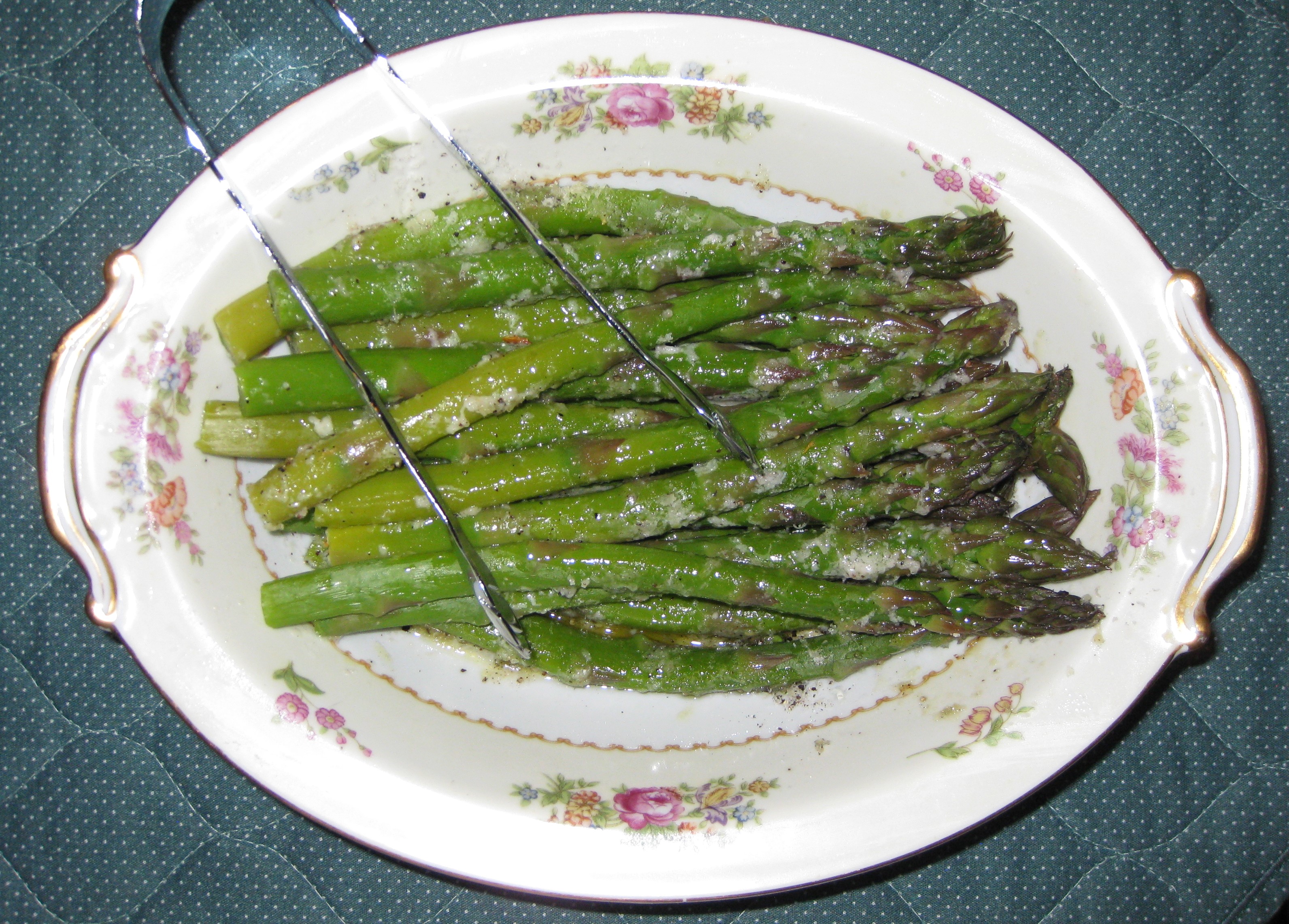
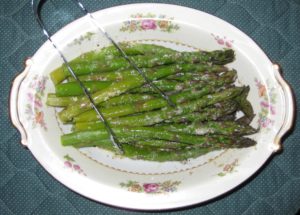
Asparagus with Parmesan Cheese

Asparagus is best cooked in an asparagus steamer. This small-diameter, tall pot allows the bottom of the asparagus spears to boil in the water while the tender tips cook by steaming. When I was a college student and didn’t have an asparagus steamer I used my stovetop Corning Ware percolator. If you don’t have a steamer, or a reasonable substitute, I find it preferable to cook the asparagus in a microwave oven rather than to boil them. After rinsing off the asparagus, put the spears and whatever water clings to them in a microwave-safe dish with a cover. Cook in 1-2 minute increments, moving the spears around after each bout of zapping, until cooked but still a little “toothy” (and certainly not mushy).
Prep Time 10 minutes
Cook Time 15 minutes
Total Time 25 minutes
Servings: 4 people

Ingredients
  

  • 1 pound asparagus
  • 2 cloves garlic
  • 3 tablespoons extra virgin olive oil
  • 1/4 cup Parmigiano Reggiano cheese freshly grated
  • 1 1/2 tablespoons lemon juice freshly squeezed
  • salt to taste
  • black pepper freshly ground, to taste

Method
 

  1. Trim the tough ends off the asparagus. The “Notes” section below contains a link to a blog post describing how to do this.
  2. Crush the garlic with the side of a chef’s knife.
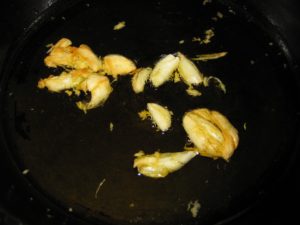
  3. Heat the olive oil in a small sauté pan over low heat. Add the garlic and sauté slowly until brown, pressing down on the garlic occasionally.
  4. Discard the garlic. Reserve the oil.
  5. Cook the asparagus until toothy, neither crunchy nor mushy. If you do this in an asparagus steamer, put about two inches of water in the bottom and bring to a boil. Lower in the basket with the asparagus. It will take 5-10 minutes, depending on the asparagus and your elevation, to cook the asparagus properly.
  6. Put the cooked asparagus in a warmed serving bowl.
  7. Add the garlic-infused olive oil and mix.
  8. Add the Parmigiano Reggiano cheese and the salt and freshly ground black pepper to taste. Mix well.
  9. Drizzle with lemon juice and serve.

Notes
You can find videos of prepping asparagus here.
Copyright © 2017 by VillaSentieri.com. All rights reserved.

Tried this recipe?

Let us know how it was!

Slovak Potato Cake (Baba or Bubba)

June 7, 2017

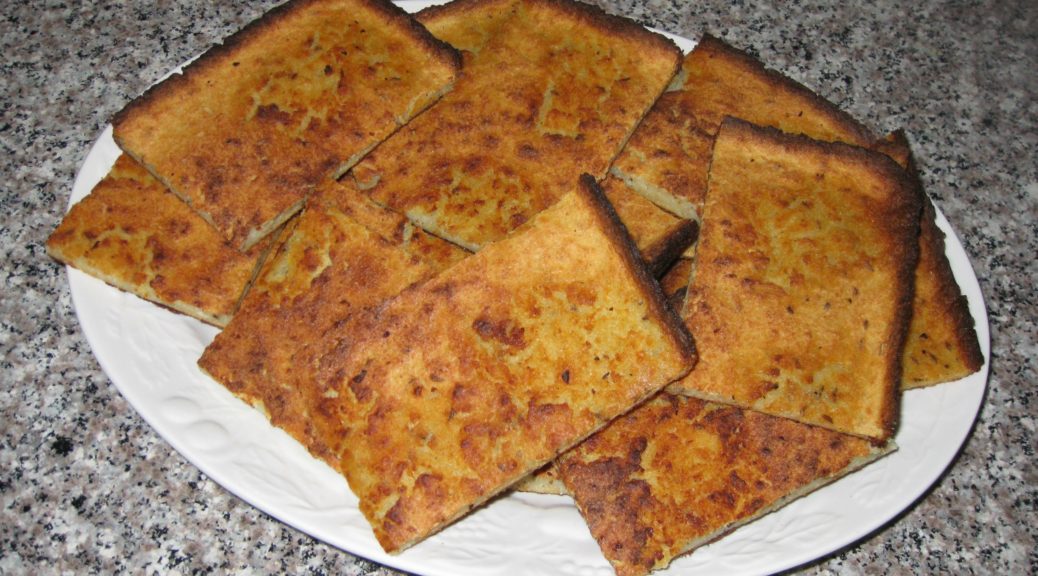
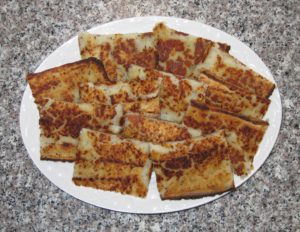
Baba was a favorite food in our house.  We often joked that my mother should open a shop selling pizza and baba.  We were convinced it would be a success, as were a number of family friends.

Although Johnstown, Pennsylvania, where I grew up, was originally founded by Germans (everyone, regardless of ethnic background, had sauerkraut, sausages, and pork on New Year’s Day), Italians and Eastern Europeans were among the largest ethnic groups when I lived there.  So, a “fusion” shop selling pizza and baba wasn’t so far-fetched!

Baba means old woman in Slovak.  I can’t tell you how it came to be applied to this very specific type of potato cake and whether it was just in our family or more widespread, though I suspect the latter.

Other than the crispy skin of our Thanksgiving turkey, this is the only food my sister and I fought over.  This, however, was three-way guerilla warfare also involving my father.  Crispy turkey skin has an immediacy about it.  It needs to be eaten right away, hot and crispy, or it loses its appeal.  The fight is right out there in the open, a virtual “land grab.”

Baba is different.  As good as it is freshly made, we all preferred it after a day or two.  Any leftover baba would be wrapped in aluminum foil and put in the oven, which had a pilot light way back then.  That kept it ever so slightly warmer than room temperature.  The baba would become chewy.

The natural tension that developed was between letting the baba mature till it had the optimum chewiness versus losing out entirely if someone else ate it first.

We all kept our eyes on the oven which was conveniently located at eye-level.  If it looked like the package had been disturbed, we could swing into action, grabbing what was left and eating it even if it didn’t have the optimum chew.  “Any baba is better than no baba” was definitely the operative mentality.

There was always the chance, however, that the first person to go for the baba would eat all of it, especially if there were only a few pieces left.

There was also the chance (sometimes turned into reality) that someone could deftly open the package, remove a piece of baba, close the package, and put it back in the oven it in a way that made it look undisturbed.  Well implemented, this was a strategy for getting more baba since others could be lulled into complacency thinking the cache of baba was still available to them for the taking.

The ingredients of baba are pretty standard potato cake fare, potatoes, onions, salt, pepper, flour and, depending on the cook, egg.  Two things make it unusual in my experience: caraway seed and the cooking method.  To be sure, Slovaks put caraway seed in lots of foods but I have yet to find a recipe for Slovak potato cakes that contains caraway seed.

As for cooking method, baba is cooked in the oven in a rimmed baking sheet.  Remembering that my grandparents raised seven sons, who in later years were augmented by daughters-in-law and grandchildren, baba was made in large quantities.  When there wasn’t enough batter to fill another baking sheet “to the thickness of your finger,” as my Aunt Mary would say, the remaining batter would be turned into individual potato “pancakes” in a frying pan in shallow oil.

The proportions given here will nicely fill an 11” by 17” baking sheet.  If you prefer to fry the potato cakes rather than bake them, by all means do!

Slovak Potato Cake (Baba)

I remember watching my mother make this, and learning from her. Though it always tasted the same in the end, it seemed like the lack of precise measurements was an issue. My mother had no difficulty cooking her regular canon of Italian food without measurements. My suspicion is that the issue with Baba is that she didn’t make it all that often. I make it even less often (though I think that’s changing) which prompted me to carefully measure ingredients until I got a perfect batch and then stick with those measurements going forward. My mother put an egg in her Baba. My Aunt Mary did not. Aunt Mary, who lived next door to my Slovak grandparents for years, insists that Grandma never used egg. I have not tried it without the egg, being happy to stick with a recipe that works. Before food processors, the potatoes and onion were grated on the fine side of a box grater. The food processor eliminates the most tedious part of making Baba.
Prep Time 30 minutes
Cook Time 1 hour
Total Time 1 hour 30 minutes
Servings: 6 people

Ingredients
  

  • 1600 grams potato cubes from approximately 6-7 large russet potatoes (3 ½ pounds)
  • 1 1/2 medium onions
  • 1 egg lightly beaten
  • 3 1/4 teaspoons salt
  • 1 1/2 teaspoons black pepper freshly ground
  • 4 teaspoons caraway seed
  • 165 grams flour (1 1/3 cups)
  • lard to grease the pan and dot the Baba

Method
 

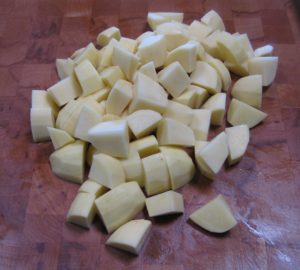
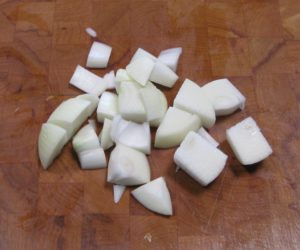
  1. Peel the potatoes. Rinse and dry them and cut into 1 inch cubes.
  2. Weigh out 1600 grams (3 ½ pounds) of potato cubes.
  3. Cut onion into 1 inch chunks.
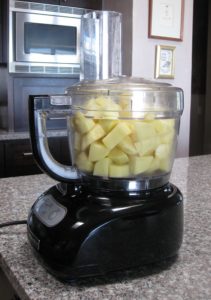
  4. In two or three batches, depending on the size of your food processor, thoroughly grind the potato and onion, putting some potato and some onion in each batch.
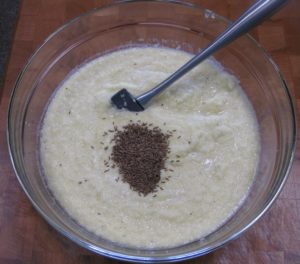
  5. Put the ground potatoes and onions into a large mixing bowl. Add the lightly beaten egg, salt, black pepper, and caraway seed.
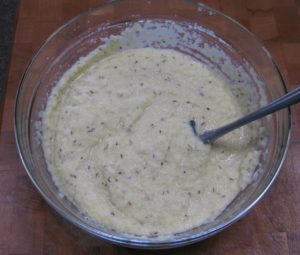
  6. Mix well.
  7. Stir in about ¾ of the flour. Add enough of the remaining flour to thickly coat a spoon. Chances are you will need all the flour. If in doubt, just add it.
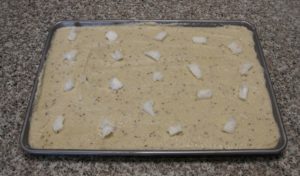
  8. Very, very generously grease an 11” x 17” x 1” baking sheet with lard. After you think you’ve used enough, add more! Remember, most potato cakes are fried. These are baked. They definitely need some fat for texture.
  9. Pour the batter into the prepared pan. Dot very generously with lard.
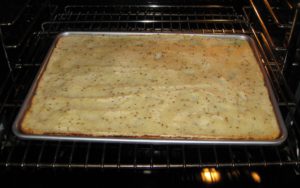
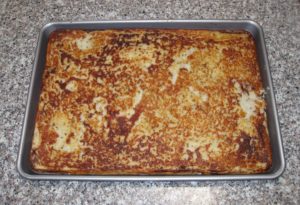
  10. Bake 425°F until browned on the bottom, about 30-40 minutes, turning the pan front to back after 20 minutes.
  11. When the bottom is brown, you’ll need to flip the Baba upside down. To do this, set another baking sheet of the same size on top of the Baba. The bottom of the baking sheet should be sitting on top of the Bubba.
  12. Flip the pans over. If you had enough lard in the pan, the Baba should release from the pan and be sitting, upside down, on the bottom of the other baking pan.
  13. Slide the Baba back into the original baking pan with the browned bottom now facing up.
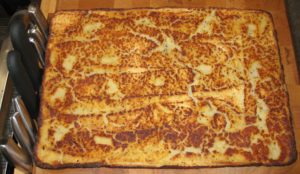
  14. Bake another 20 minutes or so until browned on the bottom and thoroughly cooked.
  15. Turn out of the pan onto a large cutting board.
  16. Cut into 16 pieces. Serve warm or at room temperature.

Notes
Although you can use solid vegetable shortening in this recipe, I suggest you use lard for better taste and better health. You can find information about lard vs. vegetable shortening in this post.
Copyright © 2017 by VillaSentieri.com. All rights reserved.

Tried this recipe?

Let us know how it was!

White Bean Soup

June 2, 2017

The weather is turning warmer in fits and spurts here in Santa Fe as I write this in early-May.  I’m writing these posts a few weeks in advance due to upcoming travel.  Warm days and cold nights, alternating with cold days and colder nights make me think of soup.  Filling, warm, humble soup.

There are few soups that I like better than bean or lentil.

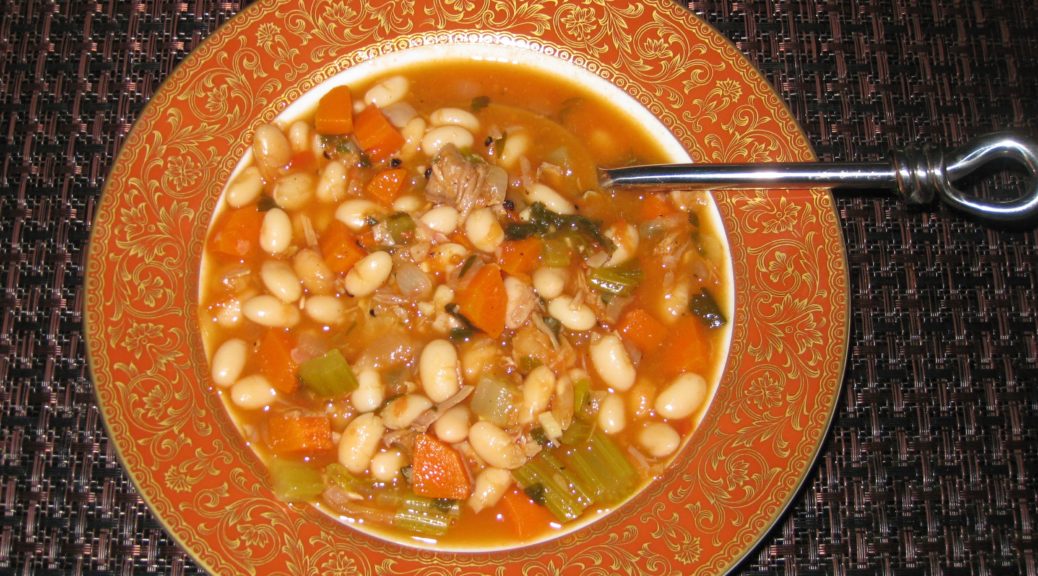
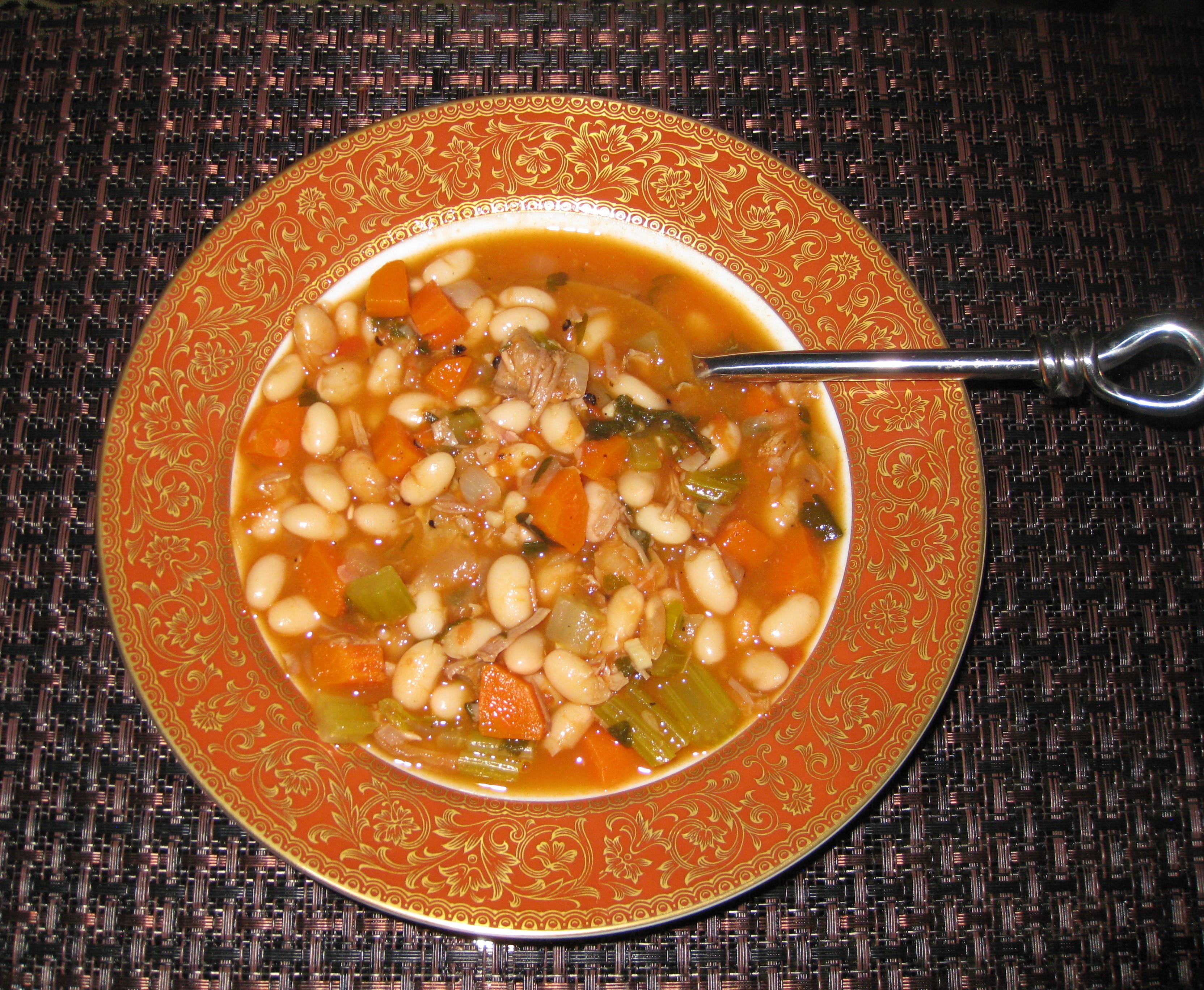
Although a ham bone is a classic way to start a bean soup, smoked turkey works well too.  I had a smoked turkey carcass in the freezer from a bird that I smoked a few months ago.  That and the combination of the cold weather made me think of making this classic American bean soup.  It made a really great dinner along with a platter of my grandmother’s potato cakes, the recipe for which will be appearing here in a few days.

This soup is assembled from very basic ingredients, many of which are almost always on hand.

With warm weather approaching, however, this will probably be the last time I serve such a hearty soup until autumn.

Which brings up an interesting topic: the effect weather has on our cooking and eating habits.  We tend to gravitate toward heartier, richer foods in the winter and lighter foods in warm weather.  Our caloric needs don’t really change appreciably from winter to summer so if we’re not gaining or losing weight, we’re probably eating about the same number of calories.  But it often doesn’t feel that way.

Eating seasonally is a good strategy for a number of reasons.  Locally grown, in-season, produce tastes better than produce shipped from far away.  Many fruits and vegetables start losing nutrients as soon as they are picked.  The shorter the time from farm field to table the more nutritious they are.

Did you ever think about what it takes to have “not from concentrate” orange juice available all year given that oranges are a seasonal crop?  Take a look here and here.  It will give you a sense of what is done to our industrialized food supply.  To be sure, we have ready access to more and cheaper food than has probably ever been the case in human history.  I’m not suggesting we abandon that, just that we become better informed consumers and make active choices about what we eat and why.

In addition to tasting better, and being more nutritious, eating seasonally brings back a sense of anticipation and, dare I say, romance, to eating.  Tomatoes are at their best in the summer so we eat lots of tomatoes then, for example.  Often times, lunch on Saturday in late summer will be thick slices of fresh tomato, fresh mozzarella cheese from The Old Windmill Dairy in Estancia, New Mexico, a few torn basil leaves from our garden, a sprinkle of salt and a drizzle of extra virgin olive oil along with some homemade bread to sop up all the juices.  Unless it’s from a can and going into something that’s cooked, you’ll rarely see a tomato in my kitchen the rest of the year.

The same sort of anticipation holds true with many other foods.  Some that come quickly to mind are zucchini blossoms (which I dip in batter and fry) and basil (which I turn into pesto and use to season quick-cooked tomato sauces all summer long but never use at other times of the year).

Seasonal eating isn’t limited to summer, however.  There are traditional winter crops and winter foods.  Cavolo nero, Tuscan kale, tastes better after a frost and is traditionally eaten in the late fall.  My mother-in-law pickles turnips each autumn which we eat in the winter made into a thick soup with cotechino, a Northern Italian sausage.

Traditionally, my mother-in-law’s pickled turnips would be made in the autumn.  That’s not only when the turnips are ready if you eat seasonally but that’s also when grapes are crushed and pressed for wine.  The turnips would be packed into a barrel with the solids left over from the grape pressing and allowed to ferment.  These days she makes a reasonable facsimile by simply pickling turnips in red wine vinegar though I keep hoping to find a winemaker in New Mexico who will sell me some crushed grapes to give the original recipe a try.

Red wine vinegar is always available, and mostly so are turnips.  Why don’t we make this at other times of the year?  Mostly it’s because of the association of pickled turnips (brovada) and cotechino with winter.  We try to maintain the seasonality even when we have the ability to circumvent it.  Doing that means there are always favorite foods to look forward to each season that we haven’t had in almost a year.

If it’s too warm where you live to have a hearty bowl of bean soup, tuck this recipe away for a few months and give it a try in the autumn.

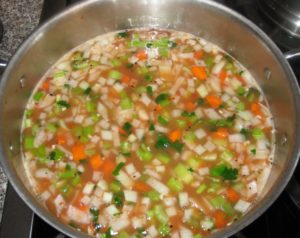
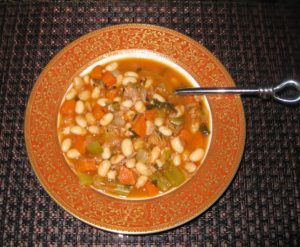
White Bean Soup

This white bean soup is easy to make and very nutritious. If you have the carcass of a smoked turkey or the bone from a baked ham, use my recipe for Roasted Turkey Broth, substituting the smoked turkey or ham bone, to make the broth for this soup. With a turkey carcass you definitely need to make broth otherwise you’d have lots of bones and bits in the final soup. While this isn’t the case with a large ham bone, I still prefer to make broth in advance so that I can skim off the fat. There is a link in the notes that follow this recipe to my recipe for Roasted Turkey Broth. Even if you don’t have a smoked turkey carcass or a ham bone you can make this soup. My supermarket sells various smoked turkey and pig parts. Just use them to make the broth. Be careful, though, as these products can be much smokier than a turkey or ham that was smoked to the right degree for eating. Failing all of that, use whatever broth you have on hand (or even water) to begin to cook the beans then add ¼ pound of chopped up bacon with the remaining ingredients.
Prep Time 20 minutes
Cook Time 3 hours
Total Time 3 hours 20 minutes
Servings: 8 people

Ingredients
  

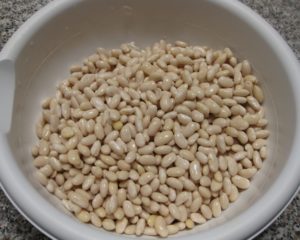
  • 1 pound Navy or Great Northern beans
  • 3 quarts ham or smoked turkey broth
  • 1 fresh bay leaf
  • 2 cups chopped carrots
  • 2 cups chopped celery
  • 1 large onion diced
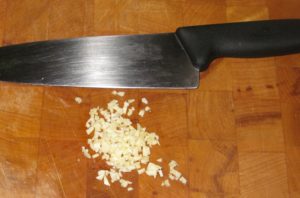
  • 3 cloves garlic minced
  • 1/2 cup minced parsley
  • 1 x 14 oz. can diced tomatoes
  • 1/2 cup white wine
  • 2 teaspoons salt plus more, to taste
  • black pepper freshly ground, to taste
  • 1 piece Parmesan rind if available
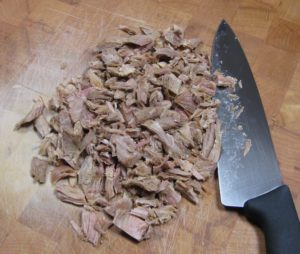
  • 1 1/2 cups chopped ham or smoked turkey.

Method
 

  1. Wash the beans. Cover with several inches of cold water. Refrigerate overnight.
  2. The next day, drain the beans.
  3. Combine the beans, broth, and bay leaf.
  4. Cover and bring to a boil.
  5. Cook, partially covered, at a medium boil for one hour, stirring occasionally.
  6. Meanwhile, prepare the other ingredients.
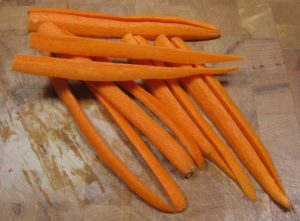
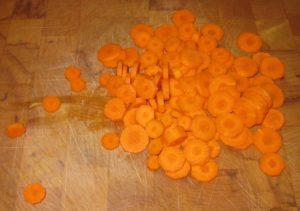
  7. Slice the carrots in quarters lengthwise.
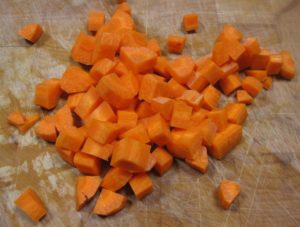
  8. Cut the carrots crosswise into 1/4 inch pieces.
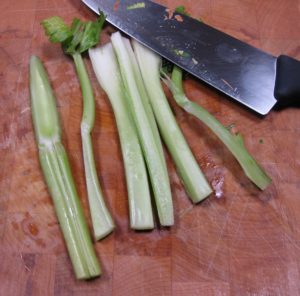
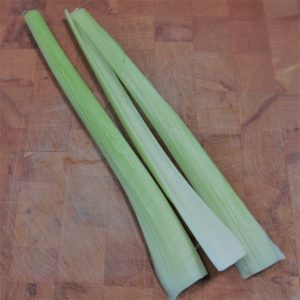
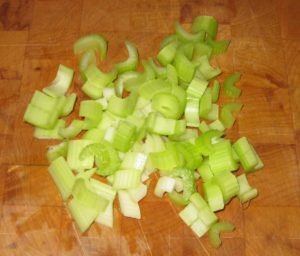
  9. Cut the celery into strips approximately the same size as the carrot strips.
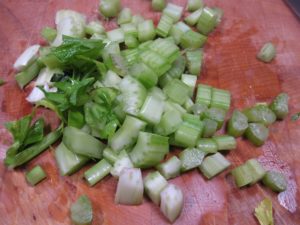
  10. Cut the celery strips crosswise into 1/4 inch pieces.
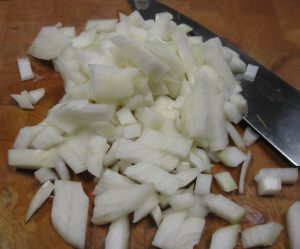
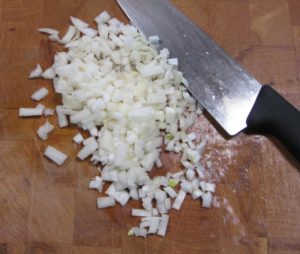
  11. Dice the onion.
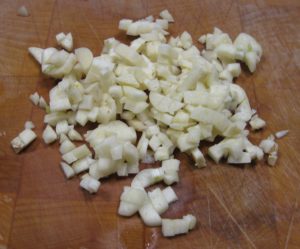
  12. Mince the garlic.
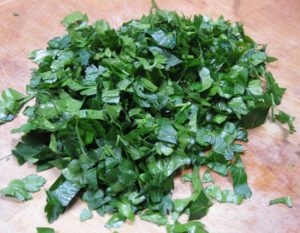
  13. Mince the parsley,
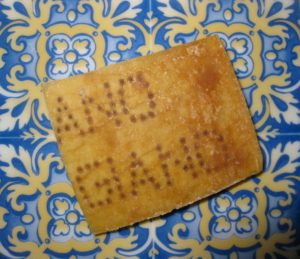
  14. Dig around in your freezer to find a Parmesan cheese rind that you froze with the intent of using in your next pot of soup.
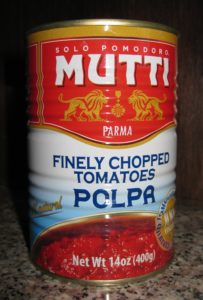
  15. Ready a can of diced tomatoes.
  16. Combine all ingredients except the chopped ham or turkey with the partially cooked beans.
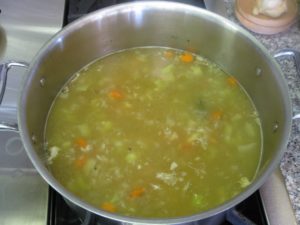
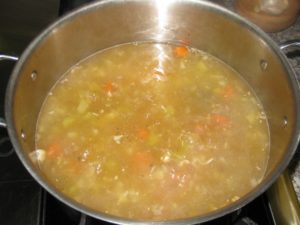
  17. Simmer, partially covered for another hour or two until beans are soft and vegetables are cooked. The cooking time will depend on the type of beans, their freshness, and your elevation.
  18. Adjust seasoning as needed while cooking.
  19. Add the chopped ham or smoked turkey during the last 10 minutes of cooking.
  20. Serve with grated Parmesan cheese, if you wish.

Notes
As good as this soup is when it is made, I prefer to let it cool then refrigerate it for at least a day before rewarming and serving.
To make the broth, substitute a ham bone or smoked turkey carcass (or other smoked meat) for the roasted turkey in my recipe for Roasted Turkey Broth.
Copyright © 2017 by VillaSentieri.com. All rights reserved.

Tried this recipe?

Let us know how it was!

Risotto with Asparagus

May 29, 2017

Risotto is not a Southern Italian dish.  Neither is polenta, for that matter.

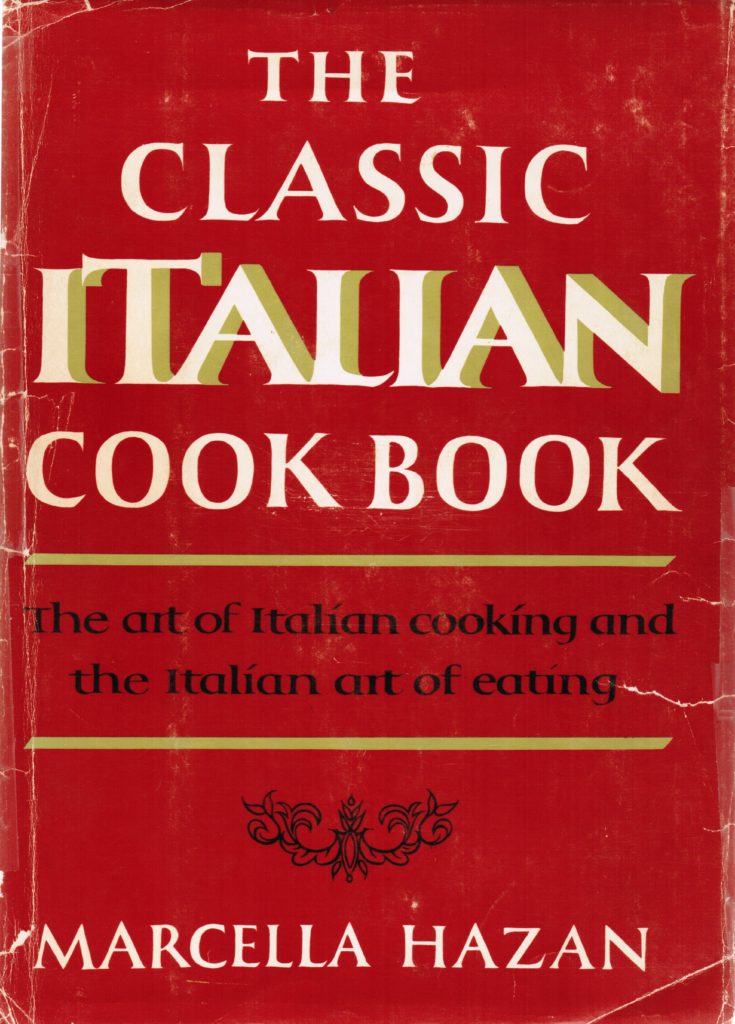
I never had either until college when I started cooking from Marcella Hazan’s The Classic Italian Cookbook published in 1973.  I still use the dog-eared copy I bought in college the year it was published.

It was a magnificent introduction to Northern Italian cooking which I knew little about as a kid of 18 from a small town in Western Pennsylvania in my sophomore year of college.

My knowledge of Northern Italian cooking expanded rapidly though.  Marcella was only the beginning.  There was a true restaurant renaissance in Philadelphia in the 1970’s.  Not only magnificent French restaurants like Le Bec Fin and La Panetiere, but wonderful Northern Italian restaurants like the Monte Carlo Living Room and a bevy of others whose names I can’t recall.  I ate at all of them…often.  I still remember one dinner at the Monte Carlo Living Room where, after being served a very simple spaghetti with garlic and oil, the waiter (they weren’t called servers back then) came by with a black truffle and shaved large quantities of it onto my pasta.  Heaven!

I also learned about Northern Italian cooking from the aunts of my college advisor Eugene (Gene) d’Aquili.  Well, it was Roman cooking, actually, which is in central Italy but still pretty far north from where my mother’s family hailed.

Auntie Helen (Zia Elena) and Auntie Louise (Zia Luigia) (they Anglicized their names after coming to America) were born in Rome in the early years of the 20th century.  They came to America as children.  Of the two, Auntie Helen was the cook.  From her I learned to make many classic Roman dishes.  Some of Auntie Helen’s dishes are slated to make it into the blog, including a Roman Chicken Cacciatore flavored with anchovies.

So, by the time I got absorbed into my husband’s Northern Italian family (his father is from Tuscany and his mother from Friuli) I had a good grasp of Northern Italian cooking.

We have risotto often.  Probably at least once every two weeks.  It’s usually made with a vegetable, though occasionally I’ll make Risotto alla Milanese flavored with saffron and not a vegetable in sight.  In the spring risotto usually includes asparagus or peas.  In the summer it is likely to be zucchini.  The fall brings butternut squash risotto and mushroom risotto.  Mushroom risotto pretty much carries us through the winter, too, with the occasional risotto made with meat sauce.

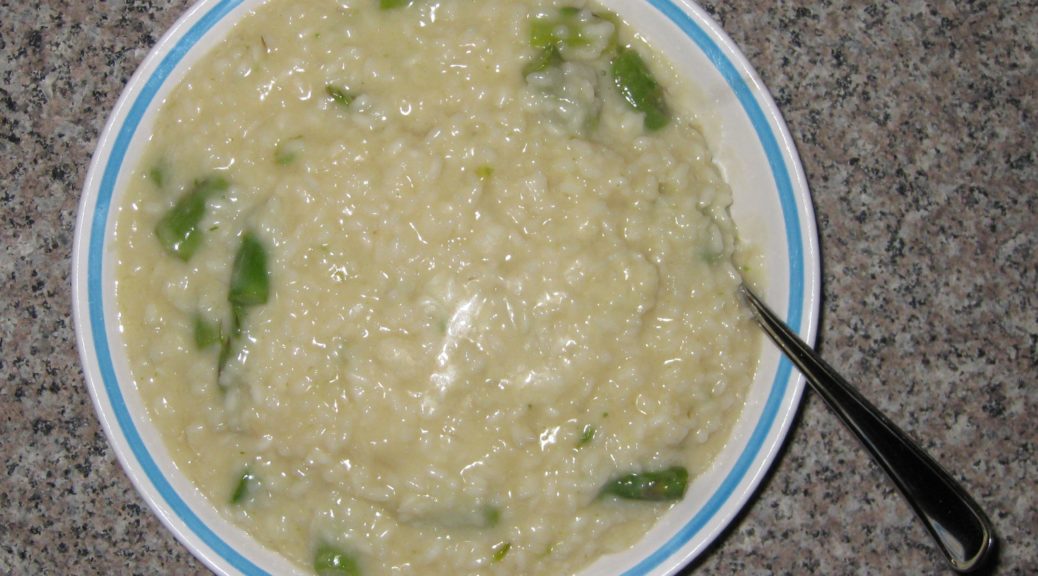
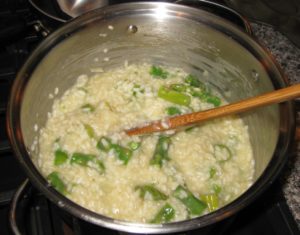
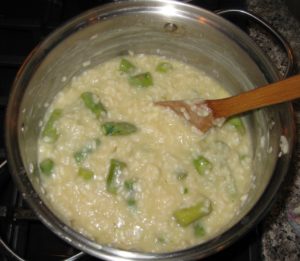
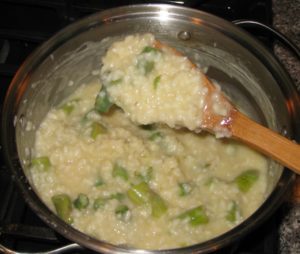
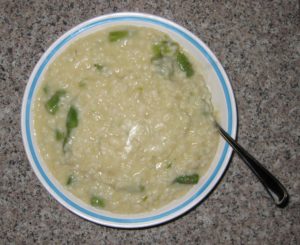
Since it’s spring, I’m doing risotto agli asparagi, risotto with asparagus.

Risotto with Asparagus

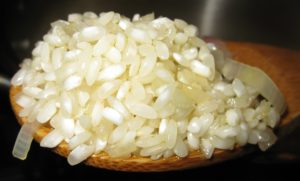
Risotto is a classic Northern Italian dish. The goal is to have rice grains that are still al dente (but not crunchy) in the middle surrounded by a creamy liquid. More often than not I find that risotto served in America is overly rich with butter, cheese, and sometimes cream. An Italian-style risotto should be creamy from the starch in the rice, augmented with a very modest amount of butter and cheese. Risotto rice is a short grain rice that cooks slowly, making it much easier to achieve an al dente texture because it takes a while to actually overcook it. The three types of rice for risotto are Arborio, Carnaroli, and Vialone Nano. Arborio is the easiest one to find though the other two are more forgiving than Arborio when it comes to overcooking. I recommend buying good quality rice imported from Italy. It really isn’t priced that differently from domestic. Do not wash the rice. I don’t buy shallots unless I have a specific recipe in mind. Since risotto is often something that I make with little advance planning based on the fresh vegetables that are in my refrigerator, I usually use onion and garlic in place of shallot. I honestly don’t think one could reliably tell the difference so feel free to use onion and garlic as noted in the recipe if shallots aren’t handy.
Prep Time 15 minutes
Cook Time 45 minutes
Total Time 1 hour
Servings: 6 people

Ingredients
  

  • 1 pound asparagus
  • 1/2 cup finely diced shallot
  • 1/4 cup extra virgin olive oil
  • 1 1/2 cups risotto rice
  • 2/3 cup dry white wine
  • 4 cups chicken broth
  • 3 tablespoons butter at room temperature
  • 1/2 cup finely grated Parmigiano Reggiano cheese
  • water as needed
  • salt to taste
  • black pepper freshly ground, to taste

Method
 

  1. Trim off the tough bottom of the asparagus spears. The standard way to do this is to bend the spear and let it crack naturally where the spear is less tough and woody.
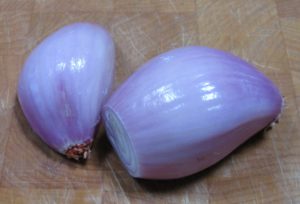
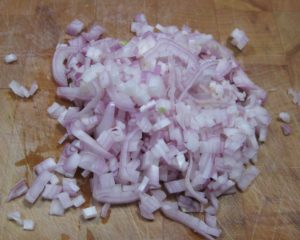
  2. Finely dice the shallot.
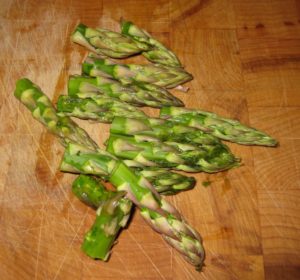
  3. Cut the tips off each spear, approximately the top 2 inches. Reserve the asparagus tips.
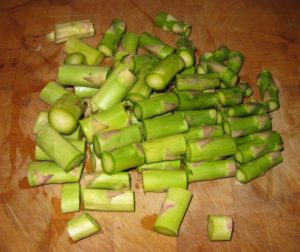
  4. Cut the remaining spears into 1 inch pieces. Reserve the cut spears separately from the tips.
  5. Bring the chicken broth to a boil.
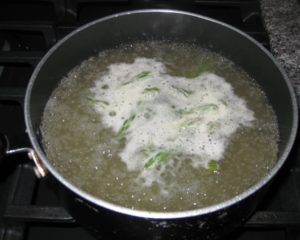
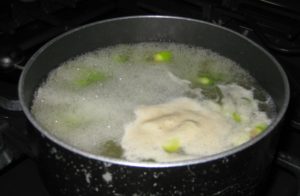
  6. Cook the asparagus tips in chicken broth for 2-4 minutes. They should be “toothy” but not crunchy.
  7. Using a spider or large slotted spoon, remove the tips from the boiling broth and put them into a bowl of ice water to stop further cooking.
  8. Cook the cut asparagus spears in the chicken broth for 4-6 minutes. Like the tips, they should be toothy but not crunchy.
  9. Add the partially cooked cut spears to the ice water with the tips.
  10. Reduce the heat so the broth remains at a simmer.
  11. Heat a two or three quart heavy-bottomed saucepan over medium high heat. Add the olive oil.
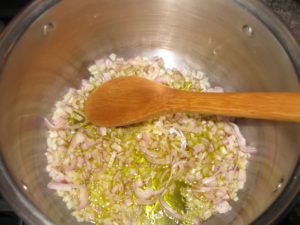
  12. When the oil is hot, add the finely chopped shallot (or onion and garlic if you are using that instead).
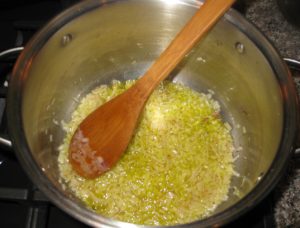
  13. Sauté, stirring frequently until the shallot softens and turns translucent. Do not brown the shallot. You may need to reduce the heat.
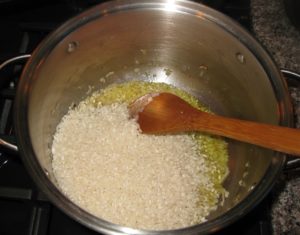
  14. When the shallot is soft, return the heat to medium high and add the rice.
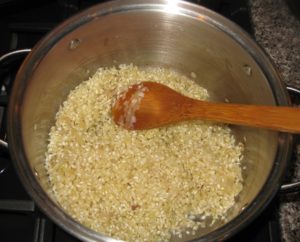
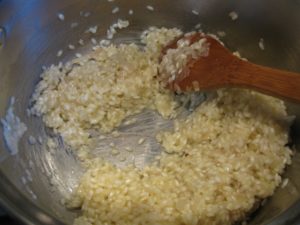
  15. Continue cooking, stirring frequently, until the rice starts to smell toasty. Do not brown the rice.
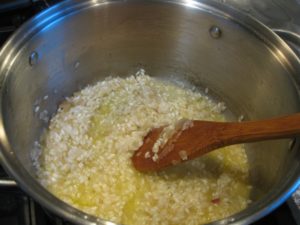
  16. The outer portion of the rice grains will get translucent while the inside will stay opaque white.
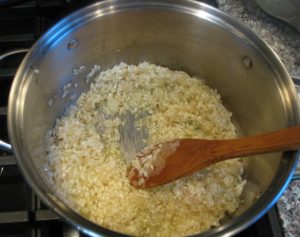
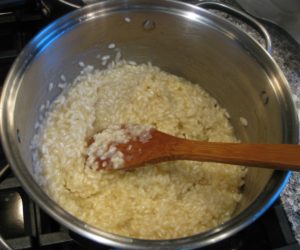
  17. Add the wine. Stir frequently, but not constantly, until the wine has totally evaporated. You will begin to see some starch leaching out of the rice. More and more of the starch will leach out as you cook the rice. This is what will make a creamy sauce.
  18. When the wine has evaporated, add a scant ½ cup of simmering broth. Stir thoroughly paying particular attention to loosening any spots where the starch seems to be sticking to the bottom of the pan. You don’t want to brown (or worse yet, burn) the starch.
  19. Stir frequently, but not constantly, until the broth has evaporated.
  20. If the broth is unsalted, as I recommend, you can add a teaspoon of salt to the rice as you begin to add broth. If the broth contains salt, I recommend not adding salt until the end.
  21. Keep repeating the process with a scant ½ cup of broth, cooking, stirring, and loosening any spots that are sticking until each addition of broth evaporates. The heat should stay as close as possible to medium high. The moderate boiling of the liquid will coax starch out of the rice to create the creaminess that is the hallmark of a good risotto.
  22. While the rice is cooking, drain the partially cooked asparagus.
  23. Begin tasting the rice after about 20 minutes of cooking. It will probably still be quite crunchy at the very core. Until you get the hang of it, I suggest testing a rice grain each time you add more broth so you develop a sense of how quickly the texture changes.
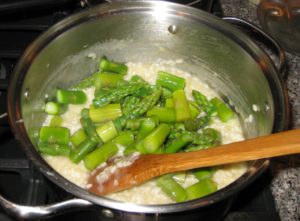
  24. When you think you’re only one or two additions of broth away from having perfectly al dente rice, add the partially cooked asparagus.
  25. Continue cooking, adding simmering broth or water as needed, until the rice is al dente.
  26. Remove the rice from the heat and stir in enough simmering broth or water to create a creamy “sauce.” The starch that you have coaxed out of the rice should absorb at least ½ cup of liquid, possibly more.
  27. Stir in the butter and Parmesan cheese. This will probably thicken the “sauce” so you will need to add a bit more simmering liquid to loosen it.
  28. Taste and add salt and freshly ground black pepper to taste.
  29. Serve immediately.

Notes
I think the standard method used to decide where to trim asparagus wastes too much.   For a quick tutorial on how I prep asparagus, check out my Preparing Asparagus post.
It will likely take more than 4 cups of broth to cook the rice. If you don’t have more broth, just use plain water. I do that very frequently. Except for the initial addition of wine, all liquid added to the risotto should be simmering.  As I’m getting near the end of the broth, I always put a couple of cups of water on to boil so that I have simmering water to add if needed.
Although the broth used for risotto should be flavorful, it should not be overly concentrated. The flavor of the asparagus should come through and not be muddled because the broth tastes assertively like chicken or herbs. Because you will be cooking down a fair amount of broth, it is best that it not be salted otherwise you run the risk of the risotto being too salty.
Copyright © 2017 by VillaSentieri.com. All rights reserved.

Tried this recipe?

Let us know how it was!

Turkey Noodle Soup

May 24, 2017

Soup!

If my mother said she was making “soup” without any qualifiers, it meant her beef noodle soup.

She would cook a good-sized piece of beef in her soup pot along with large pieces of carrot, celery and potato till the meat was falling apart.

She would cook thin egg noodles separately.

To serve the soup, everyone would get a bowl of broth with pieces of carrot, celery and potato.  The large piece of beef would be in its own serving bowl and the noodles in another.

At the table, everyone added beef (shredding it with a serving fork) and noodles to their bowl of broth for the ultimate customization.

I haven’t had soup this way since my mother died.  I actually don’t ever remember being served soup in the same manner by anyone else, anywhere, ever.  If you’ve ever heard of, or had, soup being served this way, I’d really like to hear about it.

The other soup my mother made frequently was what is sometimes called “Italian Wedding Soup.”  It is a rich chicken broth with pieces of chicken, small meatballs, carrots, celery, pasta (typically, acini de pepe), and escarole.

Occasionally my mother would make Slovak Mushroom Soup, with dried mushrooms and potatoes, or Potato Soup with potatoes, milk and onions.  More often, however, we’d get these when visiting my grandparents.  Early on, my grandmother would make soup, but when she got older, Aunt Ann or Aunt Mary would make it and bring it to my grandparents’ house.

On a Sunday, when my father, his six brothers, and all of their spouses and children would visit my grandparents, a lot of soup could be consumed.  Mind you, there was no guarantee that there would be soup, but if there was, it needed to be an industrial quantity.

In the winter, my grandmother would keep the soup in a big pot in the root cellar in the basement.  It was the same root cellar where she would make sour cabbage but that was before I was born.  I know because my father and all of my uncles never tired of talking about my grandmother’s sour cabbage soup, or kissel.  They bemoaned the fact that nobody made it any longer.  I don’t have her recipe and while I can find recipes for soups that sound similar, none of them sounds exactly like the soup my father described.

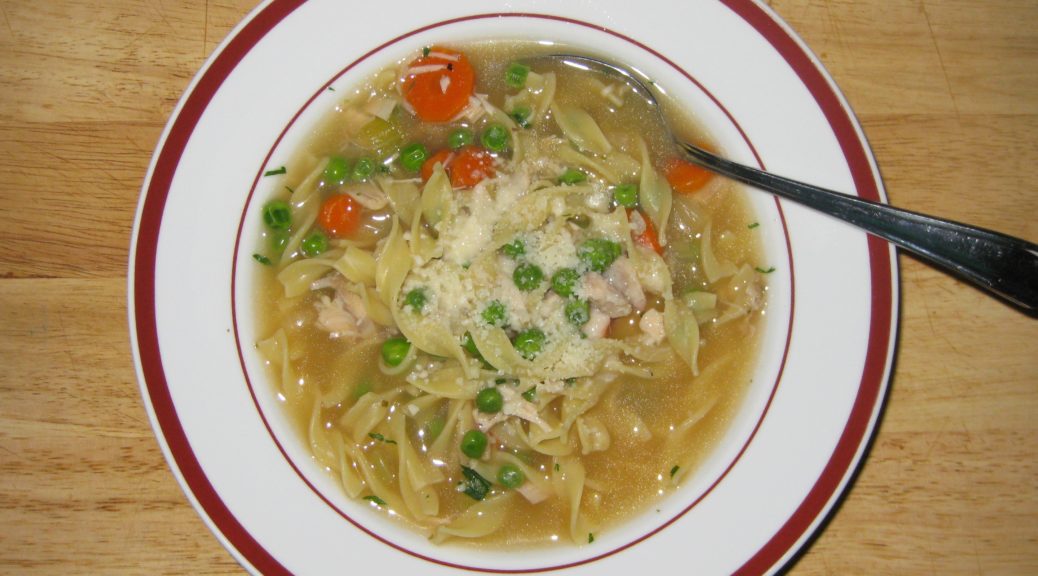
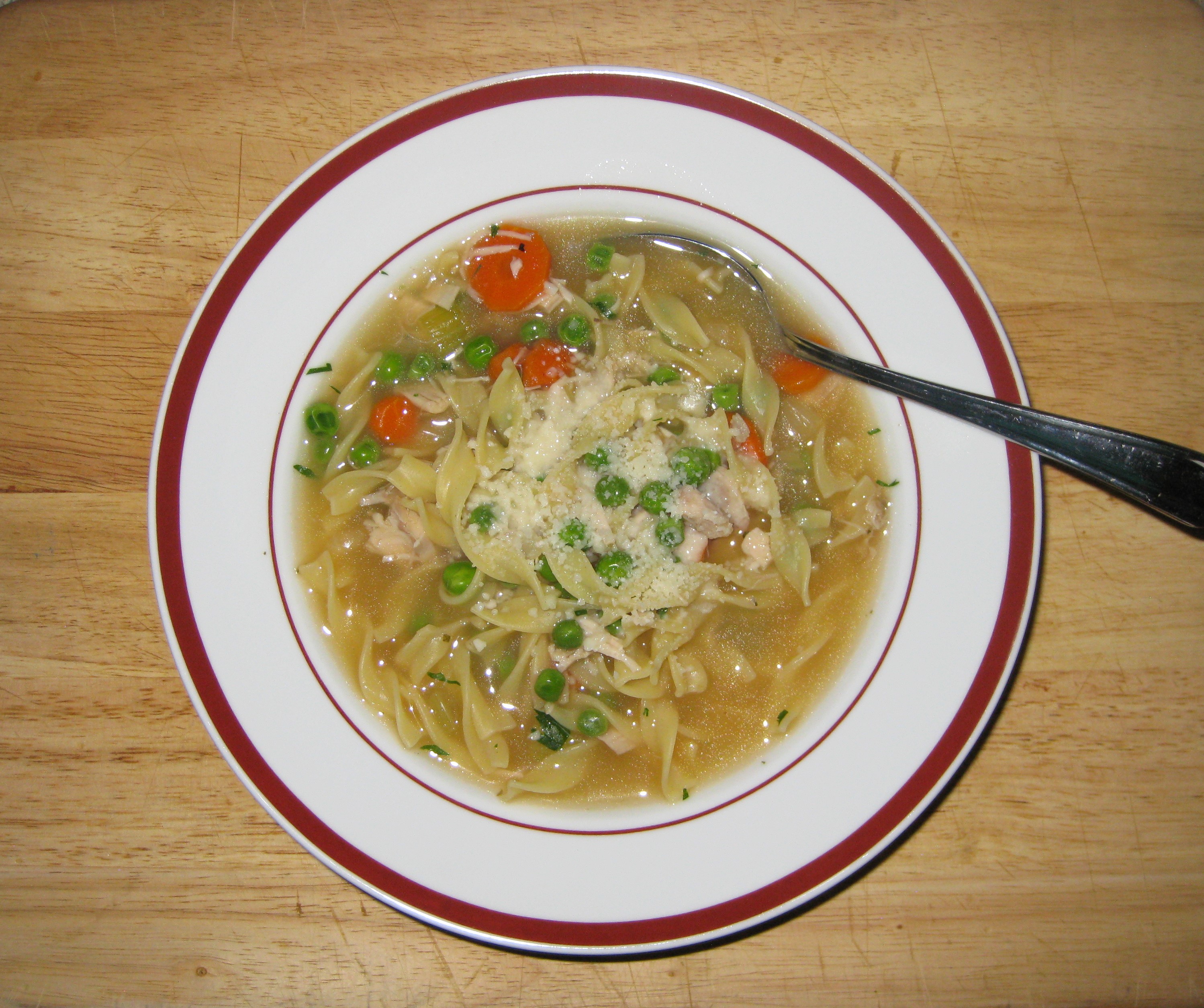
Today’s soup, however, is not one that I grew up eating.  As I mentioned in an earlier post, my mother thought the carcass of a roasted turkey wasn’t intended to be reused.  I first had turkey noodle soup, made with roasted turkey leftovers, when I was in college.  The soup was made by Mary Lou d’Aquili, the wife of my college advisor and, many years later, the person with whom I went into psychiatric practice, Eugene d’Aquili.

Ever since then, I’ve turned the bones of most roasts into broth.

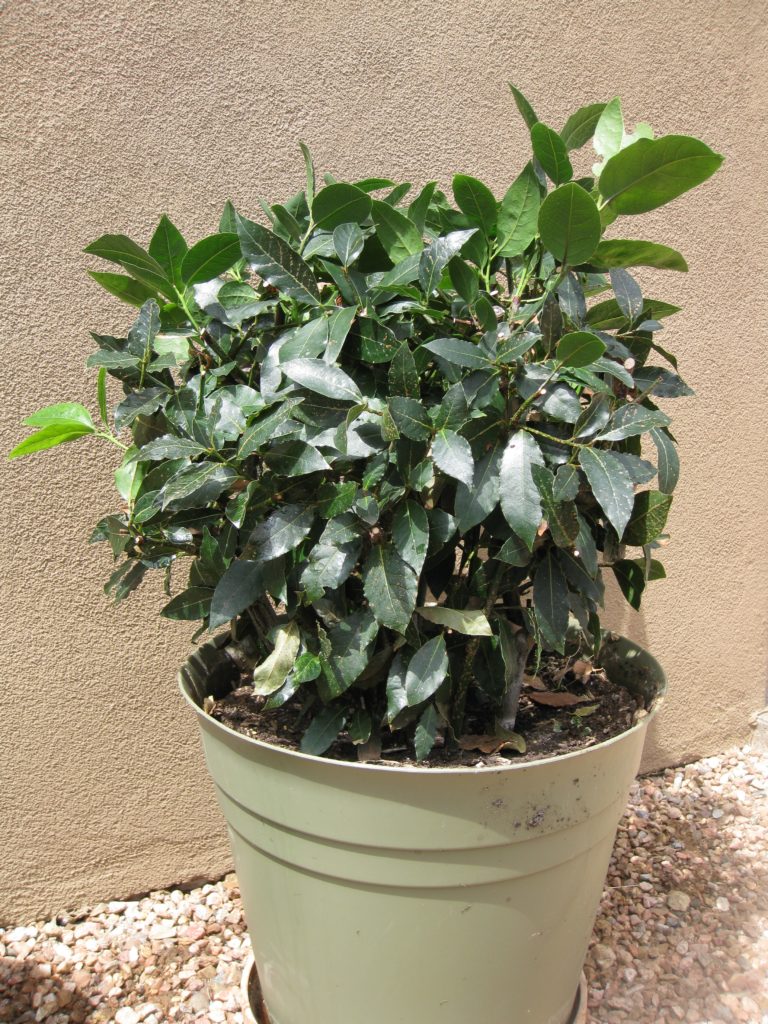
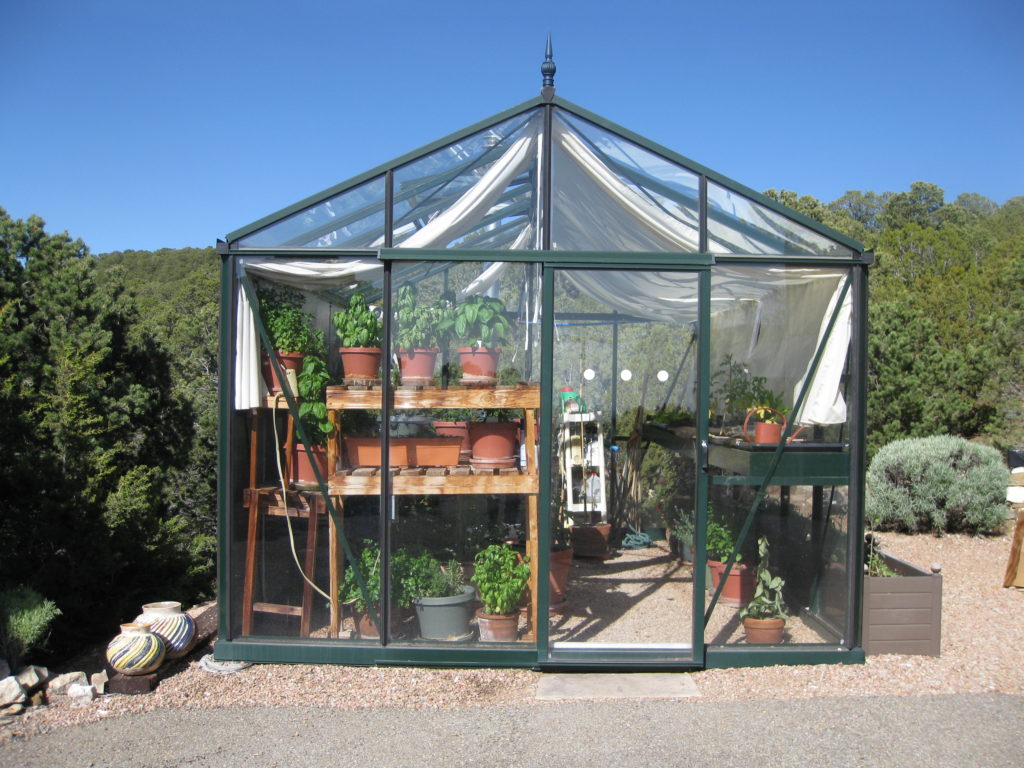
We have an array of fresh herbs year round thanks to the greenhouse.  I have totally given up dried bay leaves in favor of fresh ones.  They’re really easy to grow and the taste is incredible.  California bay leaves are stronger than Mediterranean bay leaves so if the balance of flavors in a dish is critical, and you’re using the former, opt for about half the amount called for in the recipe.  For most dishes, it’s not a critical distinction, however, and you can just substitute California for Mediterranean bay leaves.

Here’s a picture of our Bay Laurel plant, pruned down and ready to start its seasonal growth spurt.  In the fall I’ll harvest the leaves to make an Italian Bay Laurel Liqueur, Liquore al Lauro or Liquore Alloro.

The following recipe for Turkey Noodle Soup starts with the Roasted Turkey Broth I posted a few weeks ago.

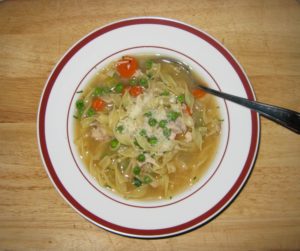
Turkey Noodle Soup

Save the bones, skin and shreds of meat from a roast turkey to make broth for soup. You can freeze the bones and make the broth later. You can also make the broth and freeze for future use. What you don’t want to do is to freeze the turkey noodle soup. I prefer not to freeze the soup, as the vegetables become too soft. If you must, however, freeze it before adding the noodles and peas. I keep a container of Parmesan cheese rinds in the freezer so that I always have them available to add to soup or other dishes to amplify the savoriness.
Prep Time 15 minutes
Cook Time 1 hour
Total Time 1 hour 15 minutes
Servings: 6 people

Ingredients
  

  • 1 recipe Roasted Turkey Broth see note below for a link to the recipe
  • 3 stalks celery sliced
  • 2-3 carrots sliced
  • 1/2 medium onion diced
  • 2 cloves garlic minced
  • 1 bay leaf preferably fresh
  • 1/2 teaspoon dry marjoram or other preferred herb
  • 1 piece Parmesan cheese rind optional
  • 2 cups coarsely chopped cooked turkey
  • 2 teaspoons tomato paste
  • 1 cup frozen peas
  • 1/2 pound dried egg noodles
  • 6-8 sprigs parsley leaves only, chopped
  • salt to taste
  • Freshly ground black pepper to taste

Method
 

  1. Bring the broth to a boil.
  2. Meanwhile, slice the carrots.
  3. Slice the celery.
  4. Dice the onions.
  5. Mince the garlic.
  6. Dig a Parmesan cheese rind out of your freezer.
  7. To the broth, add sliced celery, carrots, onions, minced garlic, bay leaf, marjoram, cheese rind, and salt and pepper to taste.
  8. Return to a low boil and cook, partially covered for 30 minutes.
  9. Taste and adjust seasoning.
  10. Add cooked turkey and tomato paste. Cook at a low boil for another 15 minutes.
  11. Taste and adjust seasoning to your preference then add an additional ½ teaspoon of salt. (Remember, you’re about to add unseasoned peas and noodles.)
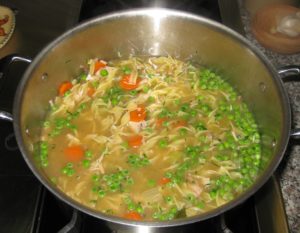
  12. Add the noodles. Bring to a boil.
  13. Add the peas. Boil gently till noodles are done.
  14. When noodles are cooked, taste and adjust seasoning. Stir in chopped parsley.
  15. Serve immediately.
  16. Pass grated Parmigiano Reggiano or Pecorino Romano cheese at the table.

Notes
Here is the recipe for Roasted Turkey Broth.  You should have 3 quarts of broth.
Copyright © 2017 by VillaSentieri.com. All rights reserved.

Tried this recipe?

Let us know how it was!

Homemade Dumplings

May 19, 2017

It is unfathomable to me that someone could voluntarily go on a low carbohydrate diet.

Avoiding gluten, short of having full-blown celiac disease, is equally unthinkable.

All of my most favorite foods start with flour.

Some contain flour and potatoes.

Roughly in order these are Potato Gnocchi, my Slovak Grandmother’s Potato Cakes and a three-way tie between Pasta (of almost any sort), Dumplings, and my Aunt Mary’s Bread Rolls Stuffed with Mashed Potatoes and rubbed with garlic and oil.

Of those five foods, the only one I get on a regular basis is pasta.  I have pasta 3 or 4 (or 5 or 6) times per week.  I could probably have it every day and never tire of it.  A few days without pasta and I begin to have serious cravings.

Until just recently, I had a frenetic travel schedule for work.  One of the first things I would do upon landing in a city that I was likely to return to over and over for work was to find a really good restaurant, preferably an Italian restaurant or one with a goodly number of Italian dishes on the menu.  Failing that, I would look for a restaurant with an ingredient-driven menu that was not into precious or pretentious presentation!

Sometimes finding that restaurant was elusive and my pasta cravings would be in full swing by the time I got home.

Over the years, my mother-in-law has learned that the best thing she could make for dinner on a day when I’m returning from a trip is pasta.  Even if I’m not having pasta withdrawal symptoms, there are few foods that I would rather have.  Actually, there’s only one:  gnocchi, which truth be told, is just the Italian word for dumpling, which as you’ve noticed is on my list in its English form, too!

Sometimes the restaurants I’d find were so spot-on perfect that I would just work my way down the menu over successive trips.  In this category are the recently closed Dish Osteria in Pittsburgh, Bari Ristorante in Memphis, Antico in Chicago, and, until the recent change in the menu, Tre Soldi in Chicago.

Sometimes I’d find a chef whose cooking I really enjoyed, as happened with Bruce Bogartz in Knoxville a number of years ago.  My business partner and I followed Bruce through at least three different restaurants.  Sometimes we’d just walk in and sit down and Bruce would come over and say: “Can I just cook for you this evening?”  That would be the sum-total of ordering.

Sometimes my business partner and I would find a restaurant that would accommodate our cravings as happened in Harrisburg, Pennsylvania.  We’d usually get to the restaurant late on the day we came into town.  After a few trips, we got bold and asked for something that wasn’t on the menu.  Something simple.  Something Italian.  As I recall it was spaghetti with anchovies, garlic, olive oil and red pepper.  The chef accommodated us.  From then on, at least once during every trip to Harrisburg we asked for the same thing, sometimes we’d mix it up by asking for a bit of fennel seed to be added.  A salad of arugula with olive oil and lemon juice always rounded out the meal.

While it’s easy to find pasta on restaurant menus, it’s pretty difficult to find dumplings unless you’re in a dumpling culture like Eastern Europe.

After two trips to Prague, I discovered that it was basically impossible to just order dumplings.  I frequently found myself ordering some sort of “Hunter’s Plate” which had an array of cooked meats and, you guessed it, dumplings.

I ate the dumplings first.

Dumplings are a breeze to make.  And don’t even think about packaged baking mix.  (For the reasons why, see my post about hydrogenated fats.)

Unless you are seriously trying to avoid carbohydrates or gluten, give these a try.  They honestly take less than 10 minutes to whip up.  You could get a serious paper cut opening up a box of Bisq…er, biscuit mix, in less time!

Homemade Dumplings

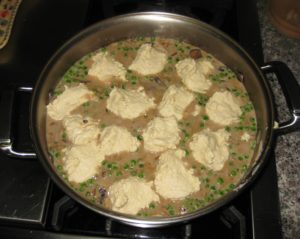
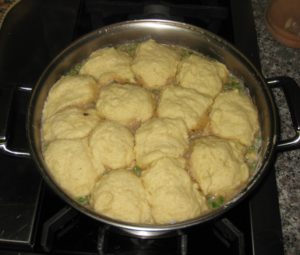
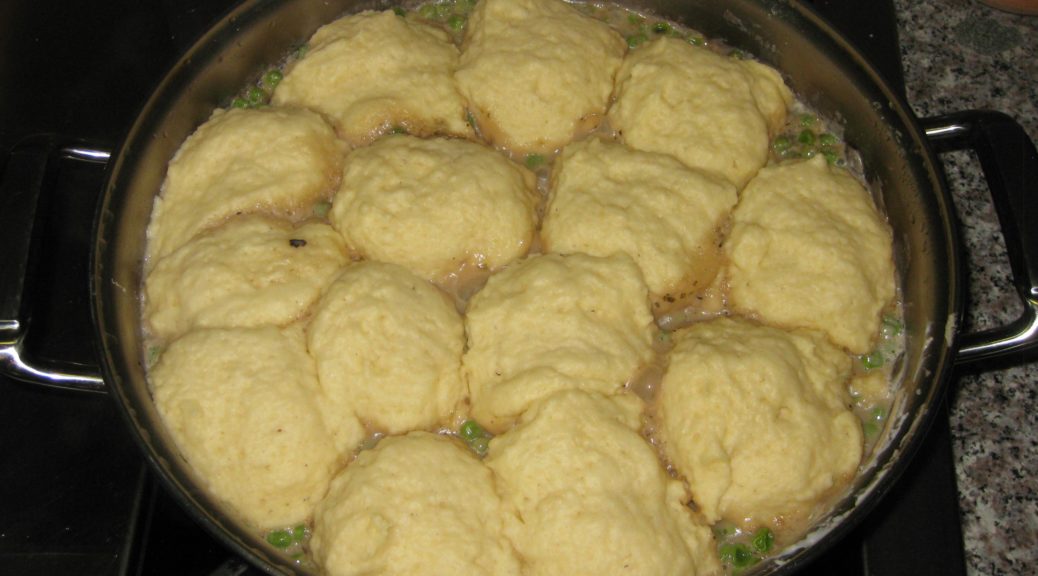
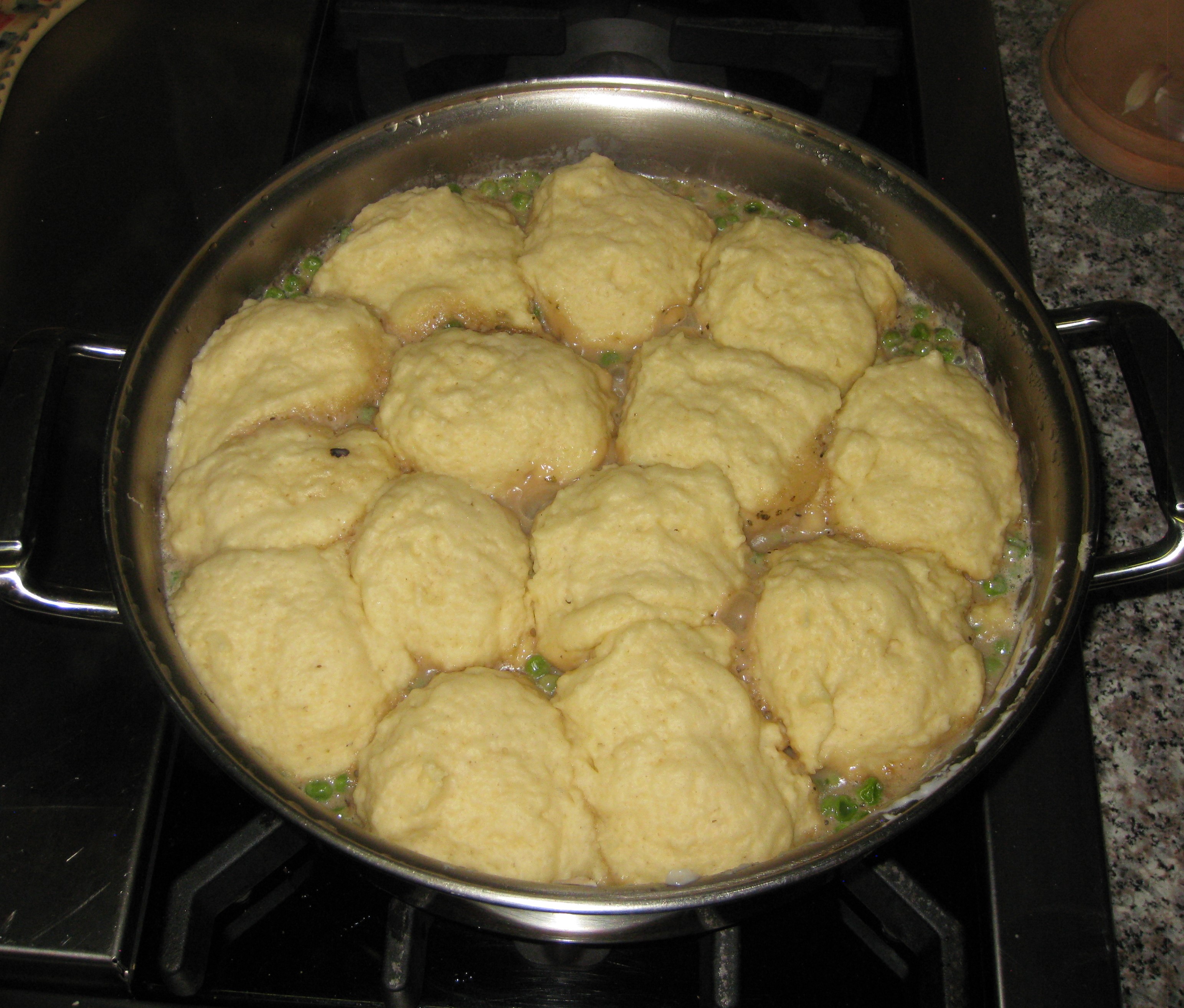
In order for the dumplings to cook properly, they need to be placed on top of food that is just submerged in the cooking liquid. A little bit of the dumpling will sink below the liquid but, basically, the dumplings should sit on top of the food and steam, rather than boil in the liquid itself. Growing up, the “food” below the dumplings was often kielbasa and sauerkraut. For this post it was turkey with mushrooms and peas in a light cream sauce due to the presence of leftover roast turkey in the fridge. Stir the contents of the pot before adding the dumplings as you won’t be able to do it afterwards. Prior to adding the dumplings, be certain that the heat keeps the liquid at a steady low boil with the lid tightly on the pot.
Prep Time 15 minutes
Cook Time 20 minutes
Total Time 35 minutes
Servings: 4 people

Ingredients
  

  • 2 cups all purpose flour
  • 1 tablespoon baking powder
  • 1 teaspoon salt
  • 3 tablespoons cold butter
  • 1 egg
  • 3/4 cup milk approximately

Method
 

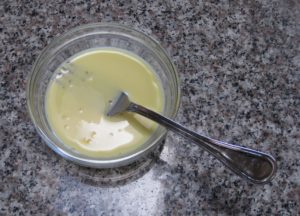
  1. Lightly beat the egg and ¼ cup of milk. Reserve.
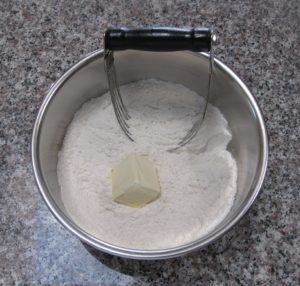
  2. Whisk together the flour, baking powder and salt.
  3. Using a pastry blender, cut the butter into the dry ingredients until there are “lumps” no bigger than flakes of oatmeal.
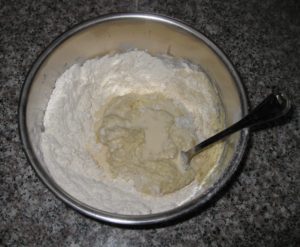
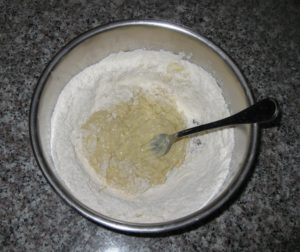
  4. Make a well in the center of the flour mixture. Add the beaten egg-milk mixture.
  5. Using a fork, gradually incorporate the flour into the liquid by starting in the center of the bowl and stirring in a circular manner, gradually widening the circle to incorporate more and more of the flour.
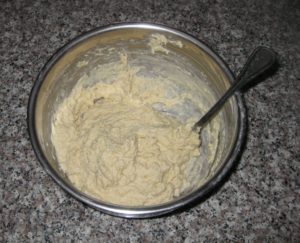
  6. When the batter will not incorporate more flour, add a few tablespoons of the remaining milk.
  7. Continue stirring and adding milk a few tablespoons at a time, until all the flour is incorporated and you have a fairly stiff but still somewhat sticky batter.
  8. Drop by rounded tablespoonsful on top of whatever you’re cooking in the liquid, such as sauerkraut, pot pie, etc.
  9. Cover tightly and cook 20 minutes without opening the lid. The contents of the pot should stay at a steady, low boil.
  10. Carefully scoop the dumplings onto a serving platter.

Notes
Copyright © 2017 by VillaSentieri.com. All rights reserved.

Tried this recipe?

Let us know how it was!

Pasta al Pesto

May 15, 2017

Gardening at 8000 feet is challenging.  Even more so when you consider that we are sitting on almost solid rock.

There’s not much soil to begin with, just the barest of covering on a rocky foundation.  The piñon and juniper that surround us work their roots through little crevices in the rock that sits just inches below the surface.

What little soil there was in the area immediately surrounding our house was removed to level the building site.  The excavation was almost exclusively rock, one hundred truck loads were taken away.  Some rock was kept on site to create retaining walls around the property.

The corollary, however, is that there’s no dirt around the house to dig into to plant much of anything.  The landscaping that was done was exclusively within rock retaining walls or our front enclosed courtyard, where topsoil was brought in.  The first load of topsoil for the courtyard arrived April 2007, before we were ready to plant anything.  April is a windy month in New Mexico.  The winds started up one day and before evening every last speck of topsoil was blown to West Texas!

We could consider raised bed gardening but that would just invite the rabbits and deer to munch their way through our garden.  As it is, we’ve offered up several stands of ornamental grasses on the periphery of our landscaped area to the critters.  We seem to have reached a truce of some sort.  We let them eat the ones around the edges and, for the most part, they let the others alone.

We installed a greenhouse that allows us to extend the growing season by many months.  It also allows us to winter over a number of plants that would not survive in this climate.  The greenhouse also allows us to grow fig trees in large pots.  The first year we grew figs, they didn’t ripen.  It turns out that even though summer days are warm, the nights are cool enough that the fruit doesn’t ripen.  The following year we left the fig trees in the greenhouse throughout the summer, convinced that it would be too warm for them to thrive even with the automatic ventilation system.

Luckily, we were wrong.  The fig trees loved the heat.  Picking a ripe fig off of the tree and eating it immediately is amazing.  The only fresh fruit experience that would be superior, in my estimation, is a fresh-picked mango…and those trees won’t fit in our greenhouse!

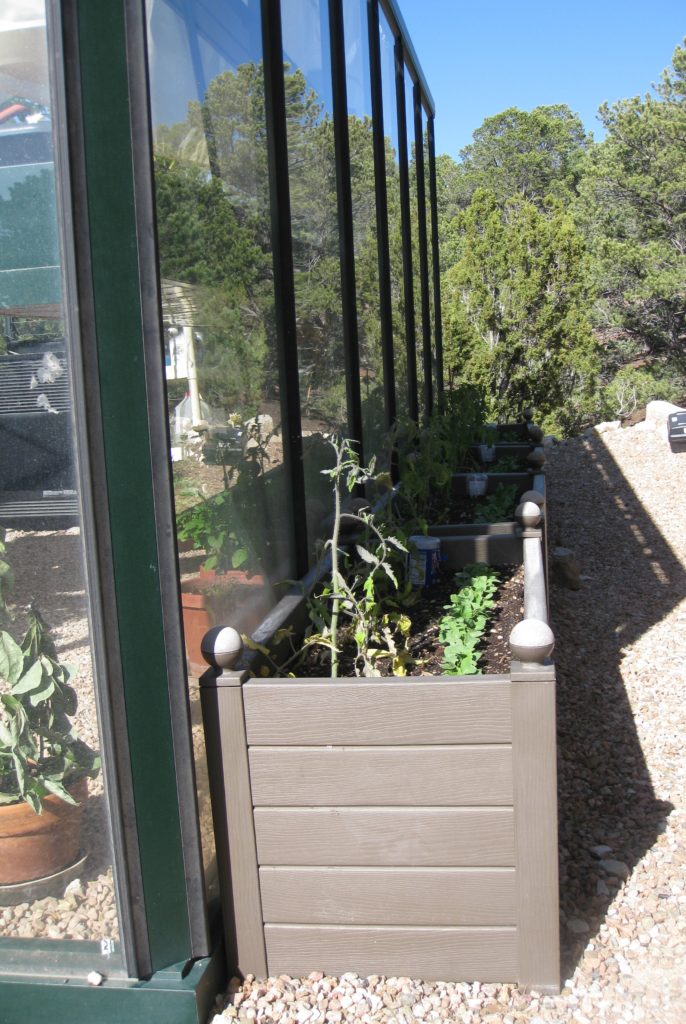
We have one row of planter boxes outside the greenhouse.  We use these for plants, like tomatoes, that are not very attractive to deer and rabbits.  Salad greens, such as arugula, radicchio, and leaf lettuce grows in shallow trays on a raised shelf in the greenhouse.  Many pots of herbs also remain in the greenhouse year-round.  Everything else is planted in our interior courtyard, either in pots or in another row of planter boxes.

Depending on the type of plants, we start planting seeds in February.  Seedlings are transplanted once the risk of frost is minimal.

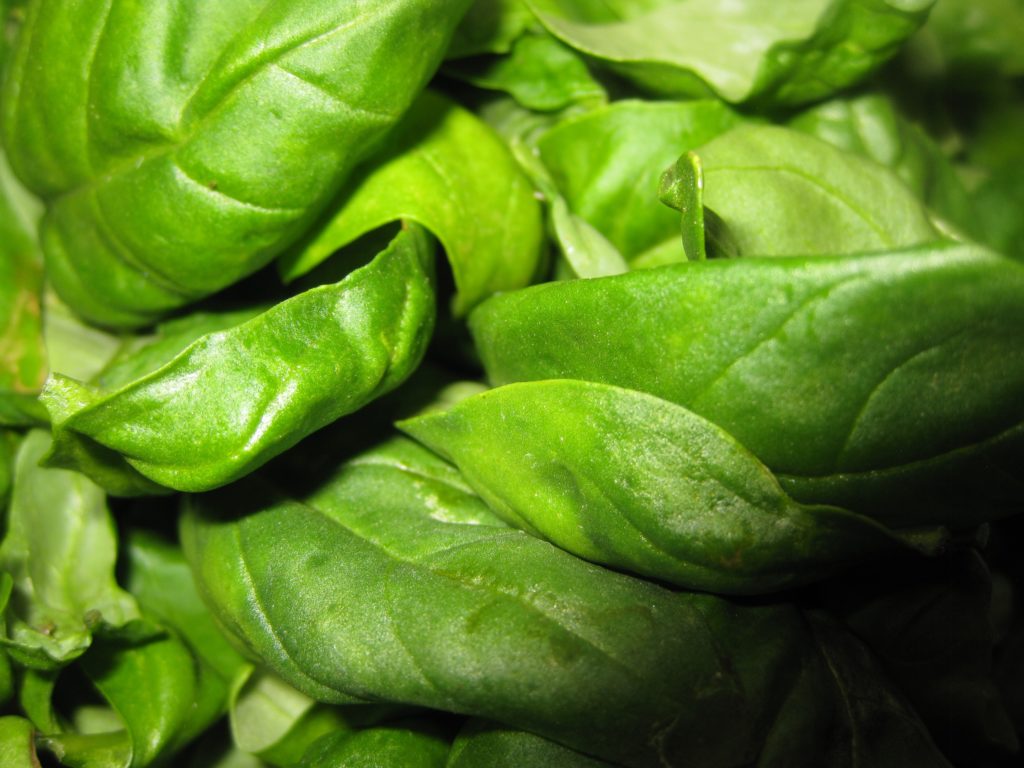
This year, we started too much basil from seed.  It needed to be thinned.  This created the opportunity for us to have pesto much earlier than would otherwise have been the case.  Usually it’s June before the basil plants have grown large enough that we can harvest leaves for pesto.

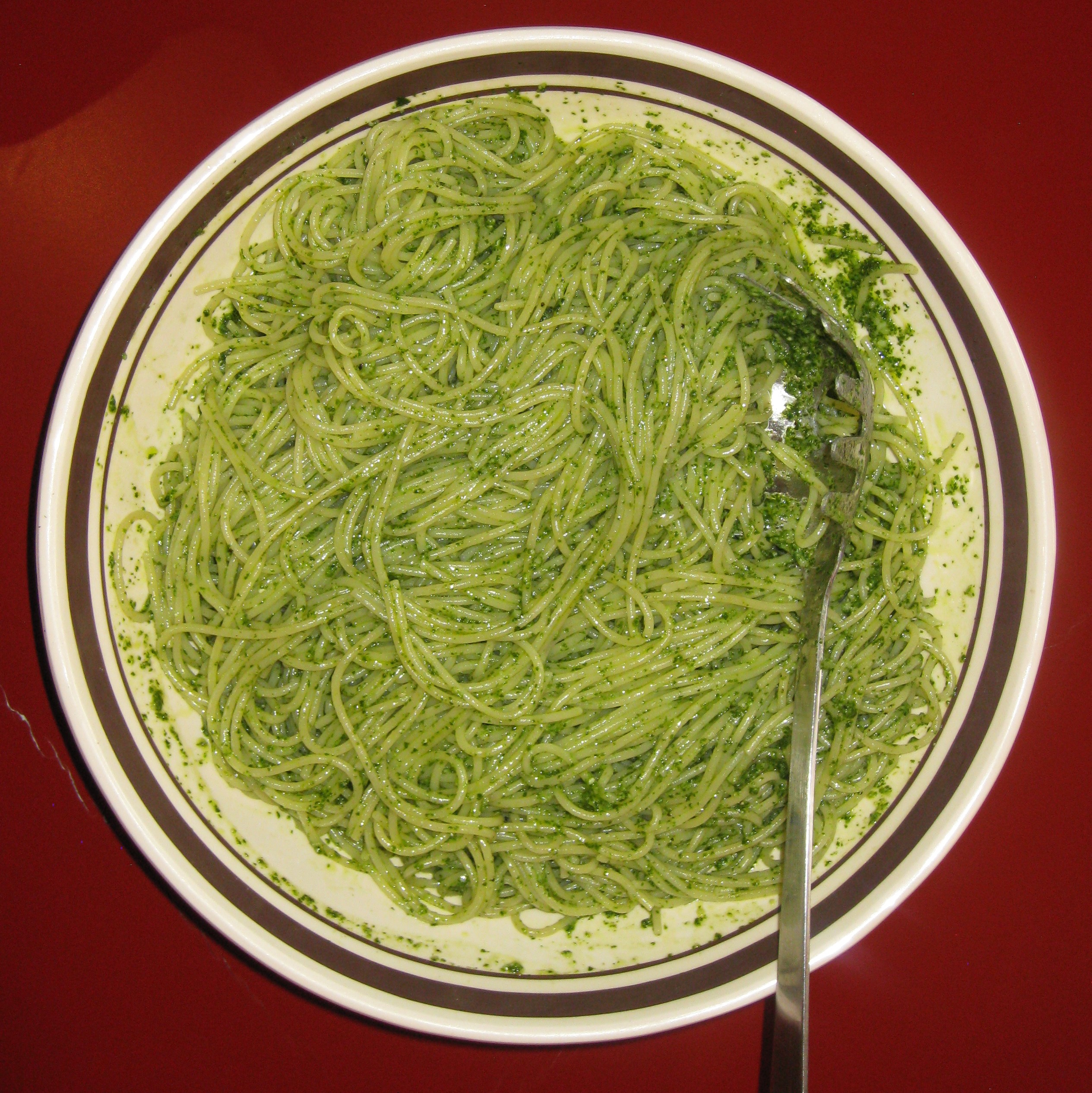
We had this pesto on April 30th, a day that measured more than 8 inches of snow at Villa Sentieri.  It was winter’s last hurrah and fresh pesto was a perfect way to welcome spring and say good-bye to winter.

Pasta al Pesto

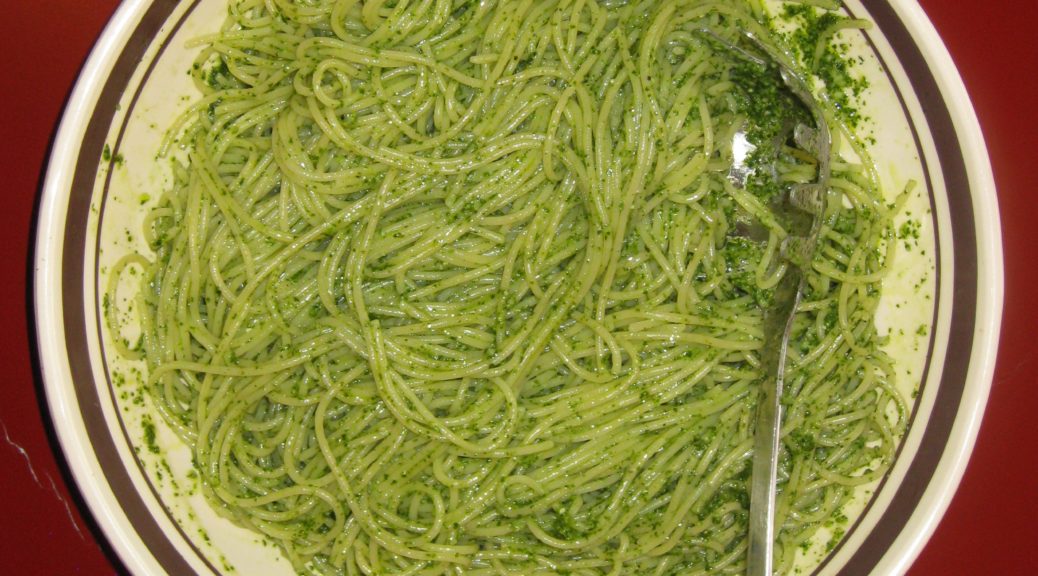
The classic basil-based pesto is Pesto alla Genovese. However, because the recipe and ingredients for Pesto alla Genovese are tightly regulated (for example, the basil must be grown in Genoa, Italy), I’ll refrain from calling this Pesto alla Genovese since it can’t meet those strict regulations. Try to use young, small basil leaves. If you must use larger ones, tear them into smaller pieces so they measure approximately the same way. Using olive oil from Liguria, where Pesto alla Genovese originated, is another of those difficult-to-meet requirements. Nonetheless, try to use a sweet, fruity olive oil rather than one that is spicy and pungent. Make the pesto as close to serving time as possible. I like to have all the ingredients measured, making the pesto after the pasta starts to a boil. If you’re wondering about the use of a food processor, that would not be permitted either but I doubt there are many of us that would make pesto if we had to use the traditional marble mortar and wooden pestle!
Prep Time 30 minutes
Cook Time 15 minutes
Total Time 1 hour 15 minutes
Servings: 6 people

Ingredients
  

For the pesto
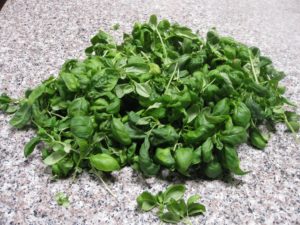
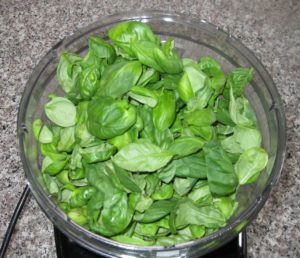
  • 2 cups basil leaves very lightly packed
  • 1/2 cup extra virgin olive oil preferably sweet and fruity
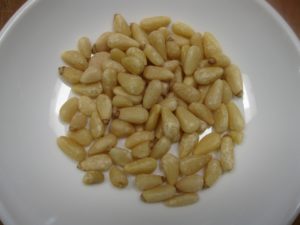
  • 2 tablespoons pine nuts
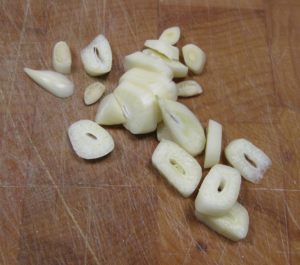
  • 2 cloves garlic roughly chopped
  • 1/2 teaspoon salt
  • 1/3 cup freshly grated Parmigiano Reggiano cheese
  • 2 tablespoons freshly grated Pecorino Romano Cheese
For the pasta
  • 1 pound dried pasta such as spaghetti, penne rigate, or fusilli
  • 3 quarts water
  • 1/3 cup salt

Method
 

  1. Pluck the basil leaves from the stems and measure 2 cups, lightly packed.
  2. Measure all the other ingredients. Pine nuts.
  3. Garlic.
  4. Parmigiano Reggiano and Pecorino Romano cheeses.
  5. Don't forget the extra-virgin olive oil and salt.
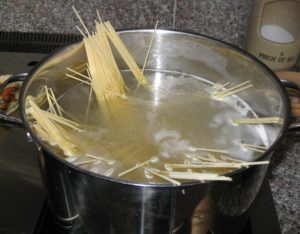
  6. Bring three quarts of water and 1/3 cup of salt to a rolling boil.
  7. While water comes to a boil and the pasta cooks, heat the serving bowl by placing it in a 150°F oven or partially filling it with boiling water.
  8. When the water comes to a boil, add the pasta. Return to a boil, stirring frequently.
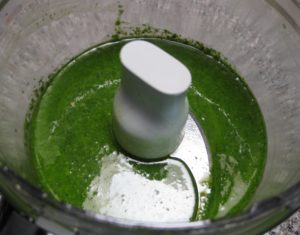
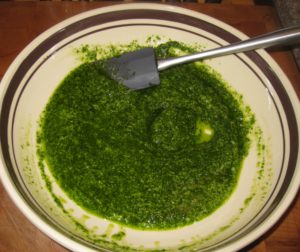
  9. As the pasta boils, put the basil leaves, olive oil, pine nuts, garlic, and salt in a food processor. Puree the basil mixture, scraping down the sides of the bowl occasionally.
  10. When the pasta is almost al dente, pour the basil puree into the warmed serving bowl.
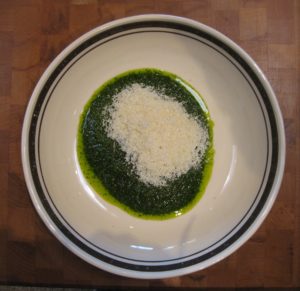
  11. Add the Parmigiano and Romano cheeses. Stir to combine.
  12. Remove ¼ of the boiling pasta-cooking water from the pot and stir into the pesto to loosen it.
  13. When the pasta is al dente, remove and reserve a cup of pasta cooking water.
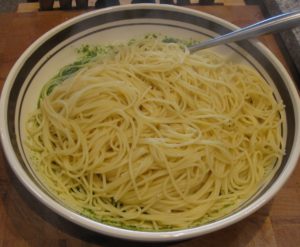
  14. Drain the pasta. Do not rinse. Add the pasta to the serving bowl and toss to coat each strand.
  15. If the pesto seems a little thick, add a tablespoon or two of the reserved pasta-cooking water.
  16. Taste and adjust salt if necessary.
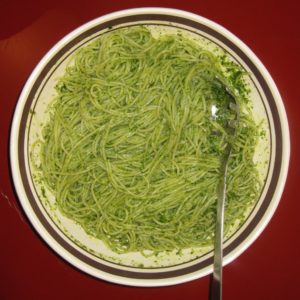
  17. The finished dish.

Notes
Copyright © 2017 by VillaSentieri.com. All rights reserved.

Tried this recipe?

Let us know how it was!

Technique: Prepping Asparagus

May 13, 2015

Spring is here.  In our house that means lots of asparagus.

It seems like a good time to show you my twist on prepping asparagus.

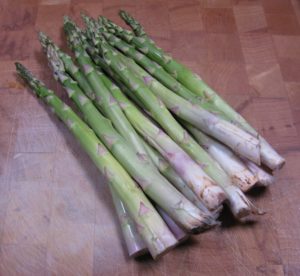
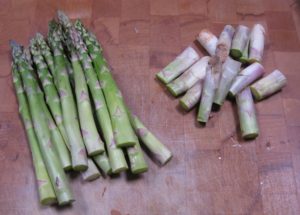
Usually the bottom portion of an asparagus spear is tough and needs to be removed.  A common method of determining how much to remove is to bend the spear and allow it to snap.  I believe that the standard “bend and snap” method wastes too much asparagus.
I like to put the asparagus on a cutting board and gently bounce a chef’s knife off the spear working up from the bottom.  If you do it gently enough you will hit a spot where the knife suddenly goes just a bit deeper into the spear.  That’s the spot to cut.  Even the sound the knife makes as it moves from the tougher bottom to the more tender portion of the stalk changes.  Sometimes the sound is all I need to know that the next bounce will be the place to cut the spear.
I’ve attached a few video clips of this technique.  Watch for the place where the knife suddenly goes a little deeper and listen to how the sound changes as the knife travels up the stalk.

Prepping Asparagus 1

Prepping Asparagus 2

Prepping Asparagus 3

Prepping Asparagus 4