All posts by Gary

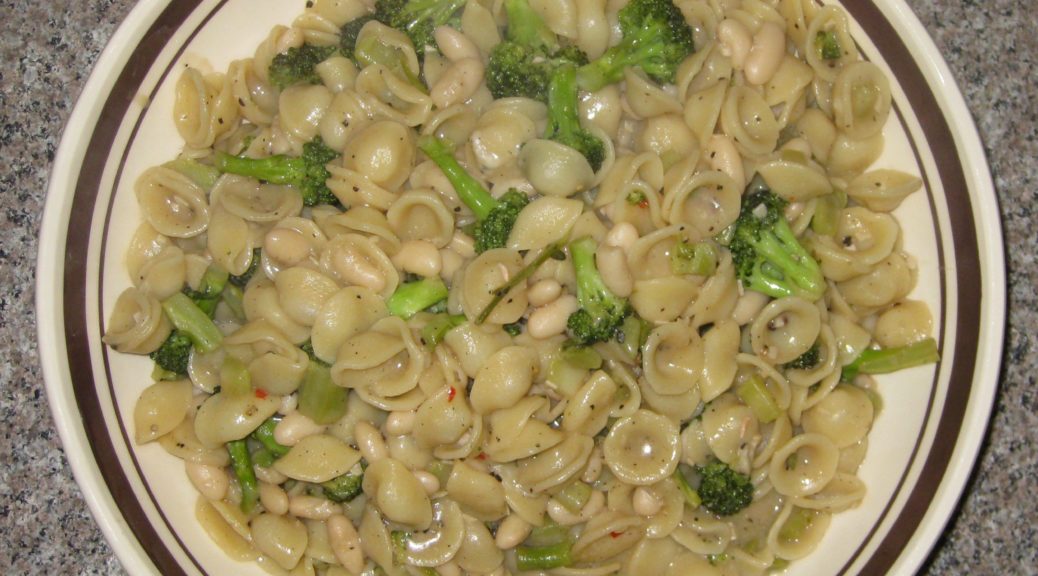
Orecchiette with Broccoli and Anchovies

May 10, 2017

A few times in my life I’ve been lucky enough to cook with my husband’s Great Aunt Fidalma.  It’s always been in my kitchen, though I keep hoping to make a trip to Tuscany to cook with her in her kitchen.

Zia Fidalma speaks Italian and German.  I speak English.  Though I studied German in high school and college, and at one point was passably able to translate scientific German, my command of spoken German (and at this point, scientific German) is hopeless.  I studied Italian for a while too, but the best I can do is read a menu, order in a restaurant, and find out where the restroom is.

So, cooking with Zia Fidalma starts with a language barrier but it doesn’t seem to matter.  Somehow we communicate.

Mostly that means Zia Fidalma speaks slowly in Italian emphasizing the words I am likely to understand most.

Like the time we were in my kitchen in Santa Fe preparing dinner for twelve.  The first course was spaghetti al pesto.  A pile of basil stalks from my father-in-law’s (Zia Fidalma’s nephew) garden were on the kitchen counter.  Zia Fidalma was plucking off basil leaves one at a time, inspecting each one.  At one point, she looked up at me holding a leaf and said “è brutta” (it’s ugly), clearly wanting my agreement to discard the less-than-perfect leaf.

One day at our home in Chicago, she was making risotto for lunch.  It had a very similar flavor profile to this pasta in that it contained broccoli, garlic and anchovies.

Zia Fidalma cranked up the 15,000 BTU burner to high.  She sizzled some minced garlic for a moment.  There was a vague hint of smoke coming from the pan.  She added the anchovies and stirred them about.  Smoke started to billow up.  She smiled knowingly.  She added the broccoli, undeterred.  Smoke continued.  She stirred.  I stood there horrified.  Then she lightly charred the broccoli.  I was even more horrified.  At long last some liquid went in and the rest of the risotto-making followed a familiar pattern.

I try to avoid smoking oil at all cost when cooking.  I was more than a little concerned about how the risotto would taste.

However, I have never had anything but fabulous food from Zia Fidalma, so I had to trust that this would be OK, too.

This wasn’t her first rodeo.  She’d been making risotto since before I was born.

In the end, all I can say is that the risotto was wonderful.  It had layers of flavor.  It provided an important lesson about how techniques different from what one would typically use can create incredible flavors.

So, if you see wisps of smoke coming from the pan as you singe the broccoli for this recipe, don’t fret.  Just raise a toast to Zia Fidalma, and enjoy!
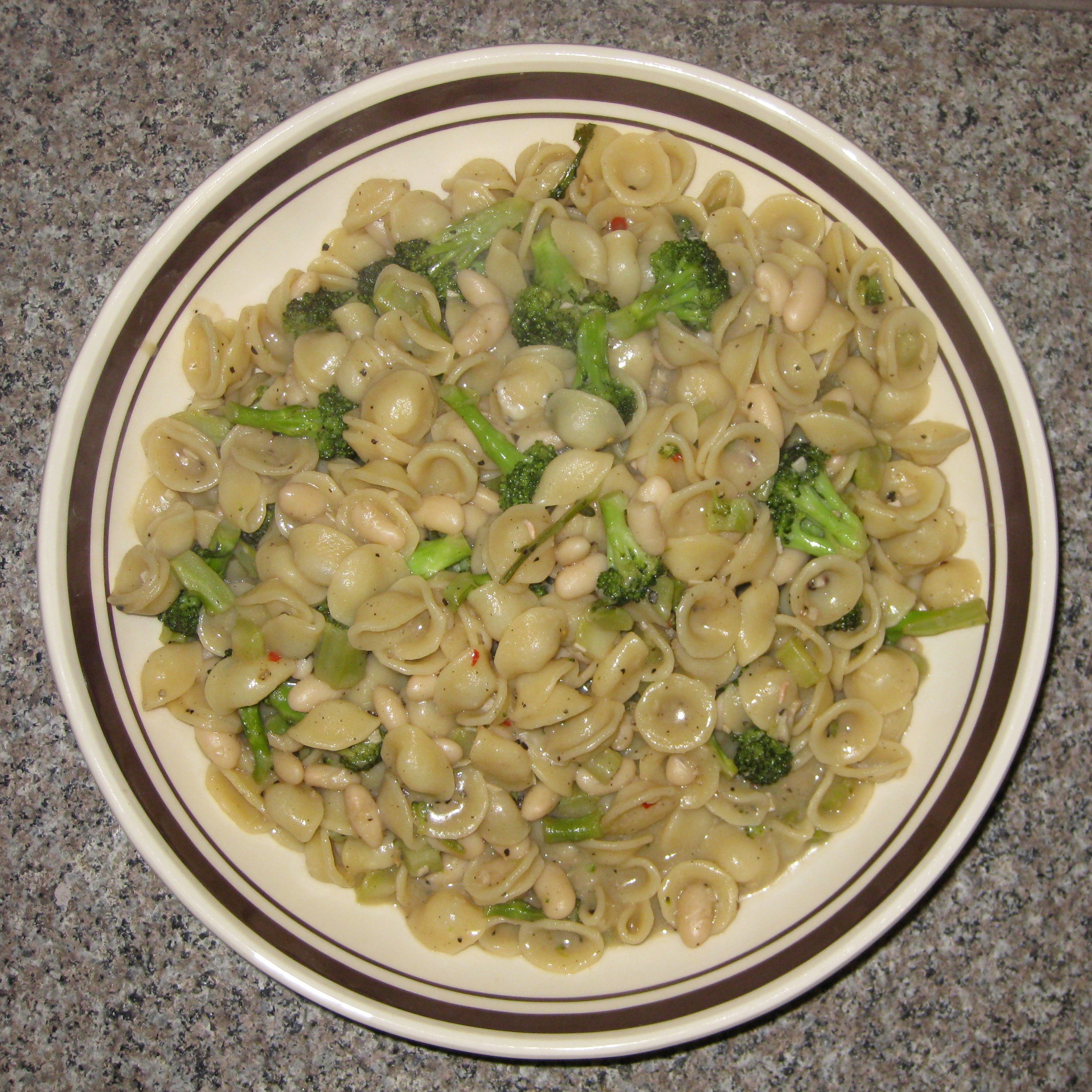
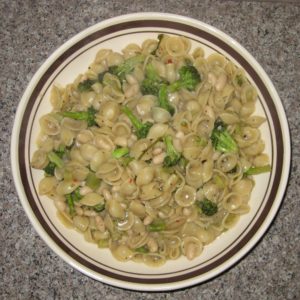
Orecchiette with Broccoli and Anchovies

My husband’s Great Aunt Fidalma, who lives in Tuscany, showed me how to cook the broccoli in this manner. Previously, I parboiled the florets and added them and the beans to the sautéed garlic and anchovies. This method adds layers of flavor that cannot be obtained by just boiling the broccoli. I prefer to use home-cooked kidney beans following my recipe for Cannellini alla Toscana. You can use either red or white (cannellini) beans but the red ones add more color contrast. As an alternative you can use one 15 ounce can of beans. Do not discard the liquid in the can as it will improve the body of the sauce.
Prep Time 15 minutes
Cook Time 30 minutes
Total Time 1 hour
Servings: 6 people

Ingredients
  

  • 3 quarts water
  • 1/3 cup salt
  • 4 1/2 cups broccoli florets from approximately 4 crowns of broccoli
  • 1/4 cup olive oil
  • 4 cloves garlic minced
  • 1 2 ounce can anchovies packed in oil
  • 1/4 teaspoon crushed red pepper or to taste (optional)
  • 1/3 cup dry white wine
  • 1 1/2 cups cooked kidney beans red or white, with enough cooking liquid to cover the beans
  • 1/2 teaspoon dried oregano
  • 1 pound orecchiette
  • 1 teaspoon Freshly ground black pepper or to taste
  • 1/2 cup grated Parmesan cheese or to taste
  • 2-3 tablespoons extra virgin olive oil best quality, for finishing

Method
 

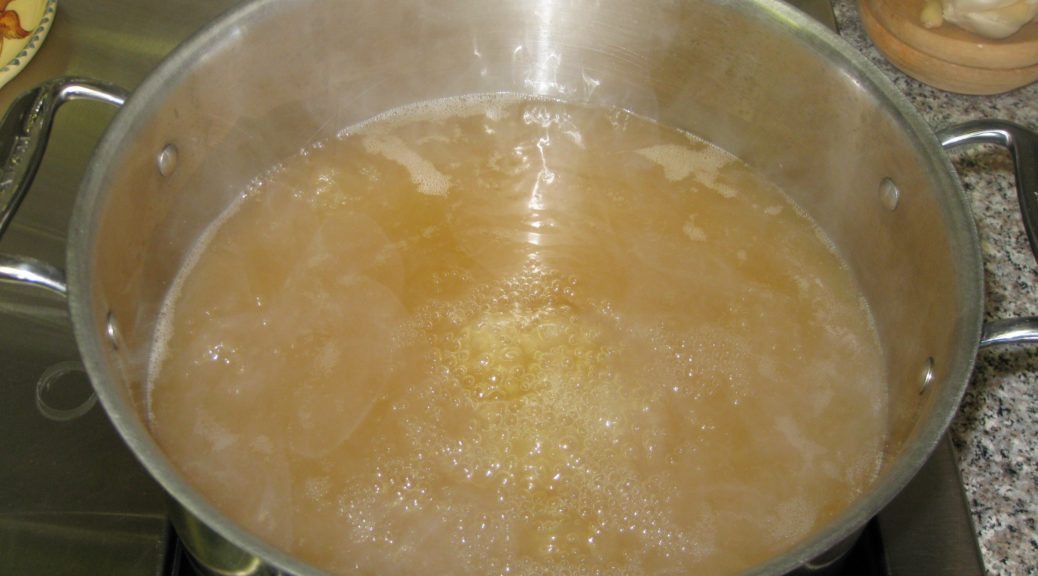
  1. Put 3 quarts of water and 1/3 cup salt in a 5 quart stockpot or Dutch oven. Bring to a boil over high heat.
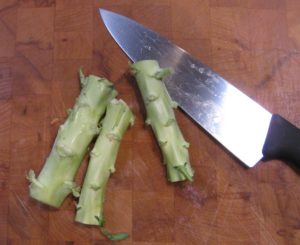
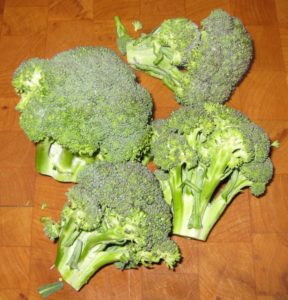
  2. Meanwhile, cut the thick stems off the broccoli just below where the stems start to branch into individual florets.
  3. Cut the individual florets off the broccoli by cutting lengthwise through the stalk from top to bottom.
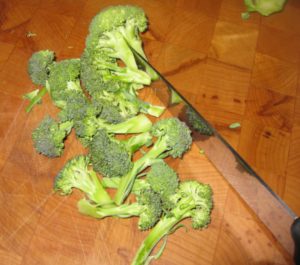
  4. Cut off any remaining stalk just below the floret. These tender stalks can be cut crosswise into one-half inch pieces and added to the florets.
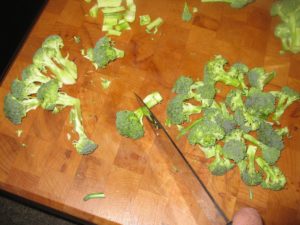
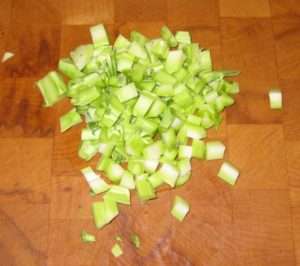
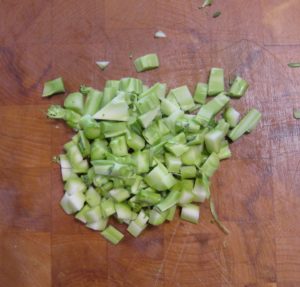
  5. You can use some of the thicker stalks as well, if you wish. To do so, use a vegetable peeler to remove the tough outer skin. Dice the peeled stems into 1/3 inch cubes. Reserve these diced stalks separately from the florets and diced tender stalks.
  6. When the salted water comes to a boil, add the diced, peeled stalks, if using. Return to a boil and cook for 2-3 minutes until they just begin to get tender. Using a spider or large slotted spoon, remove the stalks from the water and plunge them into a bowl of ice water to stop cooking. When cool, drain in a colander.
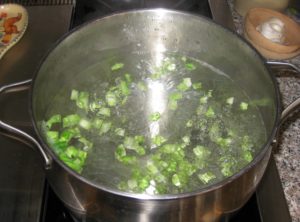
  7. Keep the water on low heat so you can return it to a boil quickly when needed to cook the pasta.
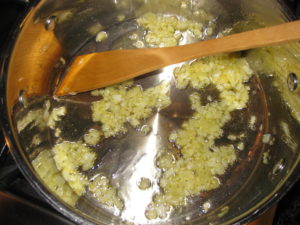
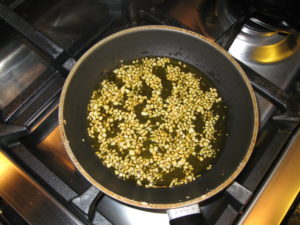
  8. In a heavy-bottomed pan large enough to hold the finished dish, sauté the garlic over medium high heat until it turns fragrant, about 30 seconds.
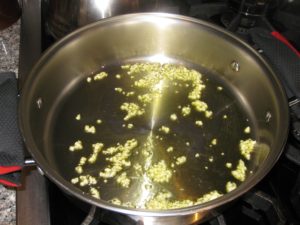
  9. Add the anchovies and their oil and continue to sauté, breaking up the anchovies till they turn to a paste.
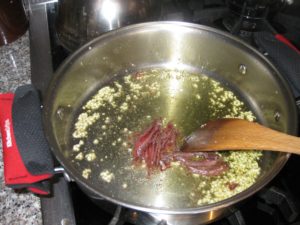
  10. Continue to cook until the anchovies darken slightly, about 1-2 minutes.
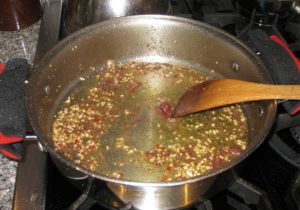
  11. Add the broccoli florets and diced tender stems. If using, add the partially cooked peeled stems. Season with salt and freshly ground black pepper.
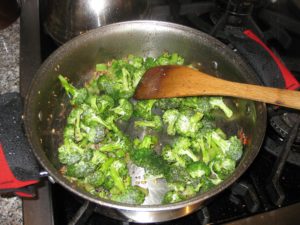
  12. Sauté on high heat, stirring very frequently, until some of the broccoli florets just begin to singe, about 5 minutes.
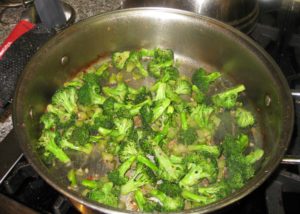
  13. Add the crushed red pepper. Stir to combine.
  14. Add the wine and cover with a tight fitting lid. Cook over medium high heat till the florets are cooked through but not mushy, shaking the pan occasionally.
  15. If all the wine evaporates before the broccoli is cooked, ladle in a bit of the pasta cooking liquid and continue.
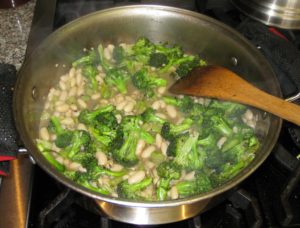
  16. When the broccoli is cooked, add the beans and their cooking liquid along with the oregano. Bring to a simmer over gentle heat.
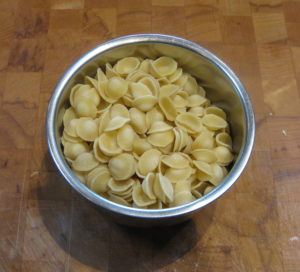
  17. Meanwhile, return the pasta-cooking water to a rolling boil and add the pasta. Cook until the pasta is slightly shy of al dente. The pasta will finish cooking in the sauce.
  18. Put about ¾ cup of pasta cooking liquid into the beans. Reserve another cup of the liquid.
  19. Quickly drain the pasta and add to the beans. Stir well. Bring to a gentle boil, uncovered. Cook stirring occasionally until the pasta is al dente. Add as much of the reserved pasta-cooking liquid as needed to have enough sauce to coat the pasta and broccoli.
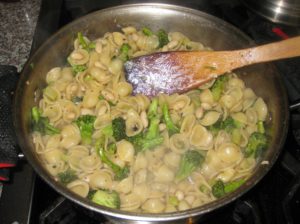
  20. The starch in the pasta-cooking liquid will add body to the sauce. One way to incorporate more of the pasta-cooking liquid is to cook the pasta over higher heat so that you can add, and boil off, more of the liquid, leaving the starch behind.
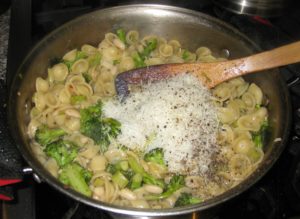
  21. When the pasta is cooked, remove the pan from the heat and stir in the Parmesan cheese and 1 teaspoon freshly ground black pepper. Taste and adjust salt after adding the cheese.
  22. Stir in the finishing extra-virgin olive oil. This will make the sauce glossy and add additional flavor.
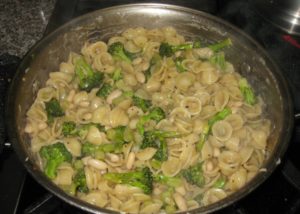
  23. The starch from the pasta water and bean-cooking liquid along with the cheese should create an emulsion with the oil. You may need to add more of the reserved pasta-cooking liquid to loosen the sauce.
  24. Serve immediately. Pass extra Parmesan cheese at the table.
Notes

Copyright © 2017 by VillaSentieri.com. All rights reserved.

Tried this recipe?

Let us know how it was!

Roasted Turkey Broth

May 5, 2017

I grew up in a house where there was absolutely no use for the carcass from a roasted turkey.  Other than my sister and I fighting over who got the crispy skin from the turkey breast, the skin went into the trash heap too.

You might imagine my surprise when, in college, I discovered that people actually did things with carcasses from roast turkey, like make broth to be used for turkey noodle soup.

To be sure, my recipe for turkey noodle soup will be posted later this month but in the meantime I would encourage you to make broth from the bones of most any roast, be it turkey, chicken, duck, pork, or beef.  Then, be creative with how to use it.

Broths made from roasted meat bones and bits of meat have a really savory quality that you won’t get from a broth made with uncooked meat.  You can’t always use them interchangeably so think about how the roasted-meat savoriness will play off the other flavors in the dish.

Roasted meat broths usually work well in hearty soups, for example, or as the liquid in a pot of Southwestern style cooked beans.  Frozen in small containers or ice cube trays, you can use the broth as the liquid for a quick pan sauce or to enrich gravy.

In fact, when I make gravy for Thanksgiving, I start by roasting a couple of Cornish game hens or a few pounds of chicken or turkey wings until they are very, very brown.  I use the roasted meat and some vegetables to make a rich, dark brown broth.  I concentrate the broth even more by boiling it down to about 3-4 cups.  While the turkey is roasting, I use the broth to make gravy, which I simmer for a couple of hours until it’s silky.  When the turkey is cooked, I deglaze the pan, skim the fat off, strain out the solids, and add the liquid to the gravy that has been bubbling away for a couple of hours.  By the time the turkey has rested and been carved, the gravy has reduced, again, to the right consistency.  The gravy is rich and savory and, more importantly, there’s enough to smother everyone’s mashed potatoes and turkey.  Doing it this way also removes the last-minute rush of actually making gravy on-the-spot from the pan drippings while you’re trying to get the meal on the table.
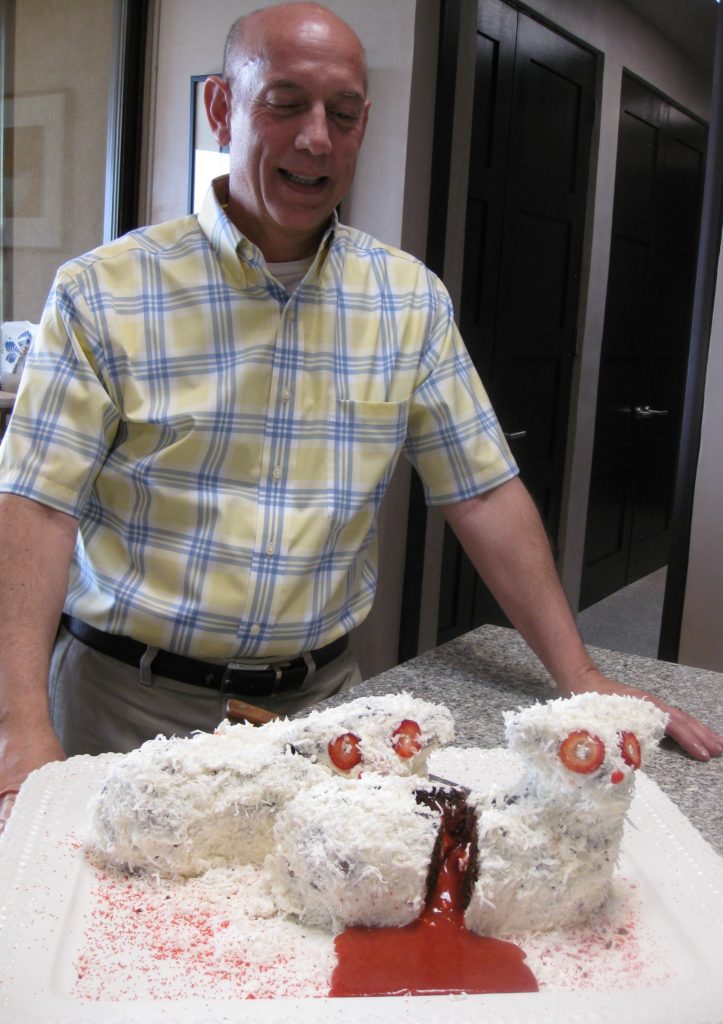
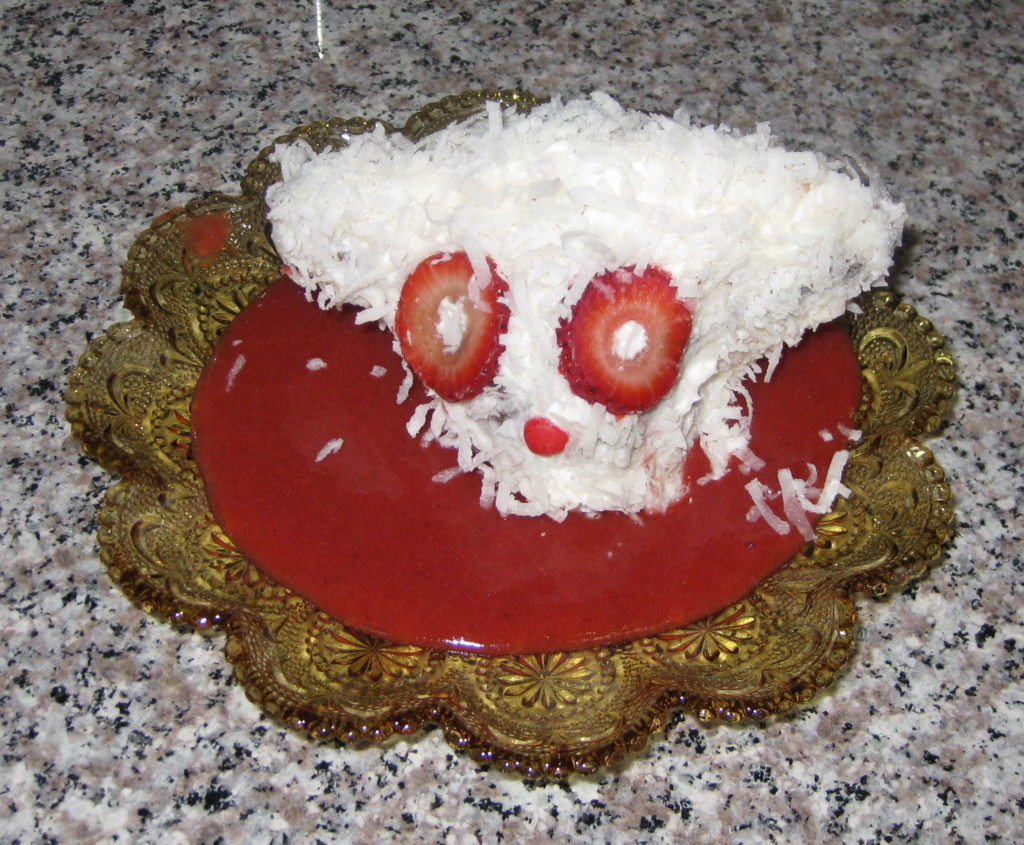
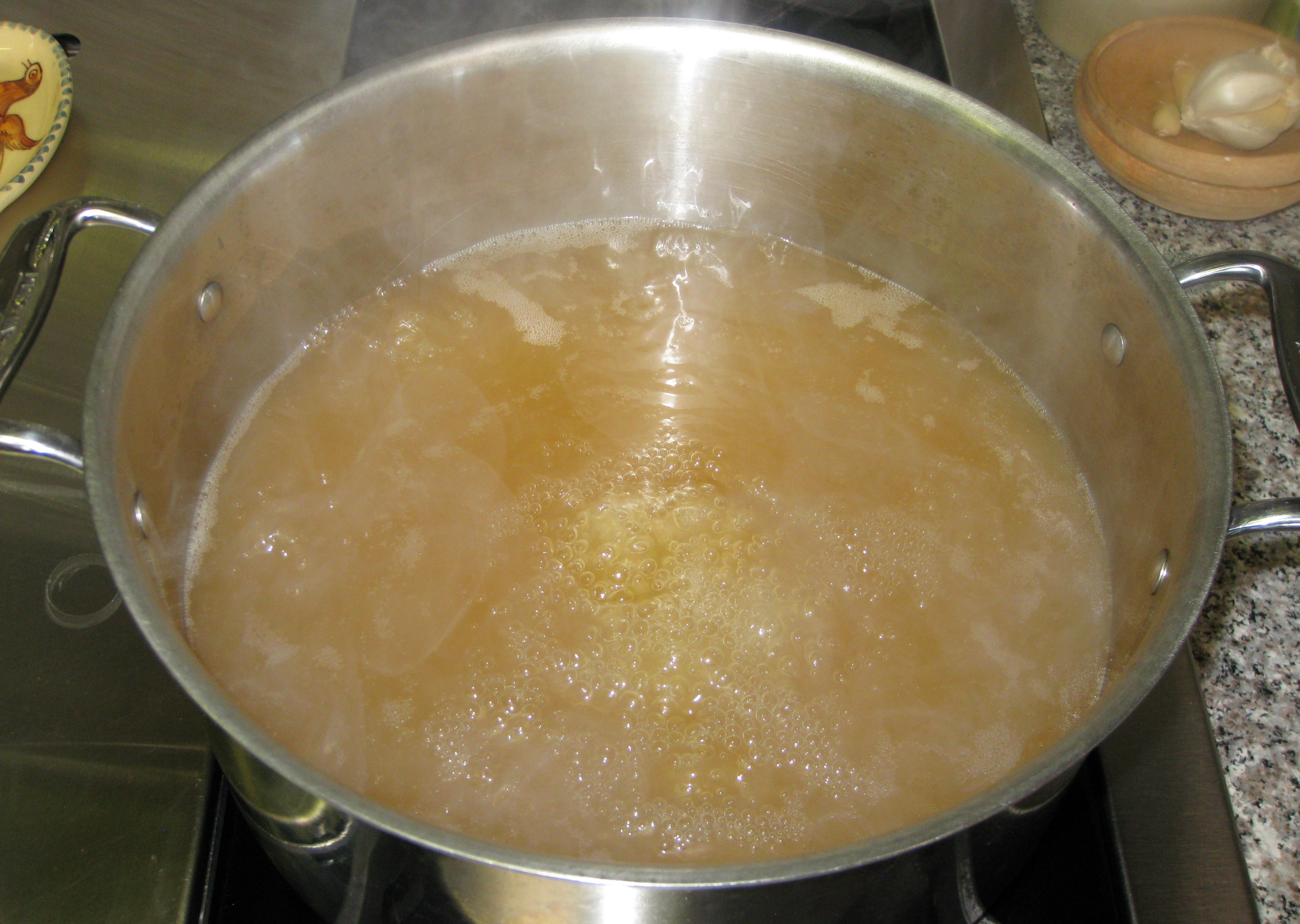
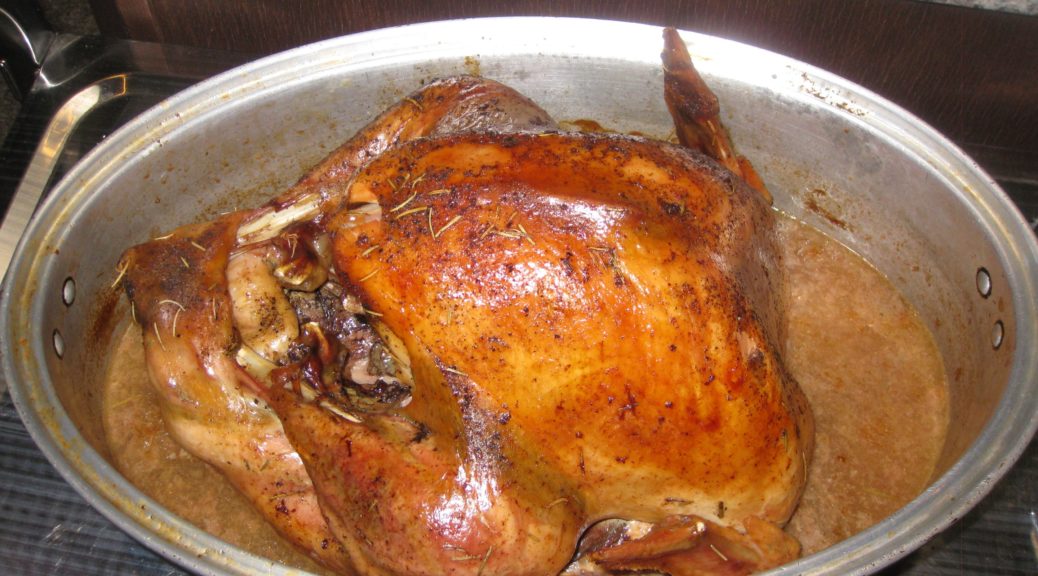
You might ask why I am dealing with a roasted turkey in spring rather than November.  Easter Dinner!  In addition to ham, I always make turkey since some of our friends don’t eat critters with more than two legs.  So, just for fun, here are a few pictures from Easter, complete with the bleeding lamb cake we always have for dessert.

I have a couple of different types of fat separators.  One is the more common style that resembles a small watering can with a spout that draws from the bottom of the liquid.  My preferred one, however, has an opening on the very bottom.  You just pour in the liquid, allow the fat to rise to the top, and squeeze the handle.  The opening opens and out pours the fat-free liquid from the bottom.  You can find a picture of it on my equipment page.

Roasted Turkey Broth

Unless I need an absolutely clear broth, I prefer to use the pressure cooker. It gets the job done in an hour of cooking and makes a more flavorful broth than simmering it on the stove. However, the broth is somewhat cloudy. If you don’t want to use a pressure cooker and you don’t want to have to think about a pot on the stove, make the broth in a slow-cooker for 6-8 hours. If your pressure cooker or slow-cooker won’t accommodate 3½ quarts of water, use as much as you can and then dilute the final product to 3 quarts.
Prep Time 15 minutes
Cook Time 5 hours
Total Time 9 hours 15 minutes
Servings: 3 quarts

Ingredients
  

  • 1 roast turkey carcass including bones, skin, and bits of meat
  • 3 celery stalks thinly sliced
  • 2-3 carrots thinly sliced
  • 1/2 medium onion sliced
  • 3 cloves garlic chopped
  • 6-8 parsley sprigs leaves only
  • 1 tablespoon tomato paste
  • 1/2 teaspoon whole black peppercorns
  • 1 whole clove
  • 3 1/2 quarts water

Method
 

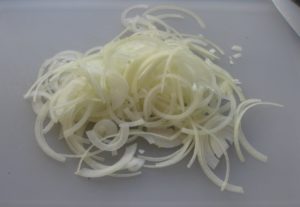
  1. Thinly slice the carrots, celery and onion.
  2. Combine all the ingredients in a stockpot.
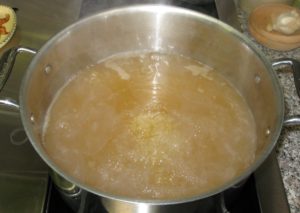
  3. Bring to a boil, reduce the heat, and simmer for 4-6 hours, stirring occasionally. Alternatively, cook at 10 pounds pressure for one hour or in a slow-cooker on low for 6-8 hours.
  4. Strain the broth.
  5. Because the broth will likely develop a gelatin-like quality on cooling, I suggest removing the fat using a fat separator while the broth is still warm.
  6. Add water to make three quarts.

Notes

I never add salt to any broth that I make unless I am making it for a specific purpose and I can plan for the final product. Broth with salt can make a dish too salty if the liquid needs to be reduced. The salt in a broth can also slow down the tenderization of dried beans. This might not be much of an issue at lower elevations but at 8000 feet getting dried beans to soften can be a challenge and anything that hinders the process is to be avoided.
Copyright © 2017 by VillaSentieri.com. All rights reserved.

Tried this recipe?

Let us know how it was!

Croquetas de Jamon (Cuban Ham Croquettes)

May 1, 2017

In early 2014, my husband and I were lucky enough to go to Cuba with two close friends.  This was prior to the loosening up of restrictions on travel by Americans to the island nation.

Because of the guidelines governing such travel, we had to spend a significant portion of our time interacting with Cubans, not being tourists.  We visited a schools for the arts and music, toured cultural sites, attended lectures, saw a cigar factory, and met with some Cubans in their homes, among other activities.

All of Cuba is divided up into small units that are under the watchful eye of a trusted local who reports any unusual activities to the authorities.  These units could be a section of a street, for example, or a multi-unit building.  What turned out to be one of the most memorable events was meeting with the residents of one such building one evening in Cienfuegos.

The children put on a small performance, we had refreshments, then spent several hours chatting with the building’s residents.  It seemed to us that everyone was quite open, talking about the challenges, as well as the benefits (such as free education and health care) of life in Cuba.  In fact, while it seems that most Cubans we met were in favor of a more open society they were understandably very protective of their access to education and health care.

One man, seemed particularly open about the difficulties of life in Cuba.  This was surprising to us as his wife was the designated party operative responsible for overseeing this particular building.  Our suspicions seemed to be confirmed when he disappeared into their apartment shortly before the evening ended after his wife gave him “the look.”  As our vehicle was pulling away from the building, he ran out and waved us good-bye.  Clearly he had been banished from the meeting but kept a watchful eye from his apartment, exiting at just the right moment.

In addition to spending the major portion of our trip interacting with Cubans we were prohibited from actually going to the beach!  This was supposed to be an educational and cultural interchange, not fun.

Even more interesting is that, at the time, Americans were prohibited from buying Cuban cigars and rum.  Mind you, I’m not talking about bringing these items back to the United States which was definitely forbidden, but buying and using them while in Cuba.

This would seem to be a singularly difficult rule to enforce and I can’t say that anybody paid particular attention to it.  One of our most pleasant experiences was sitting at a park on the waterfront in Cienfuegos sipping rum (from plastic cups) smoking cigars and watching the sun set.

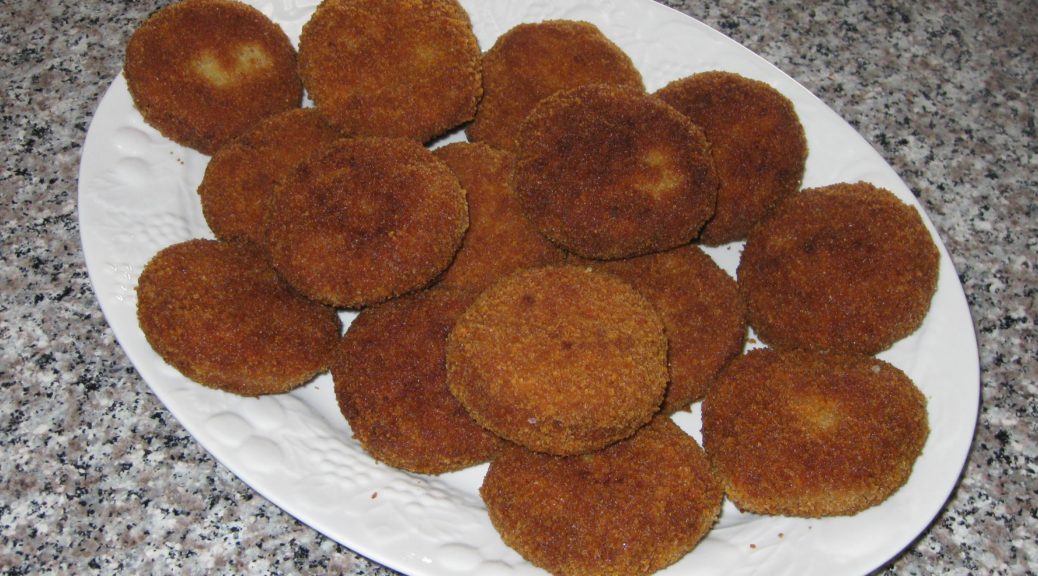
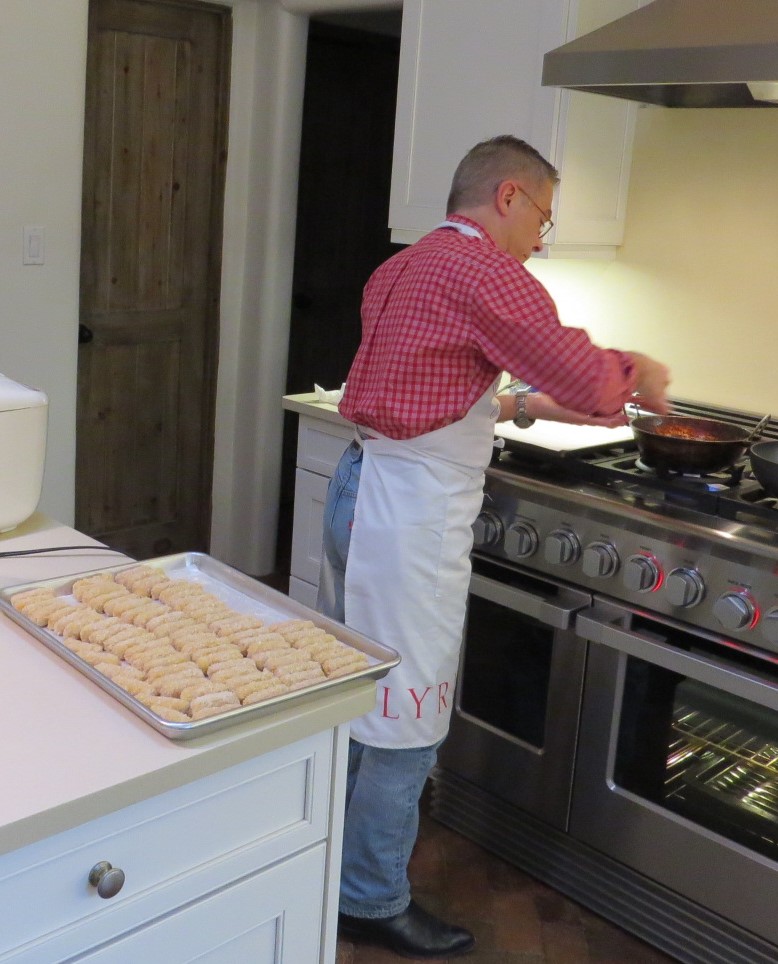
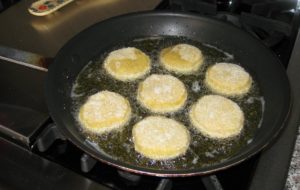
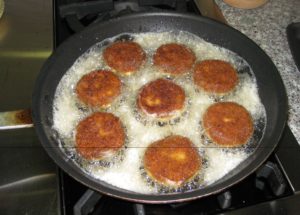
We ate a lot of croquetas in Cuba and drank a lot of rum punch, mojitos, and cariocas.  After we got back we pulled together a Cuban dinner with a few other friends.  I made the traditional finger-sized croquetas—seven dozen of them, actually!  Here is a picture of me frying them as well as a platter full of cooked ones along with some plantain chips and mojitos.

For this post, since I was cooking them as an entrée rather than as a nibble with cocktails, I made them larger.

Croquetas de Jamon (Cuban Ham Croquettes)

Instead of ham, croquetas can be made with cooked fish, salted cod, or potatoes among other ingredients. Cracker crumbs are the standard coating used in Cuba but fine dry breadcrumbs will work fine. I really like using plain panko crumbs whizzed in the food processor to finely pulverize them. They give an amazing crunch! If you are making these to serve as nibbles, you should get seven dozen. If you are making larger croquetas to serve as a main course, this recipe will make 16. Two or three of the larger croquetas will serve one person depending on what else is being served.
Prep Time 1 hour
Cook Time 20 minutes
Total Time 10 hours 20 minutes
Servings: 6 people

Ingredients
  

  • 1 pound cooked ham
  • 7 tablespoons butter
  • 1/4 cup minced onion
  • 3/4 cup all purpose flour
  • 1 cup whole milk
  • 1/2 teaspoon nutmeg freshly grated
  • 3-4 tablespoons minced parsley
  • salt to taste
  • black pepper freshly ground, to taste
  • 3 eggs
  • cracker crumbs for coating
  • corn oil for deep frying

Method
 

  1. If the ham was cooked with a sweet glaze, rinse the glaze off using warm water.
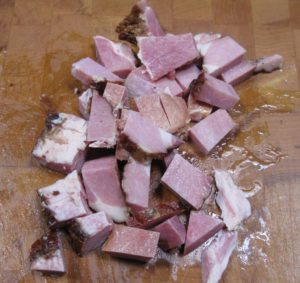
  2. Cut the ham into one-inch cubes.
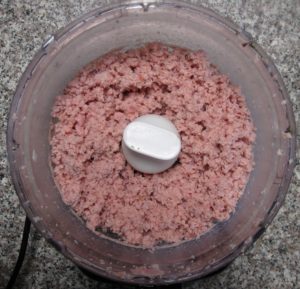
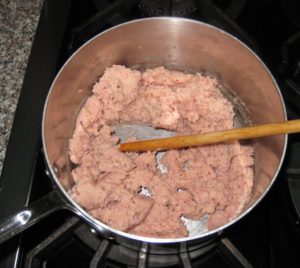
  3. Finely grind the ham in a food processor or meat grinder. Reserve the ground ham.
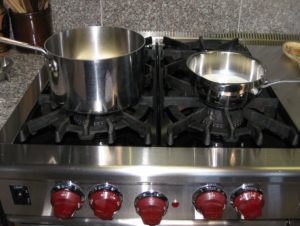
  4. Over medium heat, warm the milk in a small saucepan.
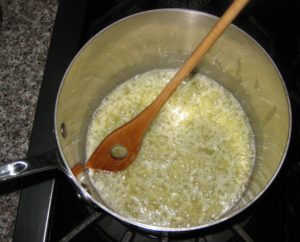
  5. Meanwhile, in a two-quart heavy bottomed pan, sauté the onion in butter on medium heat until soft, approximately 4-5 minutes.
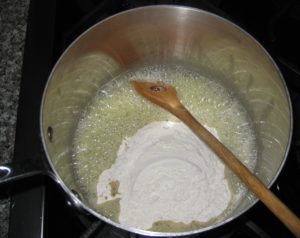
  6. Add the flour to the onion-butter mixture and cook for about two minutes, stirring constantly. Do not brown the flour.
  7. Note, the flour will appear golden from the combination of the butter and the onions.
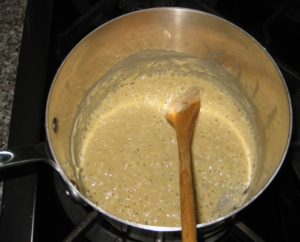
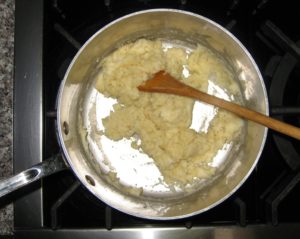
  8. Add about three tablespoons of the warm milk to the flour mixture. Stir well to fully incorporate. Continue adding about three tablespoons of warm milk at a time, stirring well after each addition, until all the milk has been incorporated. The mixture will form a rather heavy dough.
  9. Continue to cook the dough for 2-3 minutes, stirring constantly, without browning.
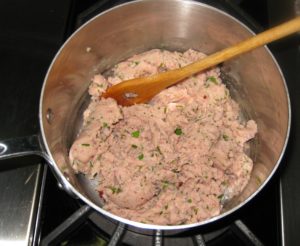
  10. Reduce the heat to low and stir in the ham. Keeping the mixture warm makes it much easier to blend the ham into the dough which would otherwise seize up with the addition of cold ham.
  11. Off the heat, stir in the nutmeg and parsley. Taste and adjust salt and pepper.
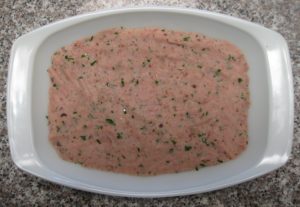
  12. Spread the mixture into a small oblong pan. Cool to room temperature uncovered.
  13. Cover and refrigerate until very cold, about six hours or overnight.
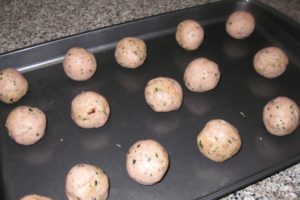
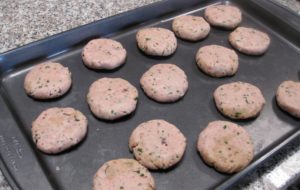
  14. Form the croquetas. If making small ones, roll portions of the dough into ½ inch diameter cylinders. Cut the cylinders into pieces about 2 inches long. If making larger croquetas, divide the mixture into 16 pieces. Roll each piece into a ball then flatten into a patty about ½ inch thick. Put the croquetas in a single layer on a cookie sheets. Refrigerate the croquetas until very cold.
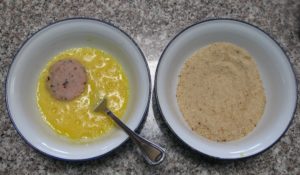
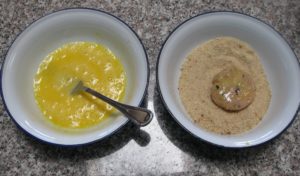
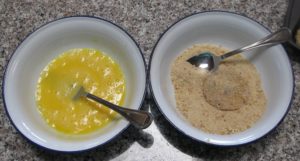
  15. To bread the croquetas, beat 3 eggs seasoned with ½ teaspoon of salt. Dip the croquettes in the beaten egg then roll in crumbs.
  16. Put the croquetas onto cookie sheets once again. Refrigerate until cold.
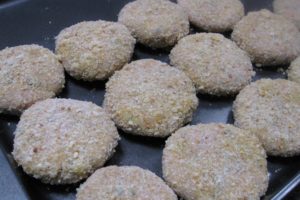
  17. Repeat the egg and crumb coating a second time. The second coating is necessary to get the traditional crunch. Refrigerate several hours or overnight.
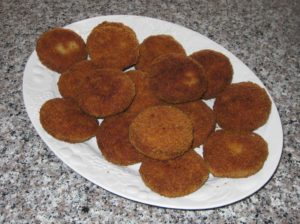
  18. Cook the croquetas in a deep fryer at 350°F until deep brown. Alternatively, put ½ inch of oil in a heavy bottomed frying pan. Bring the oil to 350°F. Fry the croquetas, turning once, until deeply browned. Drain briefly on absorbent paper. Keep the croquetas warm in a low oven until they are all fried.
  19. The croquetas ready to serve.

Notes

Copyright © 2017 by VillaSentieri.com. All rights reserved.

Tried this recipe?

Let us know how it was!

Slovak Caraway Soup

April 26, 2017

Growing up with an ethnically Italian mother and an ethnically Slovak father, we mostly ate Italian food with Slovak food appearing on the table every week or two.  On Sundays we usually went to visit my father’s parents and got a bit more Slovak food.

There were some classic American dishes that appeared on our table, too.  But, honestly, not that often.  The only thing my mother made that I didn’t like was hamburgers.  Well, that and liver.

But even my mother didn’t like liver.  She made it because my father liked it.  There was never the expectation that anyone else would eat it.

When she made liver…and that process involved running from the living room, through the dining room, to the kitchen to turn the liver as it sautéed and then running back to the living room to avoid the smell…she always made something else for the rest of us.  Well, that wasn’t so unusual either.  Remember…Southern Italian mother…food is important…everyone needs to eat.  There were nights when she would make one meal for my father, one for my sister, and one for me.  She would eat one of the three.

We always ate dinner together as a family and, despite the comment above, we usually at the same meal.  Sometimes, though, we each got individually catered food.

But back to hamburgers for a moment.  My mother was a great cook.  I know she used really good beef for her hamburgers.  She usually picked out a whole cut and had the butcher grind it.  She never bought ground beef that I recall.  I still follow the basic blueprint of her hamburger recipe today and enjoy it.  So, I can’t really tell you why I thought her hamburgers were awful.  But I did.

Soup was a big deal in our house.  My father really liked soup.  Interestingly, I don’t remember having Caraway Soup more than a few times while growing up.  I do know, however, that while I was in college I got the recipe from my mother after it appeared on our table one day.  It seemed like a revelation.

It has been a regular on my table ever since.

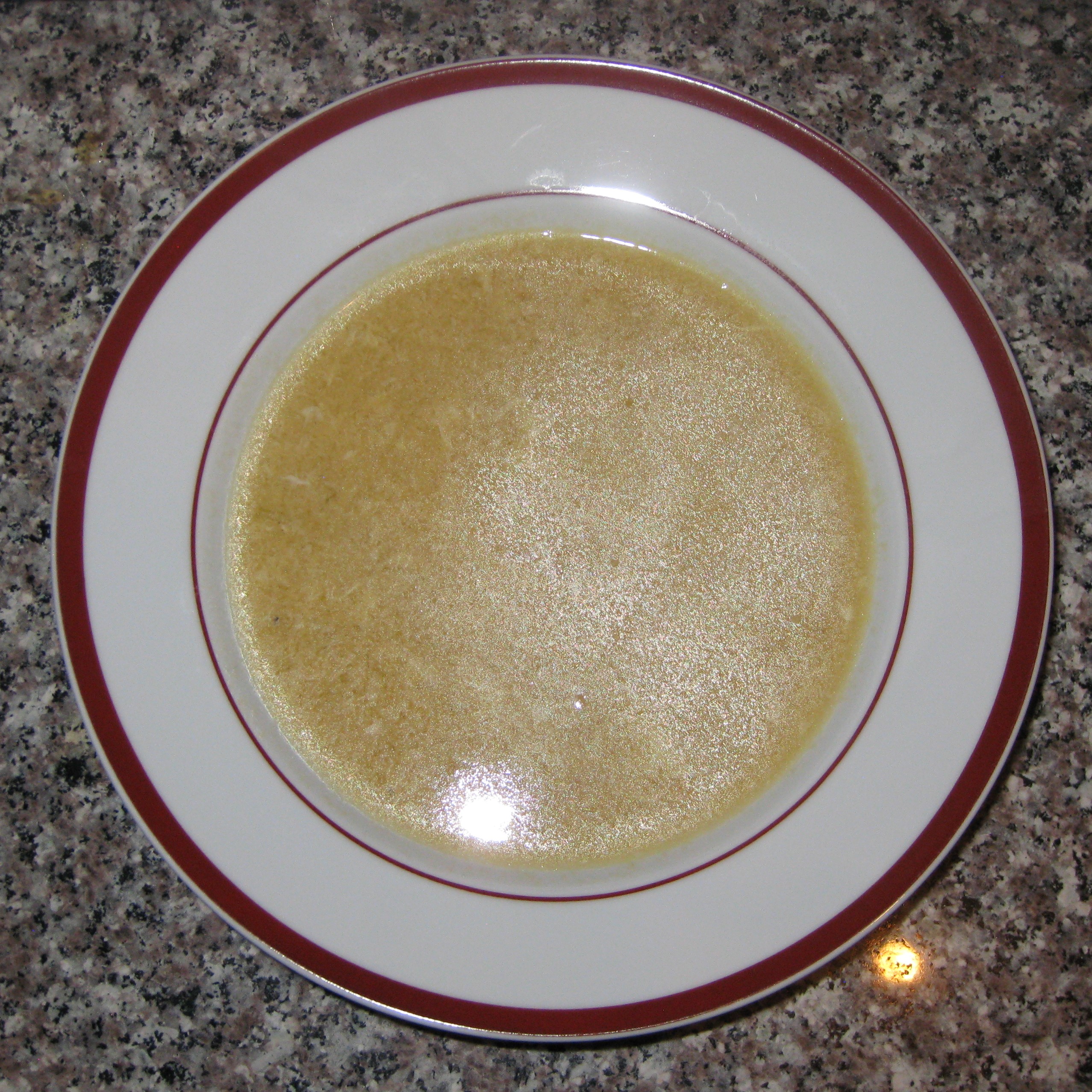
Slovak Caraway Soup

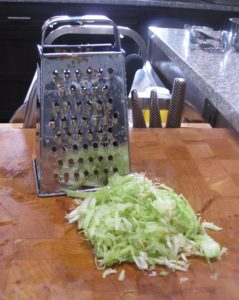
This is a light, refreshing soup based on a vegetable broth for which the ingredients are almost always on hand. I like serving it as a first course though it works equally well for lunch or as a light supper. Grating the vegetables on the large holes of a box grater was one of my mother’s tricks. It makes fast work of prep and the small pieces quickly flavor the broth.
Prep Time 15 minutes
Cook Time 1 hour
Total Time 2 hours
Servings: 6 people

Ingredients
  

  • 2-3 carrots
  • 3 stalks of celery
  • 1/2 onion
  • 2 teaspoons salt
  • 1/2 teaspoon Freshly ground black pepper
  • 2 quarts water
  • 1 tablespoon caraway seed
  • 2 tablespoons butter
  • 1/4 onion minced
  • 2 tablespoons flour
  • 2 eggs
  • 1/3 cup water
  • salt to taste
  • Freshly ground black pepper to taste

Method
 

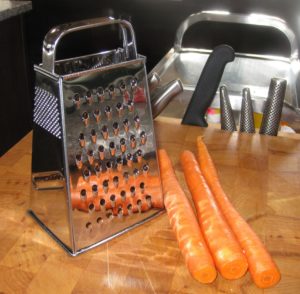
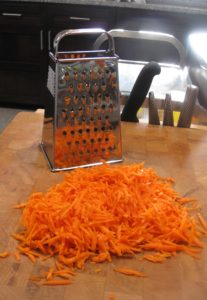
  1. Shred the carrots on the teardrop holes of a box grater.
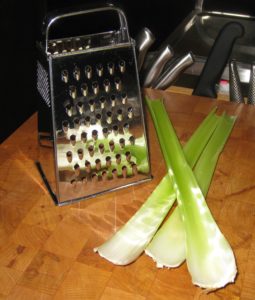
  2. Shred the celery on the teardrop holes of a box grater.
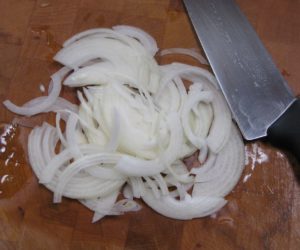
  3. Thinly slice half an onion.
  4. Combine carrots, celery, sliced onion, 2 teaspoons of salt, ½ teaspoon of black pepper and 2 quarts of water in a stock pot. Cover. Bring to a boil then reduce heat and simmer for 30 minutes.
  5. Add the caraway seeds. Cover and simmer another 25 minutes.
  6. Strain the broth. Discard the solids.
  7. Return the broth to the stock pot. The soup can be made several hours ahead to this point.
  8. When your ready to finish the soup, return the broth to a bare simmer.
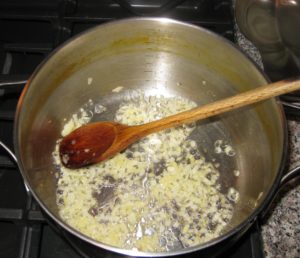
  9. In a heavy-bottomed stock pot large enough to hold the soup, sauté the minced onion in butter until soft but not brown, about 3-4 minutes.
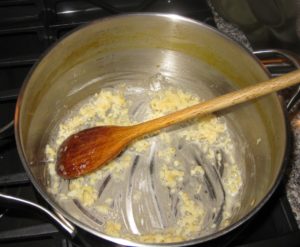
  10. Add the flour to the sautéed onions and cook until lightly colored, about 2 minutes, stirring almost constantly.
  11. Stir the hot broth into the onion-flour mixture a ladleful at a time, stirring well while adding the broth to avoid lumps.
  12. After about one-third of the broth has been added, the remainder can be added all at once.
  13. Bring to a boil and boil gently for 1-2 minutes to thicken. Adjust salt and pepper.
  14. While the soup is boiling, beat the eggs with 1/3 cup of water. Season the eggs with salt.
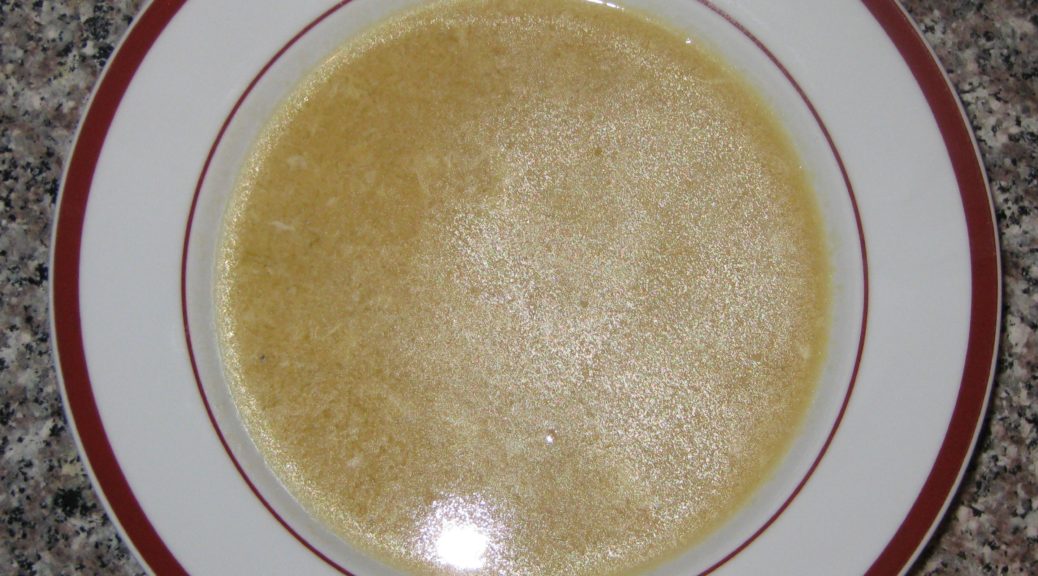
  15. While constantly whisking the stock, drizzle in the eggs to create shreds of egg.
  16. Serve immediately.

Notes

Copyright © 2017 by VillaSentieri.com. All rights reserved.

Tried this recipe?

Let us know how it was!

Italian Slow-Roasted Chicken or Turkey

April 21, 2017

For two countries that are geographically so close, Italy and France couldn’t be further apart on views of how to roast poultry.

The French typically roast quickly and at high temperature.

Italians are masters of the low and slow approach.

Italian roast chicken (or turkey, for that matter) literally falls apart.  The French version does not.  It’s a matter of style and technique, not quality or skill.

The usual style in the United States leans more toward France than Italy.  It’s the basis of the style of roasting described in most modern cookbooks and cooking magazines; higher temperatures rather than lower temperatures and yanking the bird out of the oven as soon as it reaches the minimum acceptable temperature to be “cooked” and “safe.”  Even when these magazines try to champion the approach of low and slow, they almost always miss the boat.  They miss the boat because they are still focused on the thermometer approach.

You can’t do low and slow if you’re focused on getting the bird out of the oven as soon as it hits the “safe” temperature.  Italian roast chicken is more like “pulled” chicken than the minimally cooked French version.  The whole mouthfeel is different.  So is the taste.

What I didn’t understand growing up is that my mother’s roast chicken and turkey drew from a broader Italian approach.

A few years ago we were in Tuscany having lunch with my husband’s Great Uncle Beppe and his family.

When the roast chicken was served, it was just like my mother’s!  Seasoned with garlic, rosemary, salt and pepper and roasted slowly, till it basically fell apart.

My mother’s mother came to the United States from Calabria around the turn of the 20th century at four years of age.  Here I was, nearly a century later in a province at the other end of the Italian peninsula eating chicken that could have been my mother’s, the way she learned it from her mother, who learned it from her mother.

I think that was a turning point for me in wanting to better understand Italian food traditions throughout the country and even throughout the Italian diaspora around the world.

Another amazing thing, when I think about it, is that my mother brined her chicken for an hour before cooking.  We’re talking the 1960’s here (probably the 1950’s too but I’m too young to remember that) way before brining was ever mentioned in cooking circles.  I can’t tell you why she did it or how it started but when I was learning to cook under her guidance, brining was always the first step for any recipe that included chicken.

Italian Slow-Roasted Chicken or Turkey

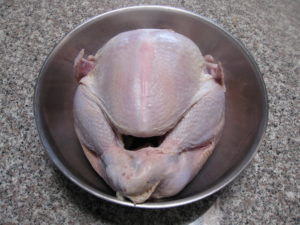
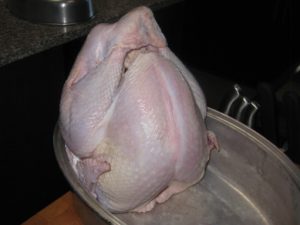
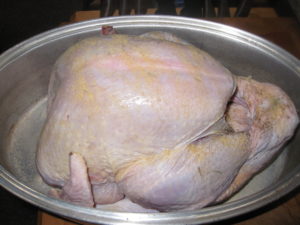
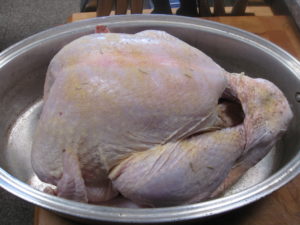
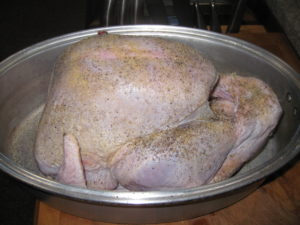
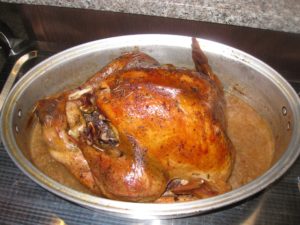
This is a no-recipe recipe. I never measure the seasonings. It’s really pretty hard to use an inappropriate amount. The cooking time is pretty forgiving, too. Until you get the hang of it, I suggest planning on the longer cooking time and the higher temperature. If the chicken or turkey is falling-apart tender before you’re ready for it, just reduce the oven to 150°F to keep the bird warm. My mother would usually brine the bird for about an hour before cooking. Time permitting, I do the same. This basic recipe works for everything from a three pound chicken to an 18 pound turkey. Just for a point of reference, the pictures feature a 12 pound turkey.
Prep Time 10 minutes
Cook Time 40 minutes
Total Time 50 minutes
Servings: 4 people

Ingredients
  

  • 1 roasting chicken or turkey
  • garlic powder
  • Freshly ground black pepper
  • dried rosemary or minced fresh rosemary
  • salt
  • 1/3 cup water sometimes I use white wine but mom never did

Method
 

  1. Brine the bird, if you like, for about an hour.
  2. Thoroughly rinse and dry the bird.
  3. Prop the bird with the cavity facing up. Generously season the inside of the bird with garlic powder, rosemary black pepper and salt. As a matter of habit, if I'm using dried rosemary, I always crust it with my fingers before sprinkling it on the bird.
  4. Put the bird in a roasting pan, breast up, preferably one able to hold the bird rather snugly. The roasting pan should have a tight-fitting cover.
  5. Generously season the outside of the bird with garlic powder, rosemary, black pepper and salt.
  6. Add water (or wine) to the bottom of the roasting pan not over the top of the bird. You don't want to displace the seasonings.
  7. Cover and roast at 350°F for 30 minutes. Reduce heat to 275°F to 300°F.
  8. After the first hour, baste the bird with the juices in the roasting pan about every 30-45 minutes. Be sure to tip the bird, or use a basting bulb, to remove the juices from the cavity and add them to the juices in the bottom of the roasting pan.
  9. Roast for a total of 30-40 minutes per pound (including the first half hour). The bird should just about be falling off the bone.
  10. If there is too much liquid in the bottom of the pan or if the bird is not brown enough, uncover the pan for the last 30 minutes or so.

Notes

Poultry cooked this way will not submit to carving in a photogenic Norman Rockwell manner. It’s just a different style. It would be like trying to cut delicate slices from pulled pork. It’s not going to happen. That said, the joints will usually separate easily and you can cut along the grain rather than against the grain to portion appropriate-sized pieces for serving.
Copyright © 2017 by VillaSentieri.com. All rights reserved.

Tried this recipe?

Let us know how it was!

Home-Rendered Lard

April 18, 2017

Blame Upton Sinclair and Crisco.

The quality of baked goods hasn’t been as good since we abandoned lard in a wholesale way in the early 20th century in favor of partially hydrogenated vegetable shortening, with Crisco being the most recognized brand.

And our health has been the worse for it.

Study after study has shown that partially hydrogenated vegetable shortening, because of trans-fats, creates more cardiovascular disease than the animal fats, like lard and butter, it was meant to replace.

Most vegetable shortening was reformulated in the first decade of the 21st century to reduce the amount of partially hydrogenated fat but this still has not resolved all the health-related concerns.  There are two main reasons.  Many products still contain some partially hydrogenated fat.  It’s just that if there is less than half a gram per “serving” the manufacturer can list the amount as zero on the label.  The other reason is that the fully hydrogenated fats that have replaced most of the partially hydrogenated fats have been shown to alter metabolism in unpredictable ways.  It will likely take us decades to determine their true health consequences.

Several years ago I took a weeklong course at the Culinary Institute of America at Greystone in St. Helena, California.  Called “Healthy Kitchens, Healthy Lives” it was sponsored by Harvard University and the Culinary Institute of America.  It was a week of hands-on cooking, cooking demonstrations, and lectures aimed at health care professionals.  A major take-away point for me was one of the Harvard faculty emphasizing that there was “zero tolerance” for trans-fats.  It was as clear a statement on the issue as I had ever heard.

My solution (and it’s been my solution since the early 1980’s when there were enough studies about the effects of partially hydrogenated fats to convince me) is to only use either vegetable oils and fats, like olive oil, corn oil, canola oil or coconut oil, among others, or animal fats, like lard and butter.

I also try to maintain fidelity to the types of fats and oils that would be used traditionally in a given cuisine.  Thus, while I cook with coconut oil when making Indonesian food, for example, I won’t use it when I’m cooking Italian food.  For the same reason, I won’t use olive oil when I’m cooking Sri Lankan food.

As a youngster, I remember looking at a lot of hand-written recipes.  It was amazing to me to see how Crisco (and it really was Crisco at the time) came to replace what would obviously have been lard in a more traditional version of the recipe.  This is true for Totos, the Italian Chocolate Spice Cookies that were the subject of one of my first blog posts.

If I’ve convinced you that you don’t want to use solid vegetable shortening and you really want to try lard, you might ask why I’m suggesting that you render it rather than just buy lard from the supermarket.

Have you looked at the label of a block or tub of lard at the supermarket lately?

Well, it’s not just pure old lard any longer.  It’s lard and…you guessed it…hydrogenated lard!  There are also a number of preservatives thrown in for “good measure.”

You can, however, buy artisanal lard that only contains pure, rendered lard.  You may have a difficult time finding these products depending on where you live.  You’ll also pay dearly for them; something in the range of $20 to $24 per pound!

So, while I didn’t make a big deal out of the lard called for in my post on Totos, I’m suggesting now that you may want to render your own lard as a replacement for the solid vegetable shortening you’re currently using (both for your health and for the quality of your food) and because I will be posting a number of recipes where lard will be a key ingredient in the coming months.

I understand that rendering your own lard isn’t sexy.  Nobody is going to wax poetic about food containing lard the way they might for the perfect long-simmered Southern Italian ragu.  But it’s really not that difficult or time-consuming and having the best ingredients, not just the most convenient, will “up” your cooking game!

I started rendering lard for cooking my junior year in college.  (Kind of geeky, I know.)  I used it with abandon.  I had fried foods several times per week and every now and then I would make a complete meal of fried foods, what Italians call Frito Misto.

Unfortunately, I now accumulate extra weight in a way I didn’t in college.  So, I eat less fried food but when I do, I want it to taste great.  For that, there’s always lard.

Home-Rendered Lard

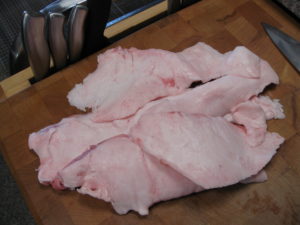
Leaf fat is the best for rendering into lard but can be difficult to obtain. The next best is fatback. I’m lucky enough that I can buy good-quality pork fat from my local supermarket but I don’t really get to specify leaf fat versus fatback. However, an easy rule of thumb is, the firmer the fat, the better the lard. Don’t use soft caul fat for rendering lard. You want firm pieces of fat. Starting with some water in the pan allows the fat to begin to render without risk of browning. Rendering lard can take a few hours but it is mostly hands-off and yields a product that is superior to what is commercially available in supermarkets.
Prep Time 20 minutes
Cook Time 3 hours
Total Time 5 hours 20 minutes

Ingredients
  

  • 3-4 lbs pork fat
  • 1/4 cup water

Method
 

  1. Remove any meat that is clinging to the fat as well as any discolored areas of fat.
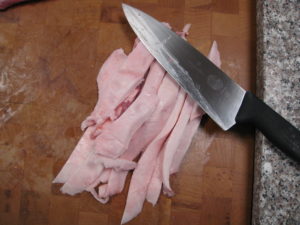
  2. Cut the fat into long strips approximately ½ inch wide.
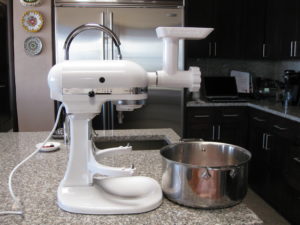
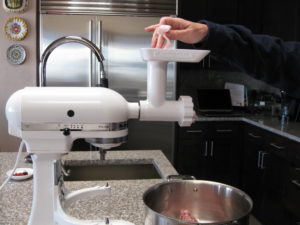
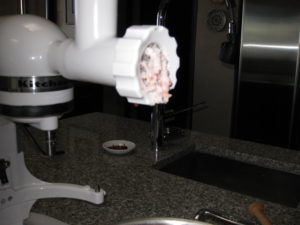
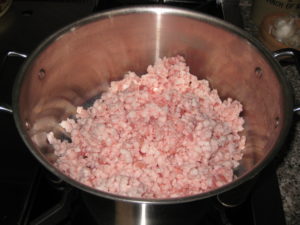
  3. Run the strips of fat through a meat grinder. If you don’t have a meat grinder, you can chop the fat by hand but this is very tedious.
  4. Put the ground fat and water into a heavy-bottomed pot.
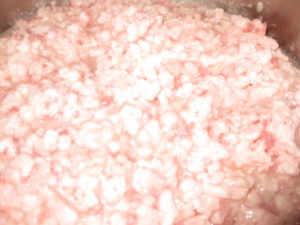
  5. Cover the pot. Heat on low till some of the fat begins to render.
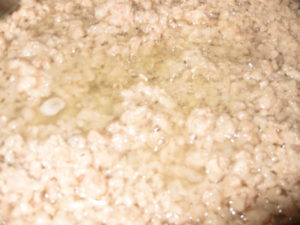
  6. Uncover the pot. Increase the heat to medium-low and cook, uncovered, stirring every 20 minutes or so until the fat is mostly rendered and the remaining bits of unrendered fat are just beginning to turn golden. This can take 2-3 hours.
  7. For the best quality pure white lard, do not brown any of the “cracklings” though a slight golden color is fine.
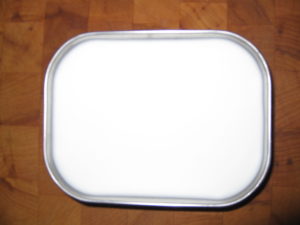
  8. Strain the lard into a metal container while still hot. Allow to cool uncovered then cover tightly and refrigerate.
  9. Lard will keep a very, very long time in the refrigerator.

Notes

Copyright © 2017 by VillaSentieri.com. All rights reserved.

Tried this recipe?

Let us know how it was!

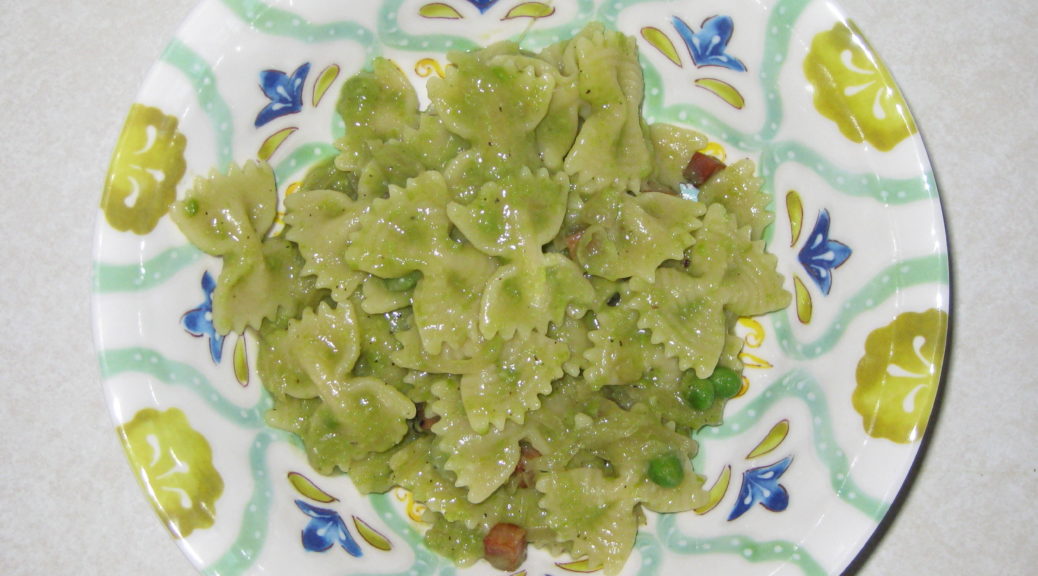
Farfalle con Salsa di Piselli (Bowtie Pasta with Peas)

April 13, 2017

I’ve been silent for a while.  It wasn’t planned or anticipated.  Life just got in the way.  Mostly it was good stuff, though.  For example…

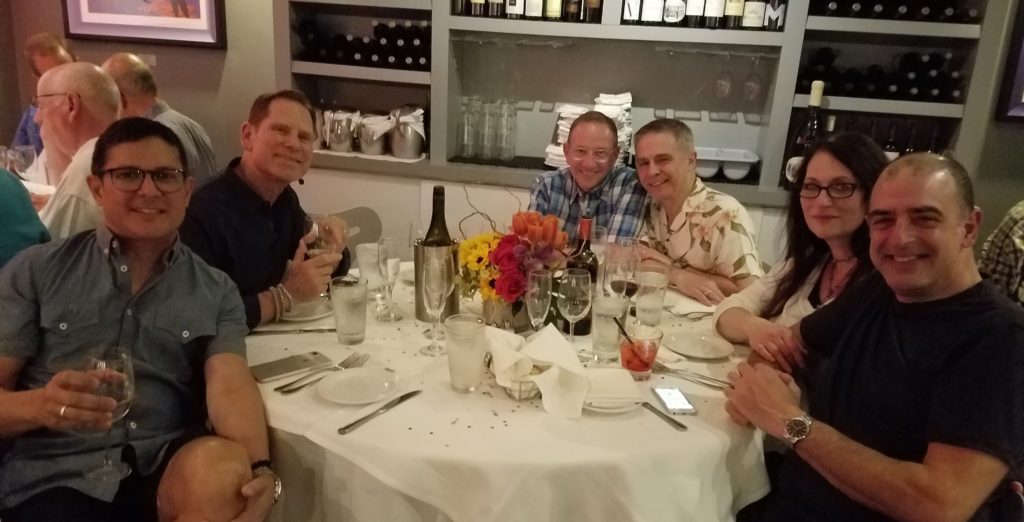
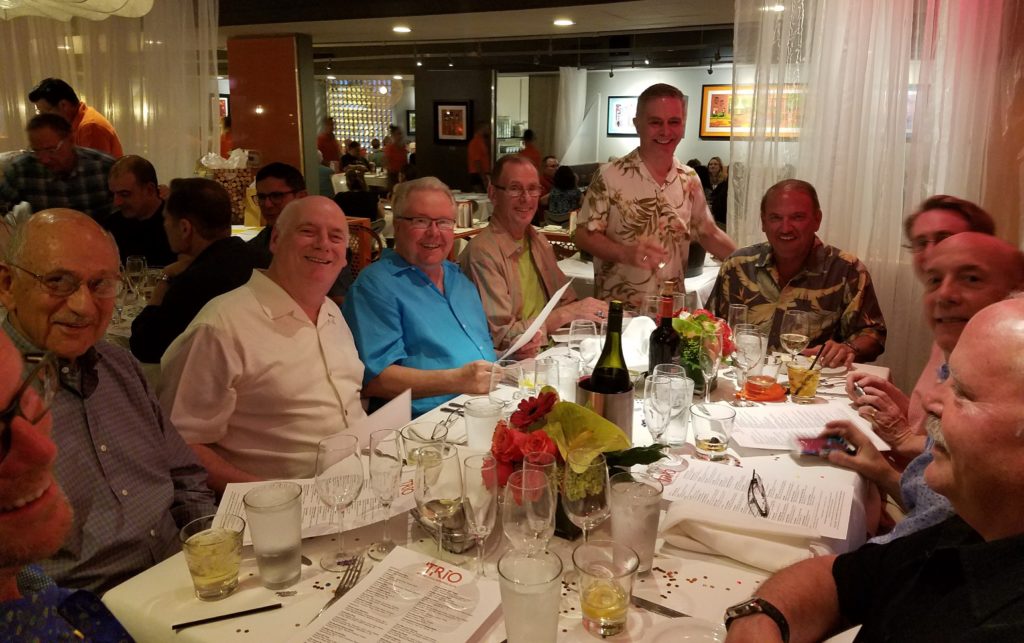
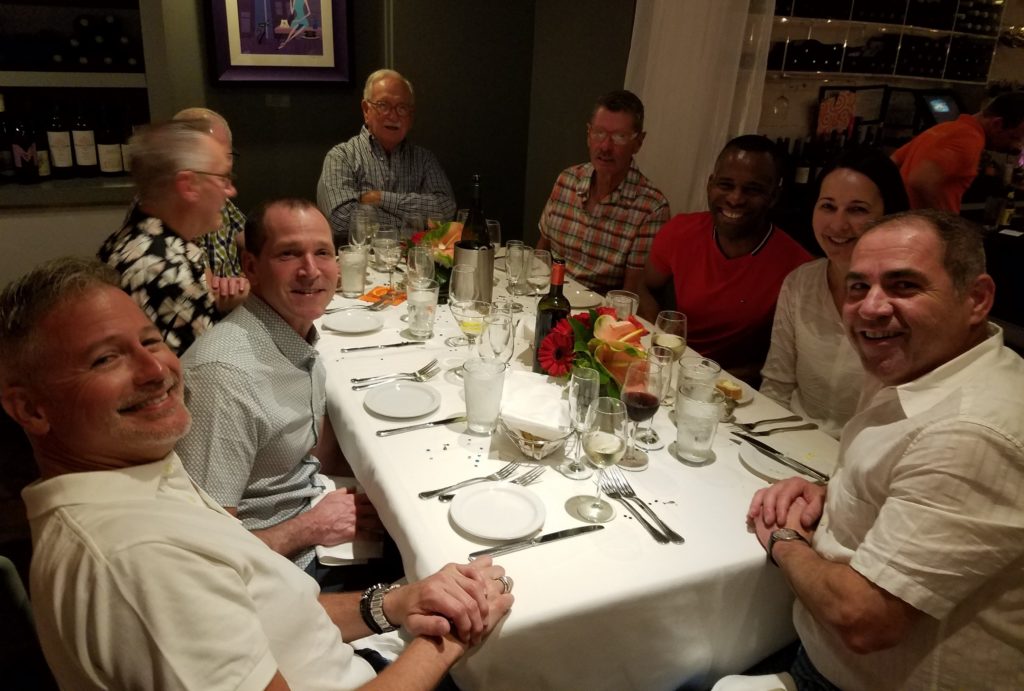
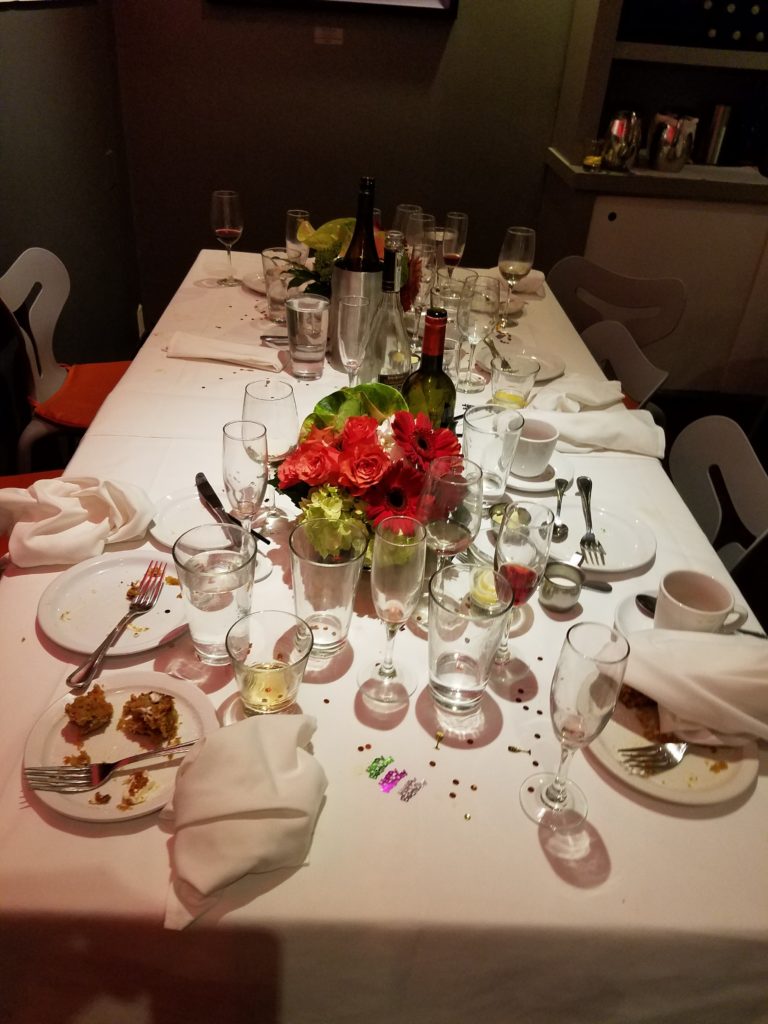
My husband’s birthday…a momentous one that ends in a zero…held at Trio Restaurant in Palm Springs.

A wedding (complete with a photo shoot using vintage hats!)  Congratulations Suzanne and Bob!!

A visit to the Trinity Site on one of the two days per year that it is open to the public.

Cooking at Palm Desert Food and Wine Festival.  Yep!  I got to cook at the Palm Desert Food and Wine Festival!!

That was a hoot!

The main events of the food and wine festival are held in a series of large tents on the top of a parking garage in Palm Desert.  The festival starts off on Friday with a multi-course, wine-paired James Beard Luncheon prepared by celebrity chefs.  The festival continues on Saturday and Sunday with The Grand Tasting and Chef Demonstrations.  There are other related events, such as special dinners, in the area, too.

There are three tents devoted to chef demonstrations.  Each demonstration runs for about an hour.  One demonstration per hour in each of three tents for two days is a lot of demonstrations.

Local chefs bring their own ingredients for their demonstrations and also prepare samples of the finished dish for about 100 audience participants.  Mostly what the local chefs really bring is their restaurant kitchen staff to do the work.

Celebrity Chefs have a whole different deal.  They submit their recipes.  The ingredients get purchased.  The commercial kitchen, set up in a tent on top of the parking garage, preps all the ingredients for their demonstrations and also prepares between 75 and 175 portions of the dish to be distributed to the audience.

I got to prepare food for The Beekman Boys, Stuart O’Keeffe, Zac Young, and Aarti Sequeira, among others.  The Beekman Boys, Josh and Brent, were gracious enough to come into the kitchen and chat with me during their Facebook Live post!  The post is below.

https://www.facebook.com/FabulousBeekmanBoys/videos/10155167453464283/


So, while I wasn’t posting recipes, for which I apologize, I was further pursuing my cooking goals.

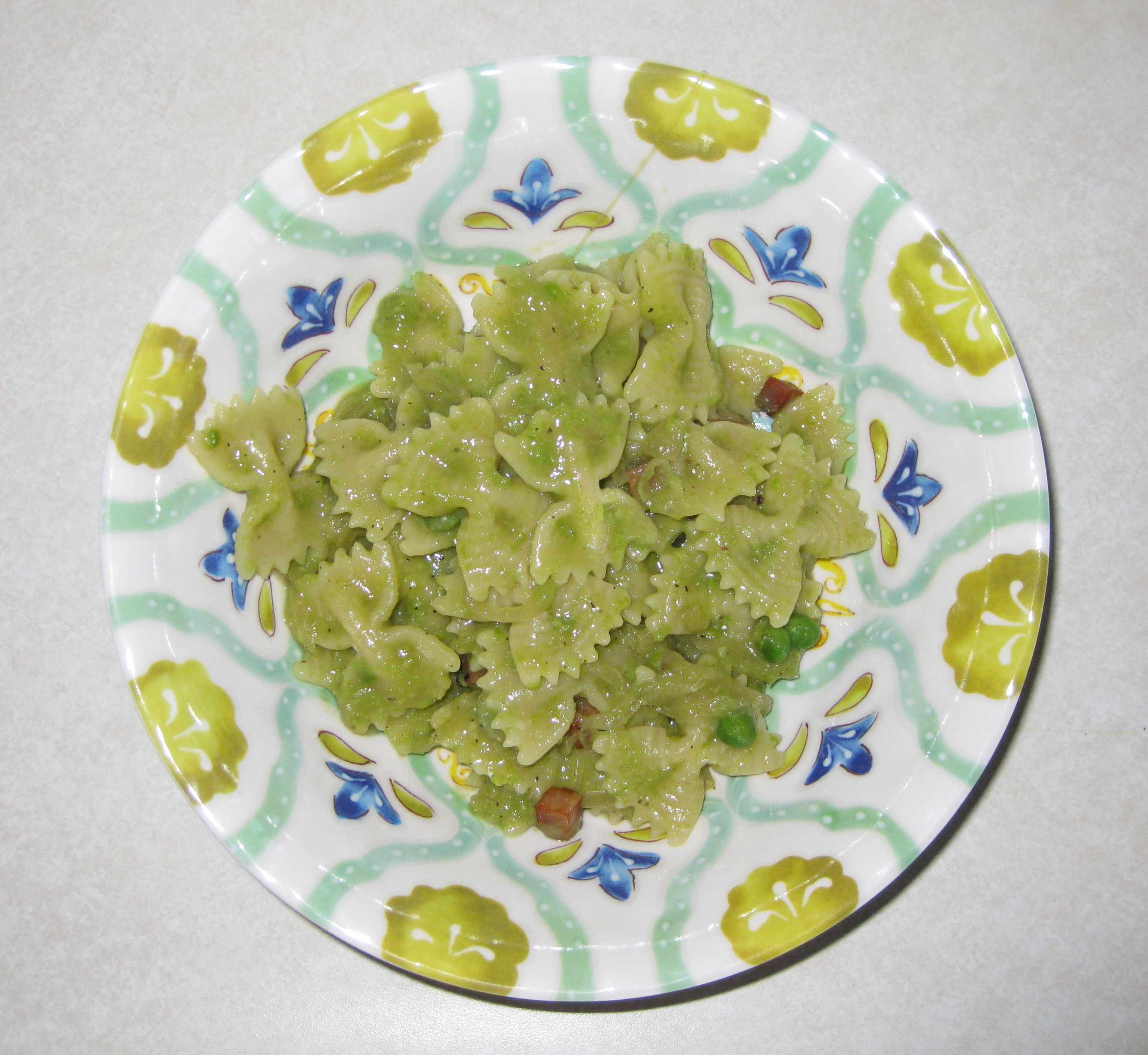
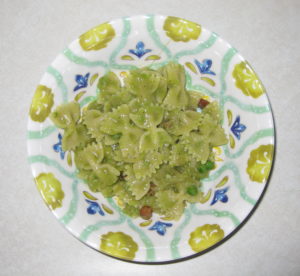
After being in Palm Desert, where it was definitely spring, and returning to Santa Fe where it was definitely winter, I felt the need for something spring-like.  This pasta, with a sauce of spring-like peas, was exactly the thing!  Unless you have absolutely glorious peas from a local farmers’ market, I suggest using frozen peas.  This is exactly what I did to create a taste of spring in the Santa Fe winter!

Farfalle con Salsa di Piselli (Bowtie Pasta with Peas)

If you have access to fresh peas from a farmers’ market please give them a try. If not, frozen peas work well. I’ve never had good luck with the “fresh” shelled peas in the supermarket. They always seem too starchy, and sometimes even musty tasting. Each pound of peas in the pod yields about 1 cup of shelled peas. For the 2 ¼ cups of peas needed for this recipe, I’d start with at least 2 ¼ pounds of peas in the pod. The vermouth adds an herbal quality and its slight bitterness balances the sweetness of the peas.
Prep Time 30 minutes
Cook Time 30 minutes
Total Time 1 hour
Servings: 6 people

Ingredients
  

  • 2 1/4 cups shelled peas fresh or frozen
  • 2/3 cup water
  • 2-3 sprigs thyme use leaves only or use 1/8 teaspoon dry thyme
  • 2 ounces pancetta
  • 1 medium onion
  • 1/2 cup dry vermouth
  • 2 tablespoons butter
  • 1/2 cup grated Parmesan cheese
  • salt and freshly ground black pepper to taste
  • 1 lb short flat pasta such as farfalle or broken up lasagne
  • 2-3 tablespoons fruity extra virgin olive oil optional

Method
 

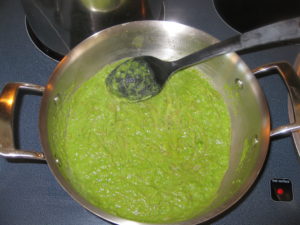
  1. Combine the peas, thyme and water. Season with salt. Bring to a boil. If you are using frozen peas remove from the heat as soon as the water comes to a boil and continue with the next step. If you are using fresh peas, cook until the skins pop when bitten into and the peas are just cooked. This will take just a few minutes. The time is dependent on the peas so you’ll have to taste a pea about every 30 seconds so that you don’t overcook them.
  2. Remove ½ cup of the cooked peas from the cooking liquid. Rinse the peas under cool water to stop the cooking. Reserve the peas.
  3. Puree the remaining peas with the cooking liquid in a blender. Reserve the pea puree.
  4. Cut the pancetta into ¼ inch dice.
  5. In a wide, heavy-bottomed pan large enough to hold the cooked pasta comfortably, cook the pancetta over medium-low heat until crisp and brown. If the oil from the pancetta starts to smoke reduce the heat and add a tablespoon of water to quickly lower the temperature. It is important to brown the pancetta well, and to create browned bits in the bottom of the pan (without burning) to build flavor for the sauce.
  6. Remove the pancetta and reserve.
  7. Thinly slice the onion.
  8. Add the butter to the pan you just used to cook the pancetta. leaving in the rendered fat and browned bits. As soon as the butter melts, add the thinly-sliced onion and sauté until the onion is soft and golden brown.
  9. Add the vermouth to the sautéed onions. (Note, the recipe can be prepared several hours in advance up to this point. If doing so, as soon as you add the vermouth, remove the pan from the heat and cover tightly.)
  10. Bring the onion-vermouth mixture to a boil and boil rapidly until the vermouth has evaporated.
  11. Add the pureed peas, reduce heat to low, and gently warm the onion-pea puree mixture.
  12. Meanwhile cook the pasta in three quarts of heavily-salted, rapidly-boiling water. When the pasta is al dente, remove one cup of the cooking liquid and reserve.
  13. Drain the pasta and immediately add it to the warm onion-pea puree mixture.
  14. Increase heat to medium. Add the whole cooked peas, the pancetta, freshly ground black pepper to taste, and enough of the reserved pasta cooking liquid to make a sauce that just clings to the pasta. Cook for a minute or two to allow the sauce to bubble and thicken, stirring occasionally. Add more pasta cooking liquid as needed.
  15. Off the heat, add the Parmesan cheese. Stir well. Add a bit more pasta cooking water if the sauce becomes too thick after adding the Parmesan cheese.
  16. Add the fruity extra virgin olive oil, if using. Stir. Taste and adjust salt and pepper, if necessary.

Notes

Browning the pancetta and onions is critical to building flavor for the sauce.  It is better to use low heat than heat that is too high.  The starch in the pasta-cooking liquid helps to add body to the sauce.
Copyright © 2017 by VillaSentieri.com. All rights reserved.

Tried this recipe?

Let us know how it was!

Limoncello (Italian Lemon Liqueur)

March 13, 2017

I love mead, more so dry mead than sweet mead.  I first tasted mead at the age of 19 when my college roommate, Ray Hugh, and I visited his mother outside of London one summer.  For some reason, I never had it again but the experience stuck with me.  (I know you’re wondering how this is going to get around to Limoncello but read on!)

Fast forward to the late 1990’s when my husband began making wine at home.  We didn’t have a proper wine cellar at the time, though we ultimately built a temperature controlled wine cellar in the basement of the coach house at our estate on Oakdale Avenue in Chicago…right below the gear works that were once used to rotate the horse-drawn carriages on the floor above.

This is what the coach house looked like when we owned the property on Oakdale Avenue.

We had a whole row of five gallon carboys of grape juice bubbling away through air locks in our family room.  The wooden floors became stained purple.  Luckily we were planning on remodeling the room and tearing up the floor so it didn’t matter much.

The wine was surprisingly good.  We had both red and white.  We made labels for our “Rohkam House” wines that portrayed a picture of the house as it looked in the late 1880’s.  You can find that picture in a previous post.

After a few successes with wine, I asked Frank to make mead.  He settled on a recipe he fancied, though it was not entirely a traditional northern European mead.  It contained honey, of course, but the recipe specifically called for orange blossom honey which obviously has no connection to northern Europe.  The recipe also required some freshly squeezed orange juice instead of just water.  I was a bit skeptical about the non-traditional ingredients but…hey…I was finally getting my mead after all these years.

I found a beekeeper in Florida who would sell me five pounds of orange blossom honey from his own bees.  I ordered five pounds of honey.  I got fifty pounds sent overnight delivery!

It turns out that Muriel, the beekeeper, got two orders at the same time.  My order was for five pounds sent by UPS ground.  Someone else ordered 50 pounds sent express.  Muriel got the orders confused and we suddenly were in the business of making ten times as much mead as we had planned.

That also meant we needed ten time the number of oranges we had planned on to get enough juice.  I couldn’t bear to let those orange peels go to waste so I took out the recipe for limoncello that I got from relatives in Tuscany on our visit a couple of years earlier and decided to make it with orange zest instead of lemon zest.

I dubbed it arancello, using the Italian word for orange in the same way the Italian word for lemon is used to make the word limoncello.

I ultimately served it to friends and family visiting from Europe.  I explained what I had done to make it.  Not one of them had ever heard of anything like it but it was a hit.

Fast forward a decade or two and arancello started to be imported from Italy (often called orancello or orangecello).  While I can’t claim to have invented arancello, I am pretty sure it was not a common product when I got the idea to repurpose the family recipe for limoncello.

Oh, and that mead…it was pretty darn good.  We served it for many dinner parties in place of white wine.  Everyone thought it was wine.  It had that haunting floral quality so like a good Viognier.  Now that we have orange trees outside our door in Palm Springs maybe we can dig up that mead recipe again and make arancello as a buyproduct!

Limoncello (Italian Lemon Liqueur)

While you will find recipes for Limoncello made with vodka, using higher proof alcohol yields a more consistent extraction of the flavor compounds. The higher the proof, the better. However, 190 proof alcohol is not available everywhere so I’ve adjusted this recipe to use 151 proof alcohol. The original recipe, which came from family in Tuscany, called for less than half the amount of lemon zest I've used here. Over successive versions for over the last 2 decades, I find I like these proportions best. Lemoncello does not keep indefinitely. It is best to use this within a year. Use the freshest lemons you can find for the most flavorful limoncello.
Prep Time 1 hour 15 minutes
Total Time 1 hour 26 minutes
Servings: 2 liters

Ingredients
  

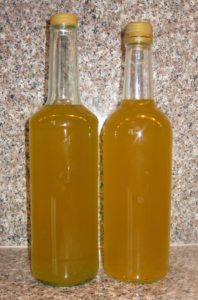
  • 375 g lemon zest from approximately 27-30 large lemons
  • 750 ml 151 proof grain alcohol such as Everclear
  • 750 ml water
  • 675 g sugar

Method
 

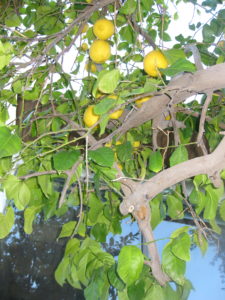
  1. The starting point: lemons in the tree in Palm Springs.
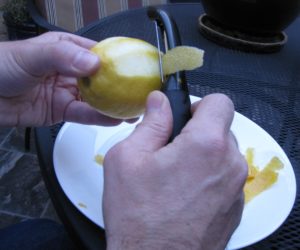
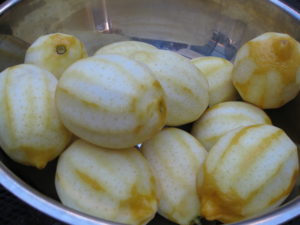
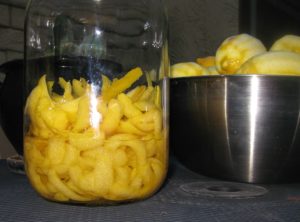
  2. Using a vegetable peeler, carefully pare zest from lemons without including any of the white pith. Use a peeler that removes the zest in strips, not the zesters that remove little tiny curls.
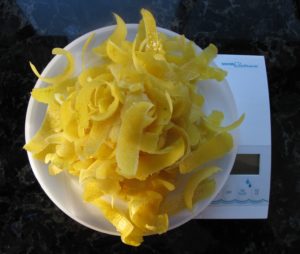
  3. Weigh the zest.
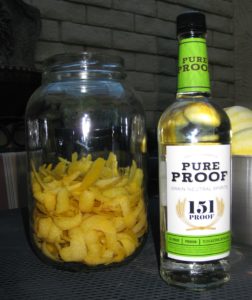
  4. Combine the zest and alcohol in a large glass jar with a tight-fitting lid. I use a one-gallon jar, though something of approximately three quarts will work just fine.
  5. Put the jar out of direct sunlight in an area that is at comfortable room temperature for seven days. Swirl the contents of the jar daily. The alcohol will not cover the zest so it is important to mix up the contents at least once a day.
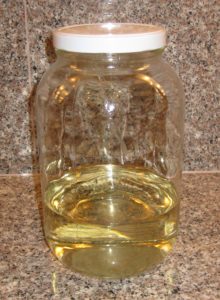
  6. On the fifth day, combine the sugar and water in another glass jar or non-reactive container. Stir or swirl several times a day until all the sugar is fully dissolved.
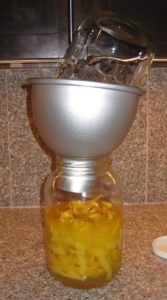
  7. After the zest has macerated for a week in the alcohol, add the sugar syrup.
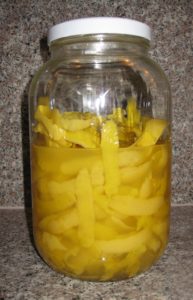
  8. The limoncello will initially become cloudy as some of the sugar comes out of solution.
  9. Allow the lemon zest to steep in the alcohol-sugar syrup mixture for an additional 3-4 days, swirling once or twice daily.
  10. It will become mostly clear after a few days. Because of the amount of lemon oil in this limoncello, it may remain slightly cloudy.
  11. It is important to not over-extract the lemon zest or the limoncello may become bitter.
  12. Strain the limoncello. Discard the zest. Divide the limoncello into bottles with tight-fitting lids. I like to use 750 ml liquor bottles.
  13. Store for at least one week before using to allow the flavors to mellow.
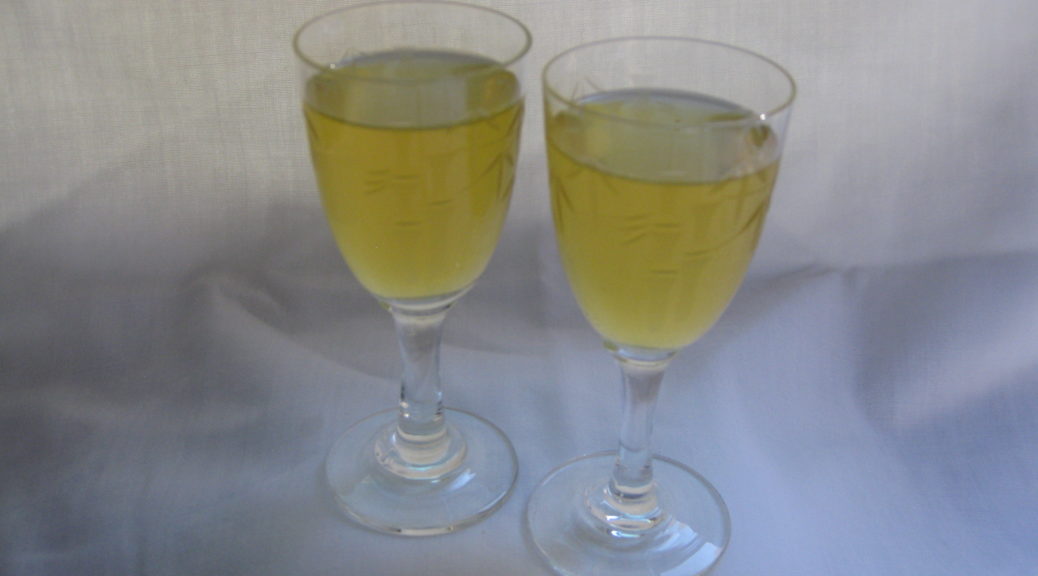
  14. Limoncello is best served frosty cold, over an ice cube or two. I like to keep a bottle in the freezer. It may get cloudy but just shake it well before using.

Notes

Copyright © 2017 by VillaSentieri.com. All rights reserved.

Tried this recipe?

Let us know how it was!

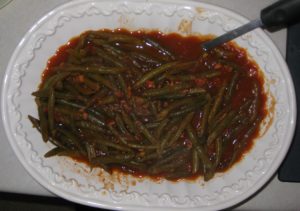
Green Beans with Tomato Sauce and Bacon

February 27, 2017

Earlier this month I wrote about my “crunchy vegetable” phase of cooking back in the 1970’s.  One of the dishes I was reacting to was my mother’s green beans with tomato sauce and bacon.  Honestly, though, I can’t tell you why.  It was, bar none, my favorite vegetable dish growing up.  Why, when I started cooking in my late teens, I thought I could make it better by cooking the beans until they were just crunchy is beyond me.

Chalk it up to youthful indiscretion.

Americans served a lot of mushy vegetables back then, no doubt, but the reaction shouldn’t be to turn every vegetable crunchy.  But I was just learning to cook and had a lot to learn, not only about technique, but about understanding the essence of a dish.

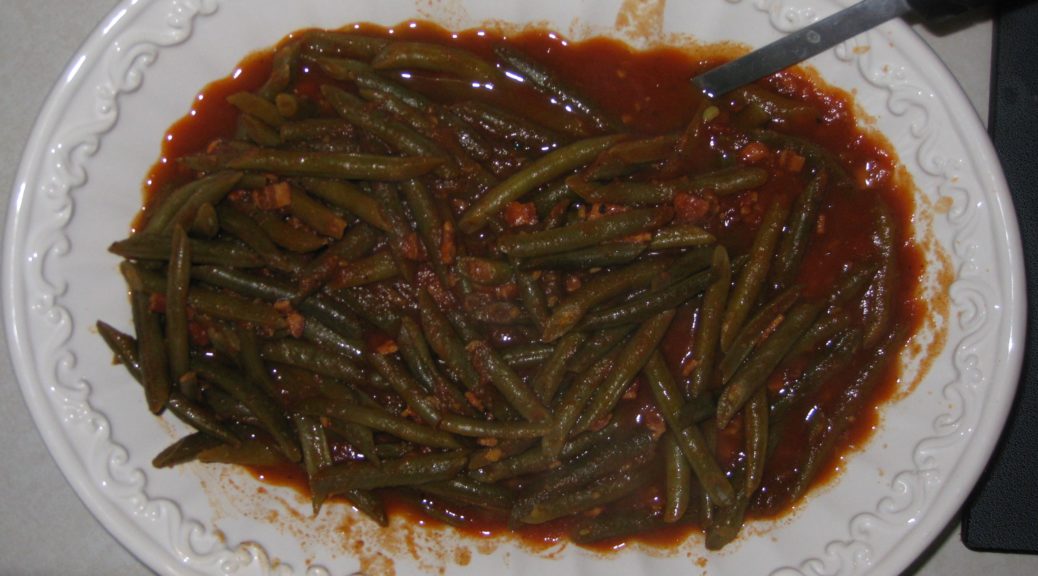
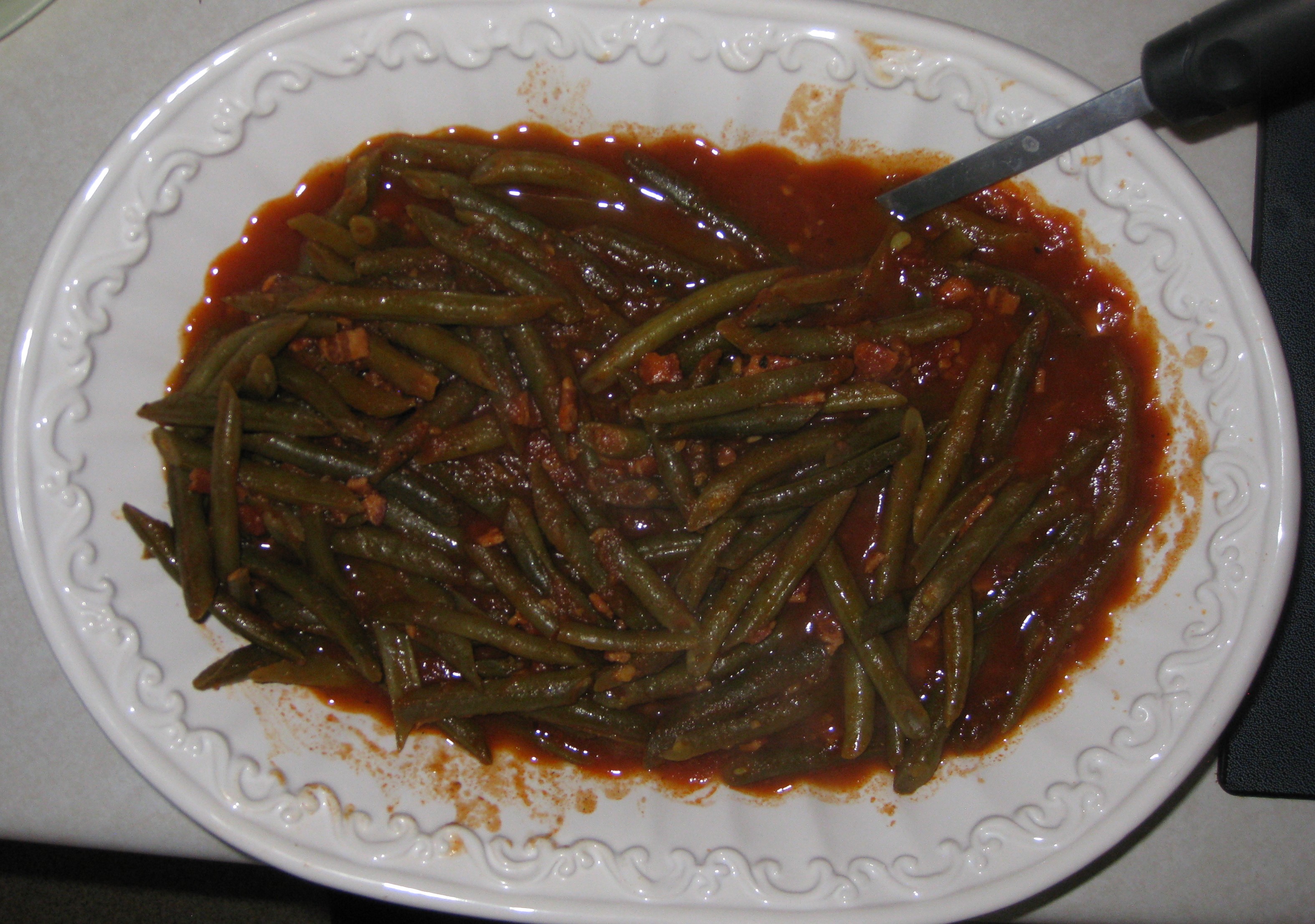
The essence of this dish is the silky texture (most definitely not mushy) of the beans cooked for a couple of hours in tomato sauce.  The textural change is accompanied by a flavor change that is unobtainable by quickly cooking the ingredients.

It’s actually pretty difficult to turn these beans mushy unless you boil them too long before adding them to the tomato sauce.  The tomato sauce reacts with the beans to somehow inhibit the development of mushiness.  I’m not sure, but it think it might be the acid in the tomatoes.

That first four minute boil is critical, however.  One time, thinking I could eliminate a step, I tried putting the cut up beans in the sauce without parboiling them first.  Mistake!  Four hours later the beans were still not cooked properly!

Green beans cooked in tomato sauce is a classic Italian combination.  The use of bacon clearly signals that this is Italian-American, however.  Italian recipes might use pancetta but not bacon.  Smoked foods are uncommon in traditional Italian cuisine.  The few that appear really stand out.

Pancetta and bacon are made from the same cut, pork belly.  Both are cured but only bacon is smoked.  Although I’ve made other versions of green beans in tomato sauce that are traditional Italian, rather than Italian-American, I keep coming back to this one as my favorite.

Green Beans with Tomato Sauce and Bacon

These long-simmered green beans in tomato sauce with bacon are an Italian-American favorite. The long, slow cooking is really essential to achieving the right texture and flavor. Although I've specified the amount of water in cups, when cooking with tomato paste my mother always measured water by the can. This dish would have had five tomato paste cans of water. She didn't quite fill them to the top so each can held about 5 1/2 ounces of water, or a little over three cups total. You may need to add more water, or to boil some away, to get a thick sauce.
Prep Time 25 minutes
Cook Time 3 hours
Total Time 3 hours 25 minutes
Servings: 8 people

Ingredients
  

  • 1/4 pound bacon preferably thick cut
  • 4-5 cloves garlic
  • 1 x 6 ounce can tomato paste
  • 3 cups water
  • 1 teaspoon salt
  • Freshly ground black pepper to taste
  • 1/2 teaspoon sugar
  • 3/4 teaspoon dried oregano
  • 2 pounds green beans fresh

Method
 

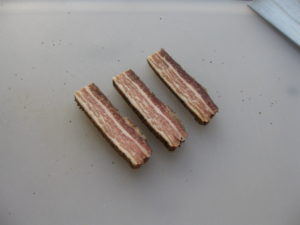
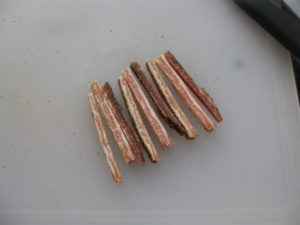
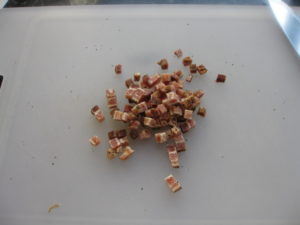
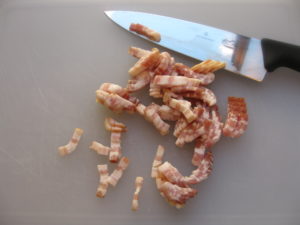
  1. Cut the bacon into matchstick-sized pieces.
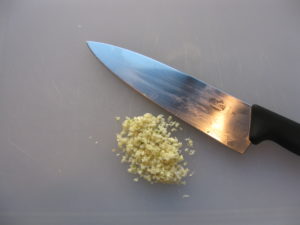
  2. Mince the garlic.
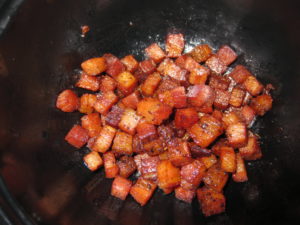
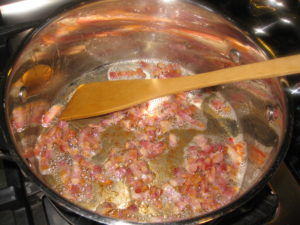
  3. In a heavy-bottomed pot, large enough to ultimately hold the beans, gently sauté the bacon until golden brown.
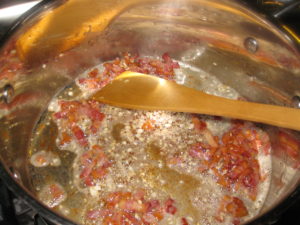
  4. Add the minced garlic to the bacon and bacon drippings and sauté until fragrant and just beginning to turn golden, about one minute.
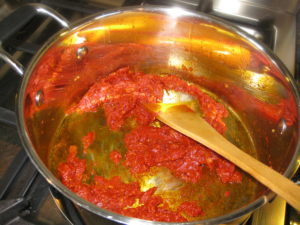
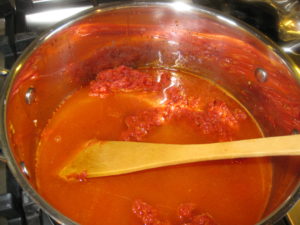
  5. Add the tomato paste and sauté until it turns a shade darker and smells sweet.
  6. Add the water, stirring to combine. Cover and bring to a boil.
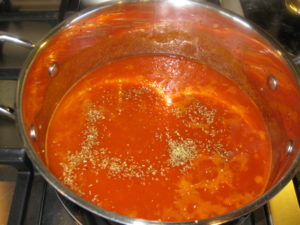
  7. Reduce to a simmer. Add salt, freshly ground black pepper to taste, oregano and sugar. Simmer, partially covered, for 45-60 minutes, stirring occasionally.
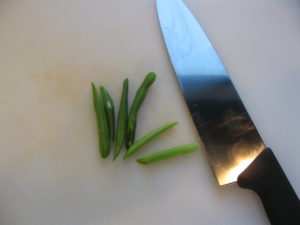
  8. Meanwhile, cut the tips off the beans at a diagonal. Cut the beans into pieces about 2 to 2 ½ inches long, also on the diagonal.
  9. Wash the beans in several changes of cold water. Cover with water and allow the beans to soak for 15 to 20 minutes, to fully plump up with water before cooking.
  10. Bring a large pot of heavily salted water (at least 4 quarts of water and ¼ cup of salt) to a boil.
  11. Drain the beans, add to the boiling water, and return to a boil as quickly as possible.
  12. Boil until the beans are just beginning to get tender, approximately 4 minutes. They will cook much longer in the sauce so be careful not to overcook them at this point.
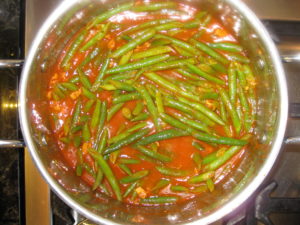
  13. Drain the beans and add to the tomato sauce, which should have been cooking for 45-60 minutes by this point.
  14. Simmer until the beans are silky, but not mushy. This can take 2 hours, plus or minus. Go by texture, not time. The beans should be silky but still have some body.
  15. Taste once or twice while cooking and adjust salt, pepper and, if you wish, oregano.

Notes

You can make the sauce and partially cook the beans in advance. After the beans have been boiled, quickly chill them in a bowl of ice water. Cool the cooked sauce to room temperature.  Drain and add the partially cooked beans to the sauce.  Refrigerate until ready to complete cooking.

Copyright © 2017 by VillaSentieri.com. All rights reserved.

Tried this recipe?

Let us know how it was!

Mom’s Pasta e Fagioli (Mom’s Pasta and Beans)

February 22, 2017

We didn’t eat a lot of prepared foods growing up.  In fact we almost never did.  OK, there were a few times in the early 60’s where I got to try out those recently-invented “TV Dinners.”

I was well into adulthood before I had a real appreciation for the quality of the homemade food that was put on our table every day.

My mother made putting great food on the table seem effortless.  I remember many Sunday mornings when I’d wake up to find her making ravioli from scratch for our big midday meal: cooking the beef and spinach filling, preparing the dough, rolling and filling the ravioli, all the while a big pot of tomato sauce bubbling away on the stove.  It was just a family Sunday dinner!

Weekday meals were usually less elaborate but no less delicious; maybe homemade sausage, pan-fried potatoes, and a vegetable or two or maybe pasta with sauce leftover from Sunday.  It was always fun to walk into the kitchen to find her making something I’d never had before; something that her mother used to make.  Sometimes that wasn’t even at a defined meal time.

Now I think I understand.  My mother died in 1993 and I bet I didn’t make her version of pasta e fagioli for 20 years after her death.  Then one day, the desire for it just struck me and there I was, in the kitchen, cooking.

It’s become part of my regular routine again after that long hiatus.  Sitting down to a bowl of my mother’s pasta e fagioli is comforting; almost as comforting as if she had made it for me.  There’s just something about the combination of pasta, beans and red sauce that I can’t explain.  It triggers an emotional bridge to what feels like an earlier time in my life.  I’m guessing something similar prompted my mother to occasionally whip up dishes from her youth that she hadn’t made in decades, if ever.

Mom's Pasta e Fagioli (Mom's Pasta and Beans)

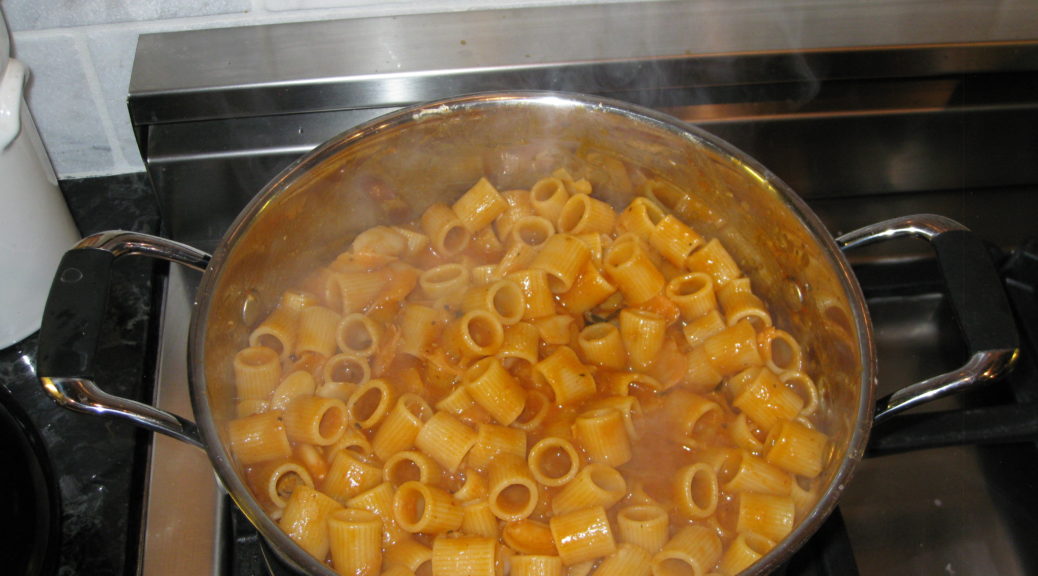
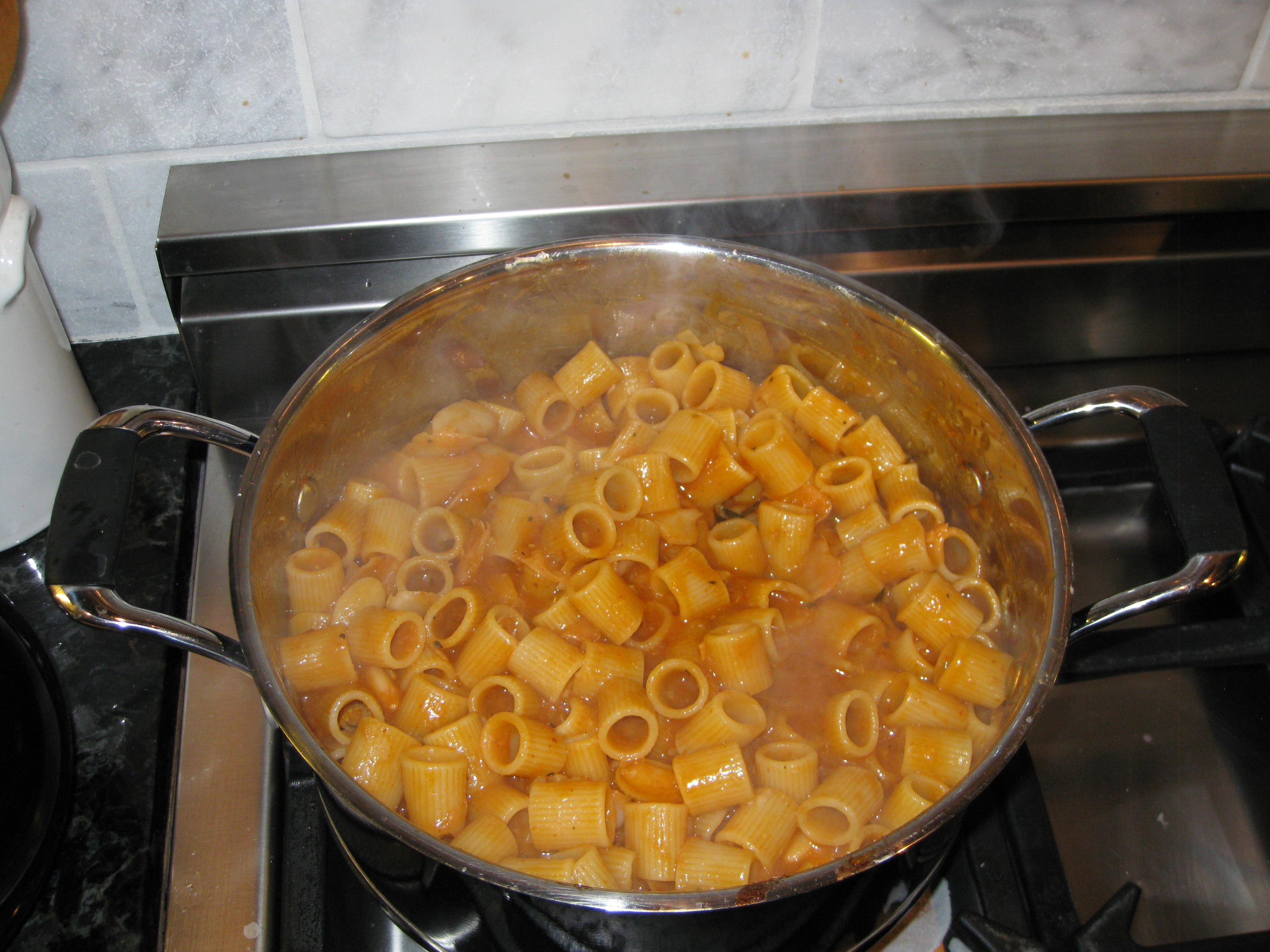
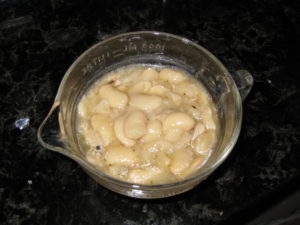
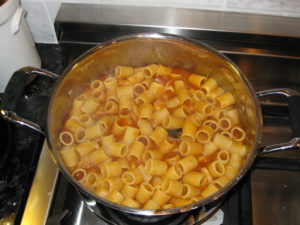
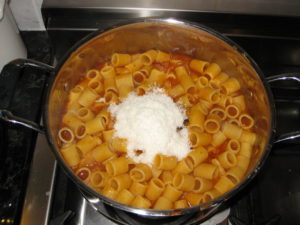
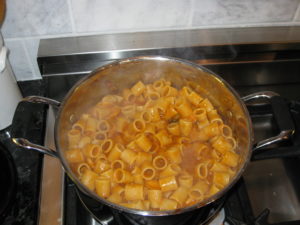
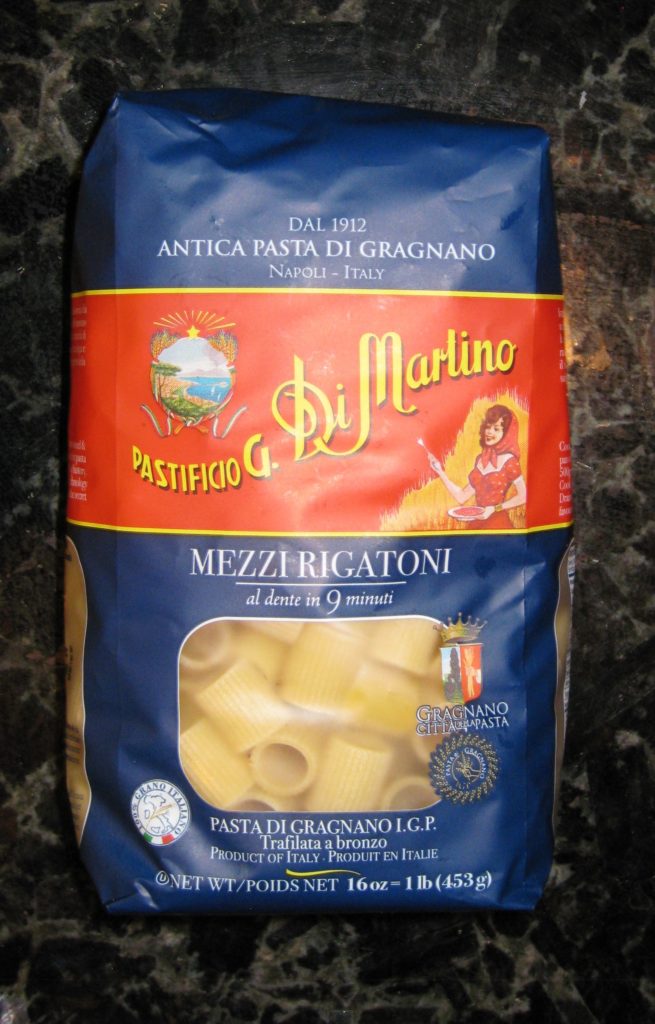
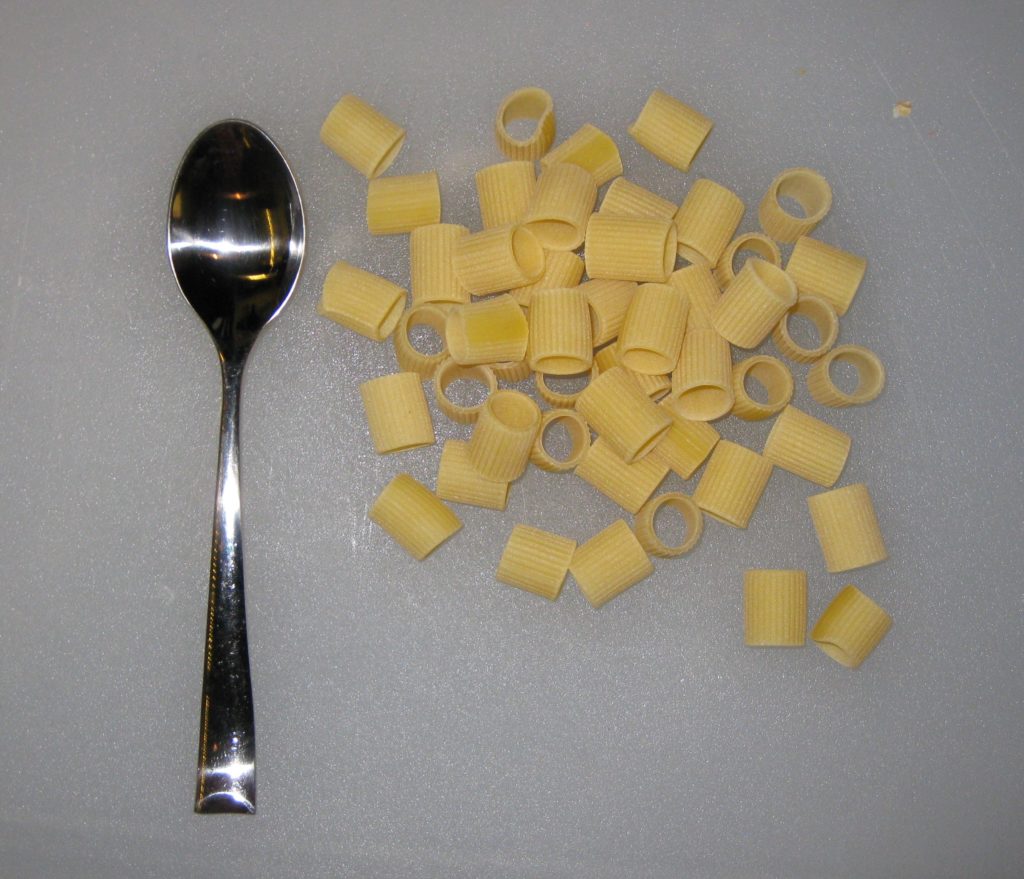
Follow the directions for Cannelini alla Toscana but use dried lima beans instead of cannellini and substitute ½ teaspoon of dried oregano and a sprig of fresh rosemary for the sage. There will be leftover beans that you can freeze or refrigerate for another use. You can also use two 15 ounce cans of Butter Beans in place of the home-cooked lima beans. Mom always used ditalini for this dish. These days, when you can find them (and it can be challenging) they have usually been upgraded from ditalini to ditali, though they are exactly what she used. More frequently, I use a slightly larger, but still rather small, pasta such as the mezzi rigatoni shown here.
Prep Time 15 minutes
Cook Time 1 hour
Total Time 1 hour 15 minutes
Servings: 6 people

Ingredients
  

  • 3 cups cooked dried lima beans plus bean-cooking liquid to cover
  • 1/3 medium onion
  • 1/2 cup extra virgin olive oil divided
  • 1/2 teaspoon crushed red pepper or to taste
  • 1 x 6 ounce can tomato paste
  • 3 cups water
  • 1/4 teaspoon dried oregano
  • 1/3 teaspoon dried basil
  • salt to taste
  • Freshly ground black pepper to taste
  • 4 cloves garlic
  • 1 pound short, fat tubular pasta such as ditali or mezzi rigatoni
  • 3 tablespoons salt for cooking the pasta
  • 1/3 cup Parmigiano Reggiano cheese freshly grated

Method
 

  1. Finely dice the onion. Sauté the onion in ¼ cup of olive oil until soft and golden.
  2. Add the crushed red pepper and sauté another minute.
  3. Add the tomato paste and sauté, stirring frequently until the tomato paste turns a shade darker and smells sweet, 2-3 minutes.
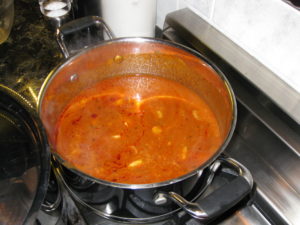
  4. Add the water, oregano, basil and salt and pepper to taste. Stir well to fully incorporate the tomato paste.
  5. Bring to a very low boil, partially covered, and cook 30-45 minutes stirring occasionally. Adjust seasoning as needed, tasting several times as the sauce cooks.
  6. Meanwhile, sauté the garlic in the remaining ¼ cup of olive oil very slowly until browned. Remove from the heat and reserve.
  7. The dish can be cooked several hours ahead to this point.
  8. Bring three quarts of water and three tablespoons of salt to a boil.
  9. While the water is heating, add the beans and their liquid to the tomato sauce, return to a simmer, and cook, partially covered till the pasta is ready.
  10. Cook pasta until it still has a small bit of chewy center. It will cook more in the sauce. Scoop out and reserve two cups of the pasta cooking liquid.
  11. Drain the pasta. Add the pasta to the tomato-bean mixture. Add the browned garlic and olive oil. Stir well, cover and cook on very low heat until the pasta is cooked but al dente and the sauce has thickened. Add some of the pasta cooking liquid as needed from time to time to create a smooth sauce.
  12. Off the heat stir in the Parmigiano Reggiano cheese. Taste and adjust seasoning.
  13. It is not unheard of for me to add an extra glug or two of olive oil at this point to get a luscious sauce. Stir and decide if another dash of pasta-cooking water is needed, as well.

Notes

Mezzi Rigatoni
 
 
Copyright © 2017 by VillaSentieri.com. All rights reserved.

Tried this recipe?

Let us know how it was!